

8
Phytotechnology with Biomass Production
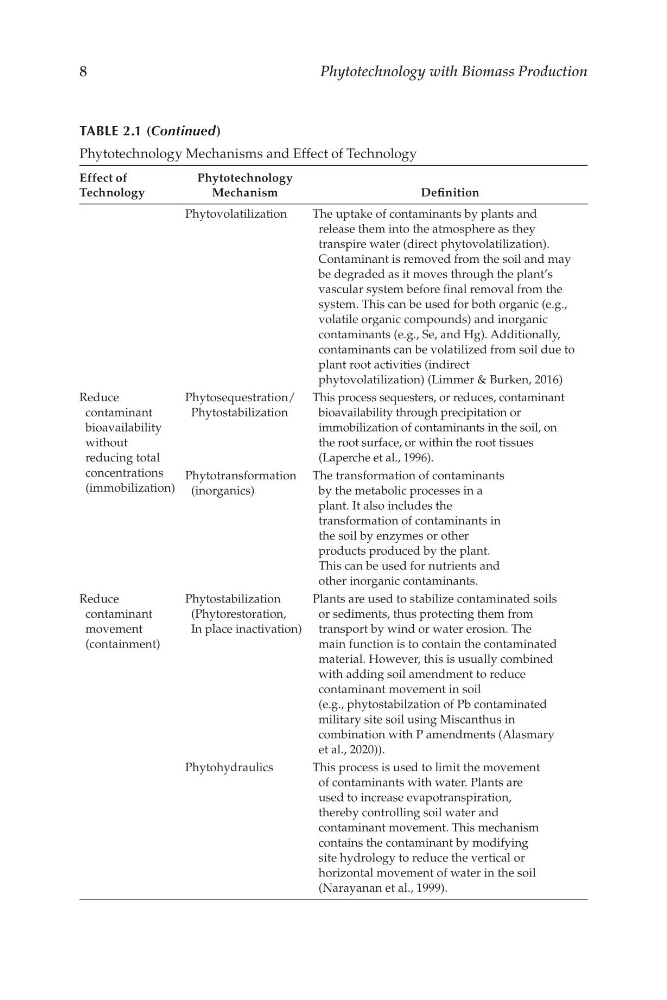
TABLE 2.1 (Continued)
Phytotechnology Mechanisms and Effect of Technology
Effect of
Phytotechnology
Technology
Mechanism
Definition
Reduce
contaminant
bioavailability
without
reducing total
concentrations
(immobilization)
Reduce
contaminant
movement
(containment)
Phytovolatilization
Phytosequestration/
Phytostabilization
Phytotransformation
(inorganics)
Phytostabilization
(Phytorestoration,
In place inactivation)
Phytohydraulics
The uptake of contaminants by plants and
release them into the atmosphere as they
transpire water (direct phytovolatilization).
Contaminant is removed from the soil and may
be degraded as it moves through the plant’s
vascular system before final removal from the
system. This can be used for both organic (e.g.,
volatile organic compounds) and inorganic
contaminants (e.g., Se, and Hg). Additionally,
contaminants can be volatilized from soil due to
plant root activities (indirect
phytovolatilization) (Limmer & Burken, 2016)
This process sequesters, or reduces, contaminant
bioavailability through precipitation or
immobilization of contaminants in the soil, on
the root surface, or within the root tissues
(Laperche et al., 1996).
The transformation of contaminants
by the metabolic processes in a
plant. It also includes the
transformation of contaminants in
the soil by enzymes or other
products produced by the plant.
This can be used for nutrients and
other inorganic contaminants.
Plants are used to stabilize contaminated soils
or sediments, thus protecting them from
transport by wind or water erosion. The
main function is to contain the contaminated
material. However, this is usually combined
with adding soil amendment to reduce
contaminant movement in soil
(e.g., phytostabilzation of Pb contaminated
military site soil using Miscanthus in
combination with P amendments (Alasmary
et al., 2020)).
This process is used to limit the movement
of contaminants with water. Plants are
used to increase evapotranspiration,
thereby controlling soil water and
contaminant movement. This mechanism
contains the contaminant by modifying
site hydrology to reduce the vertical or
horizontal movement of water in the soil
(Narayanan et al., 1999).