

7
Phytotechnologies for Site Remediation
be able to degrade the contaminants in the rhizosphere, plant roots
release organic compounds (nutrients, enzymes, organic acids, etc.)
to reach favorable conditions;
6. phytovolatilization – remediation mechanism is based on absorbing
the contaminants by roots and releasing them to atmosphere.
The term phytotechnologies, which replaces the earlier term phytoremediation, is also known as green-remediation, and in general, means using plants
to degrade, extract, contain, transform into less harmful forms, or immobilize contaminants in soil, water, or air with inorganic or organic compounds.
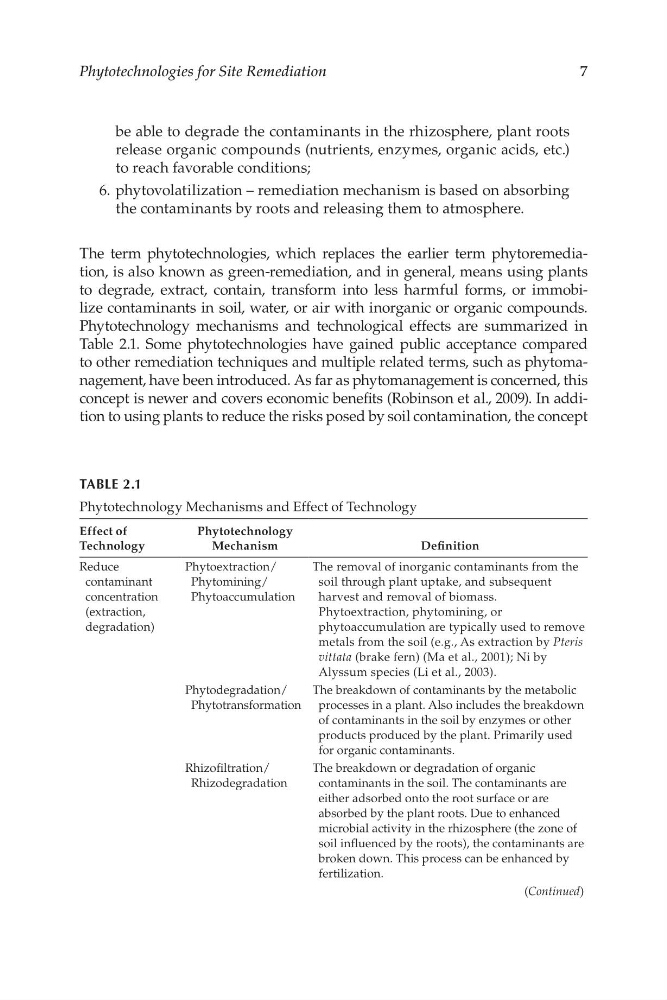
Phytotechnology mechanisms and technological effects are summarized in
Table 2.1. Some phytotechnologies have gained public acceptance compared
to other remediation techniques and multiple related terms, such as phytomanagement, have been introduced. As far as phytomanagement is concerned, this
concept is newer and covers economic benefits (Robinson et al., 2009). In addition to using plants to reduce the risks posed by soil contamination, the concept
TABLE 2.1
Phytotechnology Mechanisms and Effect of Technology
Effect of
Phytotechnology
Technology
Mechanism
Definition
Reduce
contaminant
concentration
(extraction,
degradation)
Phytoextraction/
Phytomining/
Phytoaccumulation
Phytodegradation/
Phytotransformation
Rhizofiltration/
Rhizodegradation
The removal of inorganic contaminants from the
soil through plant uptake, and subsequent
harvest and removal of biomass.
Phytoextraction, phytomining, or
phytoaccumulation are typically used to remove
metals from the soil (e.g., As extraction by Pteris
vittata (brake fern) (Ma et al., 2001); Ni by
Alyssum species (Li et al., 2003).
The breakdown of contaminants by the metabolic
processes in a plant. Also includes the breakdown
of contaminants in the soil by enzymes or other
products produced by the plant. Primarily used
for organic contaminants.
The breakdown or degradation of organic
contaminants in the soil. The contaminants are
either adsorbed onto the root surface or are
absorbed by the plant roots. Due to enhanced
microbial activity in the rhizosphere (the zone of
soil influenced by the roots), the contaminants are
broken down. This process can be enhanced by
fertilization.
(Continued)
Phytotechnologies for Site Remediation
be able to degrade the contaminants in the rhizosphere, plant roots
release organic compounds (nutrients, enzymes, organic acids, etc.)
to reach favorable conditions;
6. phytovolatilization – remediation mechanism is based on absorbing
the contaminants by roots and releasing them to atmosphere.
The term phytotechnologies, which replaces the earlier term phytoremediation, is also known as green-remediation, and in general, means using plants
to degrade, extract, contain, transform into less harmful forms, or immobilize contaminants in soil, water, or air with inorganic or organic compounds.
Phytotechnology mechanisms and technological effects are summarized in
Table 2.1. Some phytotechnologies have gained public acceptance compared
to other remediation techniques and multiple related terms, such as phytomanagement, have been introduced. As far as phytomanagement is concerned, this
concept is newer and covers economic benefits (Robinson et al., 2009). In addition to using plants to reduce the risks posed by soil contamination, the concept
TABLE 2.1
Phytotechnology Mechanisms and Effect of Technology
Effect of
Phytotechnology
Technology
Mechanism
Definition
Reduce
contaminant
concentration
(extraction,
degradation)
Phytoextraction/
Phytomining/
Phytoaccumulation
Phytodegradation/
Phytotransformation
Rhizofiltration/
Rhizodegradation
The removal of inorganic contaminants from the
soil through plant uptake, and subsequent
harvest and removal of biomass.
Phytoextraction, phytomining, or
phytoaccumulation are typically used to remove
metals from the soil (e.g., As extraction by Pteris
vittata (brake fern) (Ma et al., 2001); Ni by
Alyssum species (Li et al., 2003).
The breakdown of contaminants by the metabolic
processes in a plant. Also includes the breakdown
of contaminants in the soil by enzymes or other
products produced by the plant. Primarily used
for organic contaminants.
The breakdown or degradation of organic
contaminants in the soil. The contaminants are
either adsorbed onto the root surface or are
absorbed by the plant roots. Due to enhanced
microbial activity in the rhizosphere (the zone of
soil influenced by the roots), the contaminants are
broken down. This process can be enhanced by
fertilization.
(Continued)