

189
Miscanthus Biomass for Energy
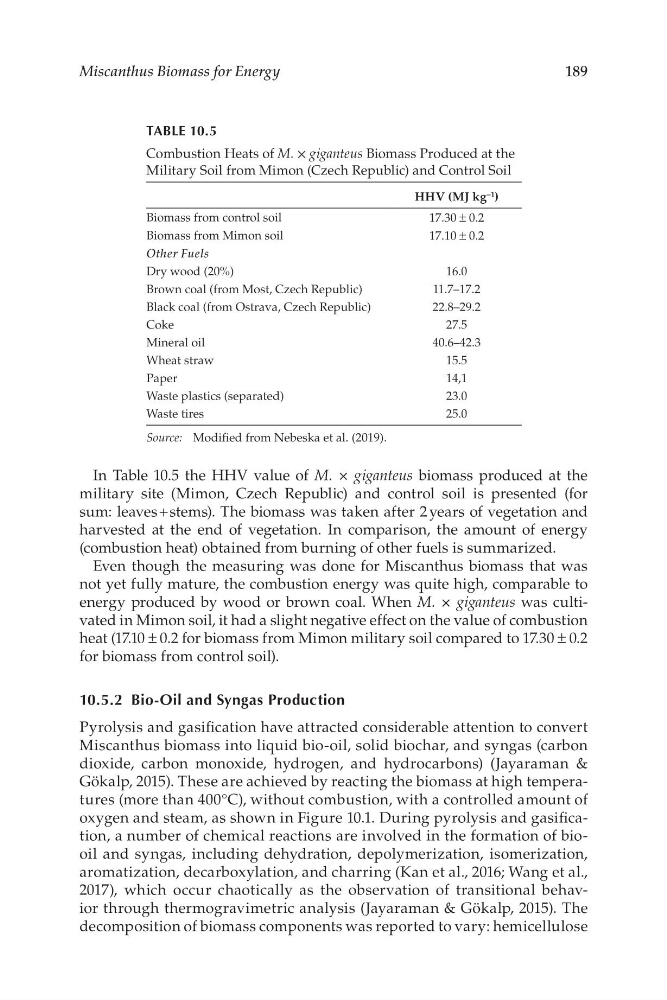
TABLE 10.5
Combustion Heats of M. × giganteus Biomass Produced at the
Military Soil from Mimon (Czech Republic) and Control Soil
HHV (MJ kg −1 )
Biomass from control soil
17.30 ± 0.2
Biomass from Mimon soil
17.10 ± 0.2
Other Fuels
Dry wood (20%)
16.0
Brown coal (from Most, Czech Republic)
11.7–17.2
Black coal (from Ostrava, Czech Republic)
22.8–29.2
Coke
27.5
Mineral oil
40.6–42.3
Wheat straw
15.5
Paper
14,1
Waste plastics (separated)
23.0
Waste tires
25.0
Source: Modified from Nebeska et al. (2019).
In Table 10.5 the HHV value of M. × giganteus biomass produced at the
military site (Mimon, Czech Republic) and control soil is presented (for
sum: leaves + stems). The biomass was taken after 2 years of vegetation and
harvested at the end of vegetation. In comparison, the amount of energy
(combustion heat) obtained from burning of other fuels is summarized.
Even though the measuring was done for Miscanthus biomass that was
not yet fully mature, the combustion energy was quite high, comparable to
energy produced by wood or brown coal. When M. × giganteus was cultivated in Mimon soil, it had a slight negative effect on the value of combustion
heat (17.10 ± 0.2 for biomass from Mimon military soil compared to 17.30 ± 0.2
for biomass from control soil).
10.5.2 Bio-Oil and Syngas Production
Pyrolysis and gasification have attracted considerable attention to convert
Miscanthus biomass into liquid bio-oil, solid biochar, and syngas (carbon
dioxide, carbon monoxide, hydrogen, and hydrocarbons) (Jayaraman &
Gökalp, 2015). These are achieved by reacting the biomass at high temperatures (more than 400°C), without combustion, with a controlled amount of
oxygen and steam, as shown in Figure 10.1. During pyrolysis and gasification, a number of chemical reactions are involved in the formation of biooil and syngas, including dehydration, depolymerization, isomerization,
aromatization, decarboxylation, and charring (Kan et al., 2016; Wang et al.,
2017), which occur chaotically as the observation of transitional behavior through thermogravimetric analysis (Jayaraman & Gökalp, 2015). The
decomposition of biomass components was reported to vary: hemicellulose