

132
Phytotechnology with Biomass Production
The analysis of the abovementioned trace elements content in the roots and
aboveground biomass of M. × giganteus, when growing on contaminated and
control soil with and without inoculation of Agrobacterium sp. Zn1-18, showed
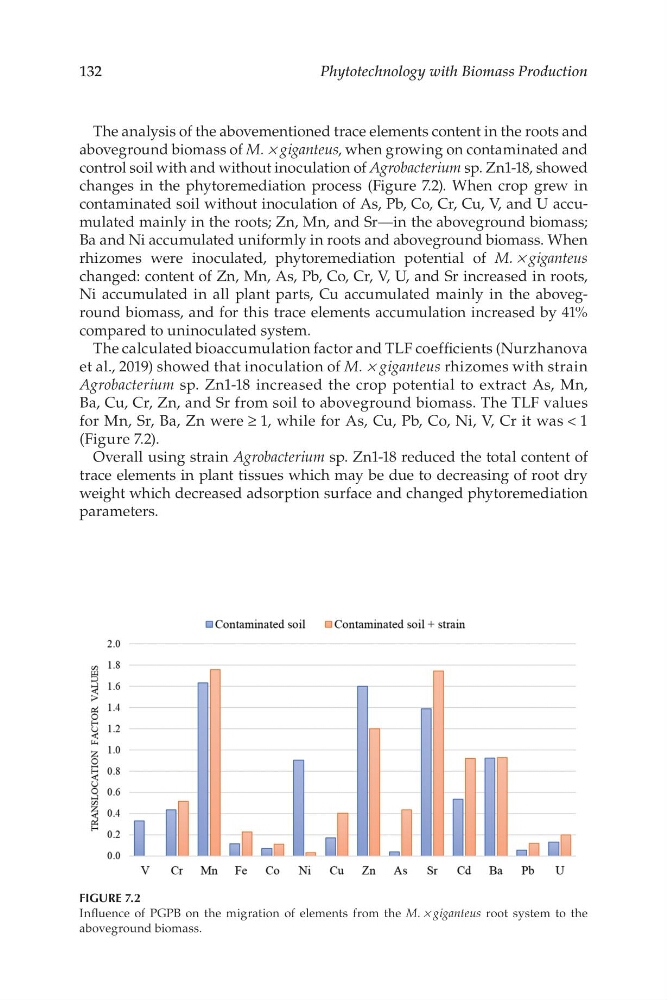
changes in the phytoremediation process (Figure 7.2). When crop grew in
contaminated soil without inoculation of As, Pb, Co, Cr, Cu, V, and U accumulated mainly in the roots; Zn, Mn, and Sr—in the aboveground biomass;
Ba and Ni accumulated uniformly in roots and aboveground biomass. When
rhizomes were inoculated, phytoremediation potential of M. × giganteus
changed: content of Zn, Mn, As, Pb, Co, Cr, V, U, and Sr increased in roots,
Ni accumulated in all plant parts, Cu accumulated mainly in the aboveground biomass, and for this trace elements accumulation increased by 41%
compared to uninoculated system.
The calculated bioaccumulation factor and TLF coefficients (Nurzhanova
et al., 2019) showed that inoculation of M. × giganteus rhizomes with strain
Agrobacterium sp. Zn1-18 increased the crop potential to extract As, Mn,
Ba, Cu, Cr, Zn, and Sr from soil to aboveground biomass. The TLF values
for Mn, Sr, Ba, Zn were ≥ 1, while for As, Cu, Pb, Co, Ni, V, Cr it was < 1
(Figure 7.2).
Overall using strain Agrobacterium sp. Zn1-18 reduced the total content of
trace elements in plant tissues which may be due to decreasing of root dry
weight which decreased adsorption surface and changed phytoremediation
parameters.
FIGURE 7.2
Influence of PGPB on the migration of elements from the M. × giganteus root system to the
aboveground biomass.
Phytotechnology with Biomass Production
The analysis of the abovementioned trace elements content in the roots and
aboveground biomass of M. × giganteus, when growing on contaminated and
control soil with and without inoculation of Agrobacterium sp. Zn1-18, showed
changes in the phytoremediation process (Figure 7.2). When crop grew in
contaminated soil without inoculation of As, Pb, Co, Cr, Cu, V, and U accumulated mainly in the roots; Zn, Mn, and Sr—in the aboveground biomass;
Ba and Ni accumulated uniformly in roots and aboveground biomass. When
rhizomes were inoculated, phytoremediation potential of M. × giganteus
changed: content of Zn, Mn, As, Pb, Co, Cr, V, U, and Sr increased in roots,
Ni accumulated in all plant parts, Cu accumulated mainly in the aboveground biomass, and for this trace elements accumulation increased by 41%
compared to uninoculated system.
The calculated bioaccumulation factor and TLF coefficients (Nurzhanova
et al., 2019) showed that inoculation of M. × giganteus rhizomes with strain
Agrobacterium sp. Zn1-18 increased the crop potential to extract As, Mn,
Ba, Cu, Cr, Zn, and Sr from soil to aboveground biomass. The TLF values
for Mn, Sr, Ba, Zn were ≥ 1, while for As, Cu, Pb, Co, Ni, V, Cr it was < 1
(Figure 7.2).
Overall using strain Agrobacterium sp. Zn1-18 reduced the total content of
trace elements in plant tissues which may be due to decreasing of root dry
weight which decreased adsorption surface and changed phytoremediation
parameters.
FIGURE 7.2
Influence of PGPB on the migration of elements from the M. × giganteus root system to the
aboveground biomass.