

90
Phytotechnology with Biomass Production
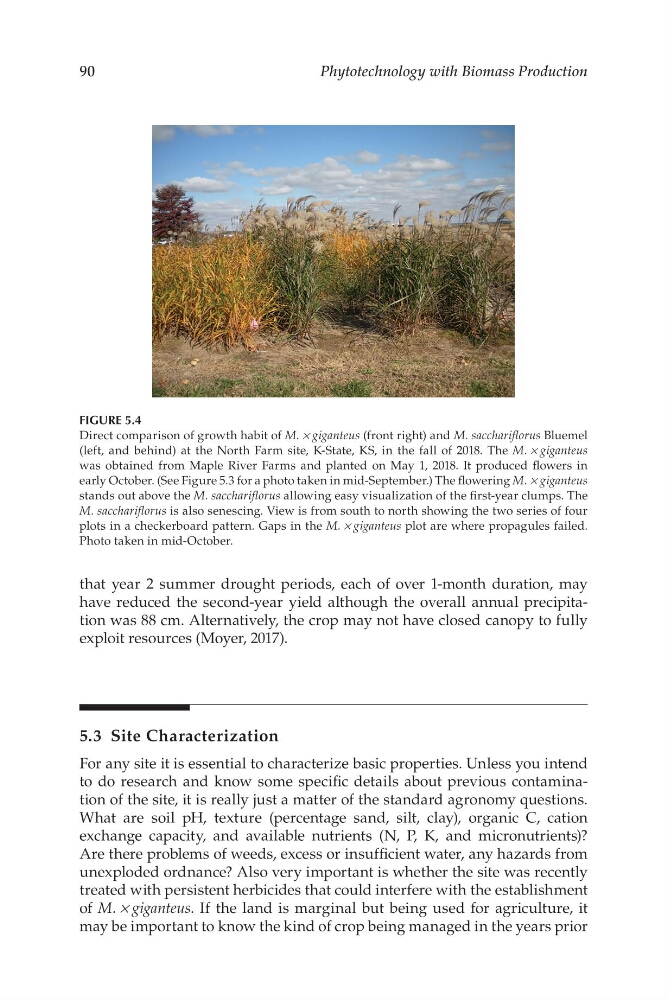
FIGURE 5.4
Direct comparison of growth habit of M. × giganteus (front right) and M. sacchariflorus Bluemel
(left, and behind) at the North Farm site, K-State, KS, in the fall of 2018. The M. × giganteus
was obtained from Maple River Farms and planted on May 1, 2018. It produced flowers in
early October. (See Figure 5.3 for a photo taken in mid-September.) The flowering M. × giganteus
stands out above the M. sacchariflorus allowing easy visualization of the first-year clumps. The
M. sacchariflorus is also senescing. View is from south to north showing the two series of four
plots in a checkerboard pattern. Gaps in the M. × giganteus plot are where propagules failed.
Photo taken in mid-October.
that year 2 summer drought periods, each of over 1-month duration, may
have reduced the second-year yield although the overall annual precipitation was 88 cm. Alternatively, the crop may not have closed canopy to fully
exploit resources (Moyer, 2017).
5.3 Site Characterization
For any site it is essential to characterize basic properties. Unless you intend
to do research and know some specific details about previous contamination of the site, it is really just a matter of the standard agronomy questions.
What are soil pH, texture (percentage sand, silt, clay), organic C, cation
exchange capacity, and available nutrients (N, P, K, and micronutrients)?
Are there problems of weeds, excess or insufficient water, any hazards from
unexploded ordnance? Also very important is whether the site was recently
treated with persistent herbicides that could interfere with the establishment
of M. × giganteus. If the land is marginal but being used for agriculture, it
may be important to know the kind of crop being managed in the years prior
Phytotechnology with Biomass Production
FIGURE 5.4
Direct comparison of growth habit of M. × giganteus (front right) and M. sacchariflorus Bluemel
(left, and behind) at the North Farm site, K-State, KS, in the fall of 2018. The M. × giganteus
was obtained from Maple River Farms and planted on May 1, 2018. It produced flowers in
early October. (See Figure 5.3 for a photo taken in mid-September.) The flowering M. × giganteus
stands out above the M. sacchariflorus allowing easy visualization of the first-year clumps. The
M. sacchariflorus is also senescing. View is from south to north showing the two series of four
plots in a checkerboard pattern. Gaps in the M. × giganteus plot are where propagules failed.
Photo taken in mid-October.
that year 2 summer drought periods, each of over 1-month duration, may
have reduced the second-year yield although the overall annual precipitation was 88 cm. Alternatively, the crop may not have closed canopy to fully
exploit resources (Moyer, 2017).
5.3 Site Characterization
For any site it is essential to characterize basic properties. Unless you intend
to do research and know some specific details about previous contamination of the site, it is really just a matter of the standard agronomy questions.
What are soil pH, texture (percentage sand, silt, clay), organic C, cation
exchange capacity, and available nutrients (N, P, K, and micronutrients)?
Are there problems of weeds, excess or insufficient water, any hazards from
unexploded ordnance? Also very important is whether the site was recently
treated with persistent herbicides that could interfere with the establishment
of M. × giganteus. If the land is marginal but being used for agriculture, it
may be important to know the kind of crop being managed in the years prior