

89
Miscanthus Production
(Davis L. personal observation) contrasting with zero losses in 2016 with
abundant rain (Alasmary, 2020). During 2018 a direct comparison was
done with M. × giganteus and the M. sacchariflorus Bluemel strains both
at the Ft. Riley site and at the Kansas State University North Farm site
(~39.2 N latitude). At the former location there was a failure of rains over
several weeks, and nearly total loss (>90%) of both CVs (two replicates each
of 16 plants planted on 45 cm centers). At the North Farm where some
supplemental irrigation was available, four replicate plots each of 36 plants
grown on 45 cm centers were compared. Survival of the Bluemel strain
was much higher (~3/4) than that of M. × giganteus (<1/2) perhaps because
larger propagules of 60–90 g vs 25 g were available. Even in autumn 2020,
the M. × giganteus plants remain as individual clumps of <50 cm diameter, while the Bluemel strain plants, with no supplemental irrigation since
early summer 2017, are invading the entire planting (Davis L. personal
observation). This is consistent with observations mentioned above where
it sometimes takes more than 4 years to reach maximum productivity
which depends on total number of stems (tillers) and number of leaves on
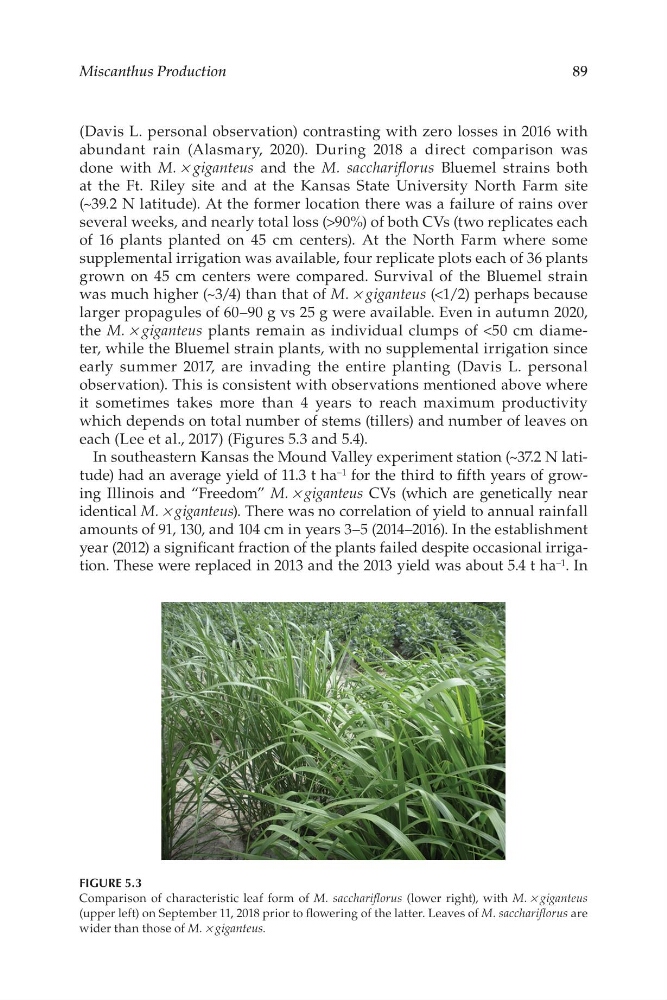
each (Lee et al., 2017) (Figures 5.3 and 5.4).
In southeastern Kansas the Mound Valley experiment station (~37.2 N latitude) had an average yield of 11.3 t ha −1 for the third to fifth years of growing Illinois and “Freedom” M. × giganteus CVs (which are genetically near
identical M. × giganteus). There was no correlation of yield to annual rainfall
amounts of 91, 130, and 104 cm in years 3–5 (2014–2016). In the establishment
year (2012) a significant fraction of the plants failed despite occasional irrigation. These were replaced in 2013 and the 2013 yield was about 5.4 t ha −1 . In
FIGURE 5.3
Comparison of characteristic leaf form of M. sacchariflorus (lower right), with M. × giganteus
(upper left) on September 11, 2018 prior to flowering of the latter. Leaves of M. sacchariflorus are
wider than those of M. × giganteus.