

19
Arsenic [As, 33]
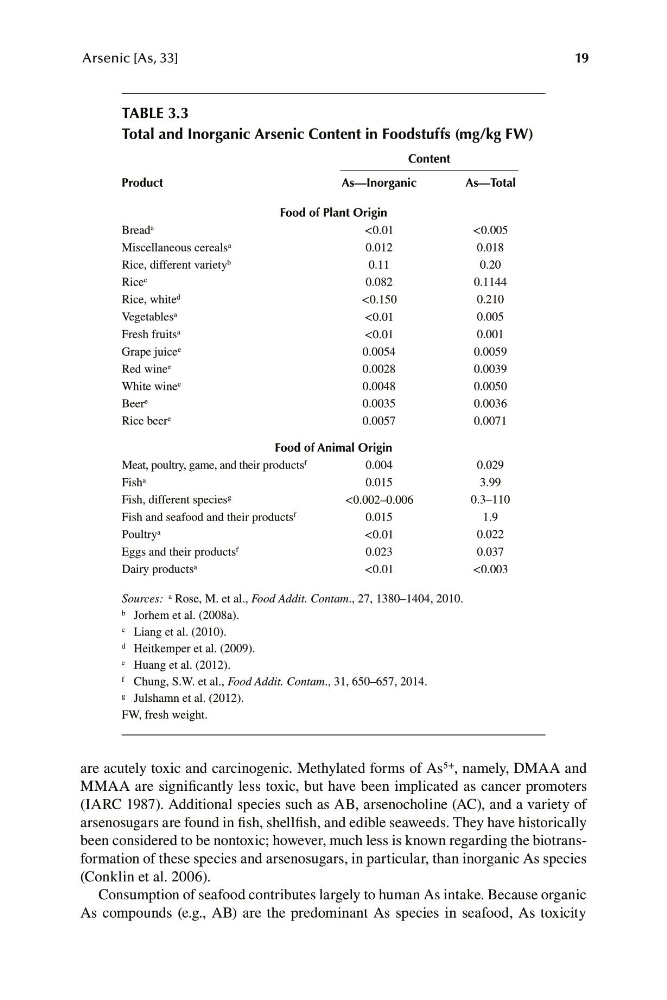
TABLE 3.3
Total and Inorganic Arsenic Content in Foodstuffs (mg/kg FW)
Content
Product
As—Inorganic
As—Total
Food of Plant Origin
Bread a
<0.01
<0.005
Miscellaneous cereals a
0.012
0.018
Rice, different variety b
0.11
0.20
Rice c
0.082
0.1144
Rice, white d
<0.150
0.210
Vegetables a
<0.01
0.005
Fresh fruits a
<0.01
0.001
Grape juice e
0.0054
0.0059
Red wine e
0.0028
0.0039
White wine e
0.0048
0.0050
Beer e
0.0035
0.0036
Rice beer e
0.0057
0.0071
Food of Animal Origin
Meat, poultry, game, and their products f
0.004
0.029
Fish a
0.015
3.99
Fish, different species g
<0.002–0.006
0.3–110
Fish and seafood and their products f
0.015
1.9
Poultry a
<0.01
0.022
Eggs and their products f
0.023
0.037
Dairy products a
<0.01
<0.003
Sources: a Rose, M. et al., Food Addit. Contam., 27, 1380–1404, 2010.
b Jorhem et al. (2008a).
c Liang et al. (2010).
d Heitkemper et al. (2009).
e Huang et al. (2012).
f Chung, S.W. et al., Food Addit. Contam., 31, 650–657, 2014.
g Julshamn et al. (2012).
FW, fresh weight.
are acutely toxic and carcinogenic. Methylated forms of As 5+ , namely, DMAA and
MMAA are significantly less toxic, but have been implicated as cancer promoters
(IARC 1987). Additional species such as AB, arsenocholine (AC), and a variety of
arsenosugars are found in fish, shellfish, and edible seaweeds. They have historically
been considered to be nontoxic; however, much less is known regarding the biotransformation of these species and arsenosugars, in particular, than inorganic As species
(Conklin et al. 2006).
Consumption of seafood contributes largely to human As intake. Because organic
As compounds (e.g., AB) are the predominant As species in seafood, As toxicity
Arsenic [As, 33]
TABLE 3.3
Total and Inorganic Arsenic Content in Foodstuffs (mg/kg FW)
Content
Product
As—Inorganic
As—Total
Food of Plant Origin
Bread a
<0.01
<0.005
Miscellaneous cereals a
0.012
0.018
Rice, different variety b
0.11
0.20
Rice c
0.082
0.1144
Rice, white d
<0.150
0.210
Vegetables a
<0.01
0.005
Fresh fruits a
<0.01
0.001
Grape juice e
0.0054
0.0059
Red wine e
0.0028
0.0039
White wine e
0.0048
0.0050
Beer e
0.0035
0.0036
Rice beer e
0.0057
0.0071
Food of Animal Origin
Meat, poultry, game, and their products f
0.004
0.029
Fish a
0.015
3.99
Fish, different species g
<0.002–0.006
0.3–110
Fish and seafood and their products f
0.015
1.9
Poultry a
<0.01
0.022
Eggs and their products f
0.023
0.037
Dairy products a
<0.01
<0.003
Sources: a Rose, M. et al., Food Addit. Contam., 27, 1380–1404, 2010.
b Jorhem et al. (2008a).
c Liang et al. (2010).
d Heitkemper et al. (2009).
e Huang et al. (2012).
f Chung, S.W. et al., Food Addit. Contam., 31, 650–657, 2014.
g Julshamn et al. (2012).
FW, fresh weight.
are acutely toxic and carcinogenic. Methylated forms of As 5+ , namely, DMAA and
MMAA are significantly less toxic, but have been implicated as cancer promoters
(IARC 1987). Additional species such as AB, arsenocholine (AC), and a variety of
arsenosugars are found in fish, shellfish, and edible seaweeds. They have historically
been considered to be nontoxic; however, much less is known regarding the biotransformation of these species and arsenosugars, in particular, than inorganic As species
(Conklin et al. 2006).
Consumption of seafood contributes largely to human As intake. Because organic
As compounds (e.g., AB) are the predominant As species in seafood, As toxicity