

17
Arsenic [As, 33]
the variety Aman, from the same site, it is 0.15 mg/kg (Ahmed et al. 2011). However,
according to these authors, As contents in rice grains depends on environmental
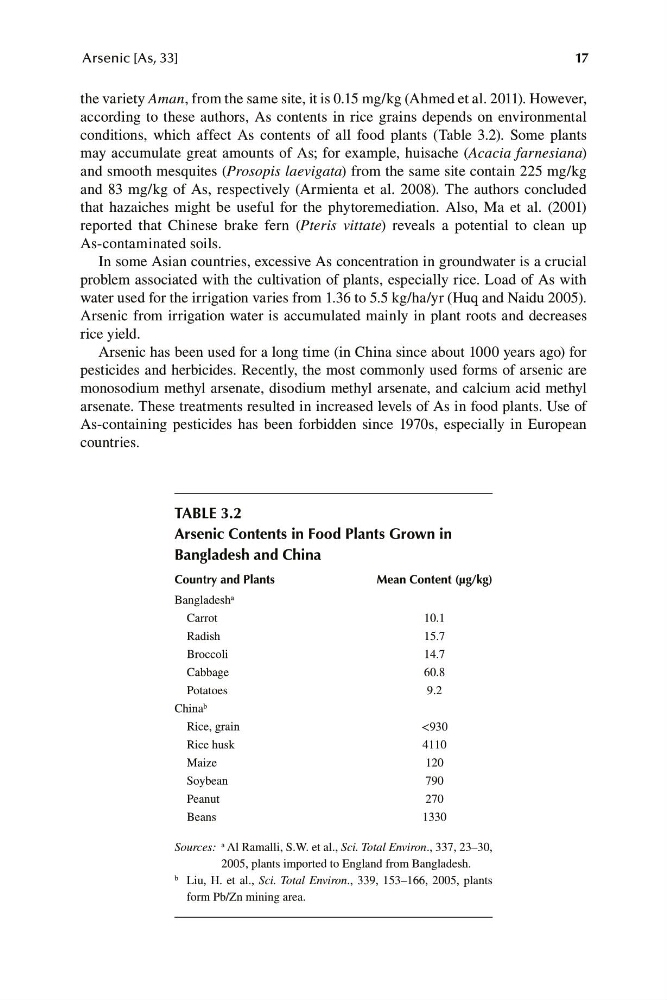
conditions, which affect As contents of all food plants (Table 3.2). Some plants
may accumulate great amounts of As; for example, huisache (Acacia farnesiana)
and smooth mesquites (Prosopis laevigata) from the same site contain 225 mg/kg
and 83 mg/kg of As, respectively (Armienta et al. 2008). The authors concluded
that hazaiches might be useful for the phytoremediation. Also, Ma et al. (2001)
reported that Chinese brake fern (Pteris vittate) reveals a potential to clean up
As-contaminated soils.
In some Asian countries, excessive As concentration in groundwater is a crucial
problem associated with the cultivation of plants, especially rice. Load of As with
water used for the irrigation varies from 1.36 to 5.5 kg/ha/yr (Huq and Naidu 2005).
Arsenic from irrigation water is accumulated mainly in plant roots and decreases
rice yield.
Arsenic has been used for a long time (in China since about 1000 years ago) for
pesticides and herbicides. Recently, the most commonly used forms of arsenic are
monosodium methyl arsenate, disodium methyl arsenate, and calcium acid methyl
arsenate. These treatments resulted in increased levels of As in food plants. Use of
As-containing pesticides has been forbidden since 1970s, especially in European
countries.
TABLE 3.2
Arsenic Contents in Food Plants Grown in
Bangladesh and China
Country and Plants
Mean Content (μg/kg)
Bangladesh a
Carrot
10.1
Radish
15.7
Broccoli
14.7
Cabbage
Potatoes
60.8
9.2
China b
Rice, grain
Rice husk
<930
4110
Maize
120
Soybean
Peanut
790
270
Beans
1330
Sources: a Al Ramalli, S.W. et al., Sci. Total Environ., 337, 23–30,
2005, plants imported to England from Bangladesh.
b Liu, H. et al., Sci. Total Environ., 339, 153–166, 2005, plants
form Pb/Zn mining area.