

11
Antimony [Sb, 51]
coinfections. Historically, Sb has been known for its emetic properties. Oral exposure to Sb predominantly affects the gastrointestinal system. Sb amounts as low as
0.529 mg/kg can result in vomiting (Sundar and Chakravarty 2010).
There is inadequate evidence for the carcinogenicity of Sb trioxide and trisulfide
in humans, but these compounds have been seen to cause lung tumours in rats. The
greatest concern, with regard to the carcinogenicity of Sb, relates to the inhalation
route. Antimony trioxide is classified as possibly carcinogenic to humans (Group 2B)
and Sb trisulfide (Group 3), as reported by the IARC (1989).
Primary source of exposure to Sb 2 O 3 for the general population in Canada is flame
retardants used in furniture upholstery and mattress covers. Flame retardant polyester fabrics used in children’s stuffed toys may be another source of exposure (Health
Canada 2010a). Sb trioxide is a priority pollutant in the Europe and the United States.
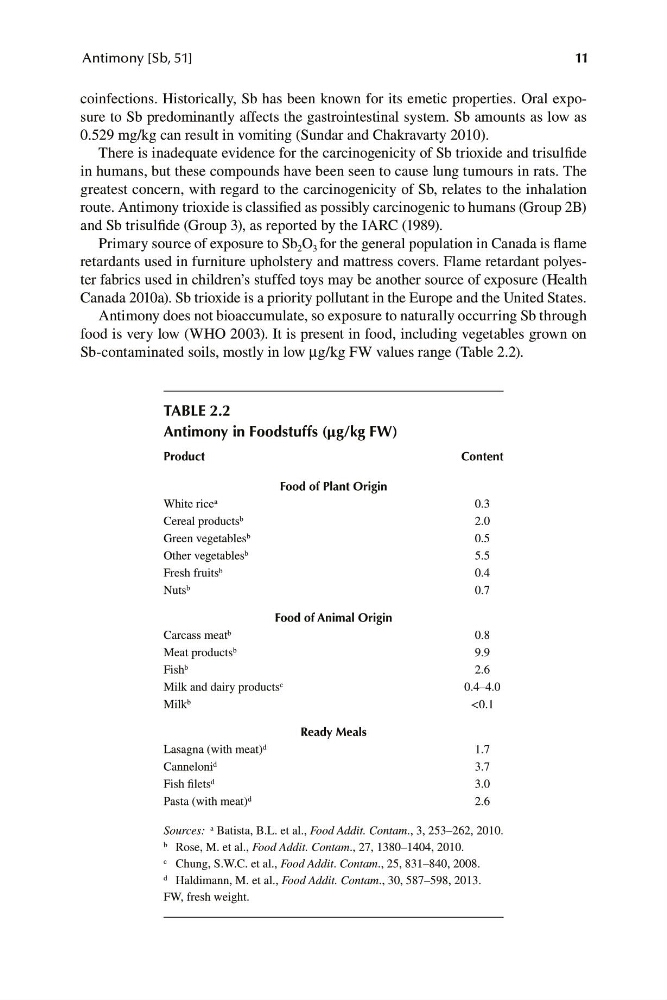
Antimony does not bioaccumulate, so exposure to naturally occurring Sb through
food is very low (WHO 2003). It is present in food, including vegetables grown on
Sb-contaminated soils, mostly in low μg/kg FW values range (Table 2.2).
TABLE 2.2
Antimony in Foodstuffs (μg/kg FW)
Product
Content
Food of Plant Origin
White rice a
0.3
Cereal products b
2.0
Green vegetables b
0.5
Other vegetables b
5.5
Fresh fruits b
0.4
Nuts b
0.7
Food of Animal Origin
Carcass meat b
0.8
Meat products b
9.9
Fish b
2.6
Milk and dairy products c
0.4–4.0
Milk b
<0.1
Ready Meals
Lasagna (with meat) d
1.7
Canneloni d
3.7
Fish filets d
3.0
Pasta (with meat) d
2.6
Sources: a Batista, B.L. et al., Food Addit. Contam., 3, 253–262, 2010.
b Rose, M. et al., Food Addit. Contam., 27, 1380–1404, 2010.
c Chung, S.W.C. et al., Food Addit. Contam., 25, 831–840, 2008.
d Haldimann, M. et al., Food Addit. Contam., 30, 587–598, 2013.
FW, fresh weight.
Antimony [Sb, 51]
coinfections. Historically, Sb has been known for its emetic properties. Oral exposure to Sb predominantly affects the gastrointestinal system. Sb amounts as low as
0.529 mg/kg can result in vomiting (Sundar and Chakravarty 2010).
There is inadequate evidence for the carcinogenicity of Sb trioxide and trisulfide
in humans, but these compounds have been seen to cause lung tumours in rats. The
greatest concern, with regard to the carcinogenicity of Sb, relates to the inhalation
route. Antimony trioxide is classified as possibly carcinogenic to humans (Group 2B)
and Sb trisulfide (Group 3), as reported by the IARC (1989).
Primary source of exposure to Sb 2 O 3 for the general population in Canada is flame
retardants used in furniture upholstery and mattress covers. Flame retardant polyester fabrics used in children’s stuffed toys may be another source of exposure (Health
Canada 2010a). Sb trioxide is a priority pollutant in the Europe and the United States.
Antimony does not bioaccumulate, so exposure to naturally occurring Sb through
food is very low (WHO 2003). It is present in food, including vegetables grown on
Sb-contaminated soils, mostly in low μg/kg FW values range (Table 2.2).
TABLE 2.2
Antimony in Foodstuffs (μg/kg FW)
Product
Content
Food of Plant Origin
White rice a
0.3
Cereal products b
2.0
Green vegetables b
0.5
Other vegetables b
5.5
Fresh fruits b
0.4
Nuts b
0.7
Food of Animal Origin
Carcass meat b
0.8
Meat products b
9.9
Fish b
2.6
Milk and dairy products c
0.4–4.0
Milk b
<0.1
Ready Meals
Lasagna (with meat) d
1.7
Canneloni d
3.7
Fish filets d
3.0
Pasta (with meat) d
2.6
Sources: a Batista, B.L. et al., Food Addit. Contam., 3, 253–262, 2010.
b Rose, M. et al., Food Addit. Contam., 27, 1380–1404, 2010.
c Chung, S.W.C. et al., Food Addit. Contam., 25, 831–840, 2008.
d Haldimann, M. et al., Food Addit. Contam., 30, 587–598, 2013.
FW, fresh weight.