

Zinc [Zn, 30]
365
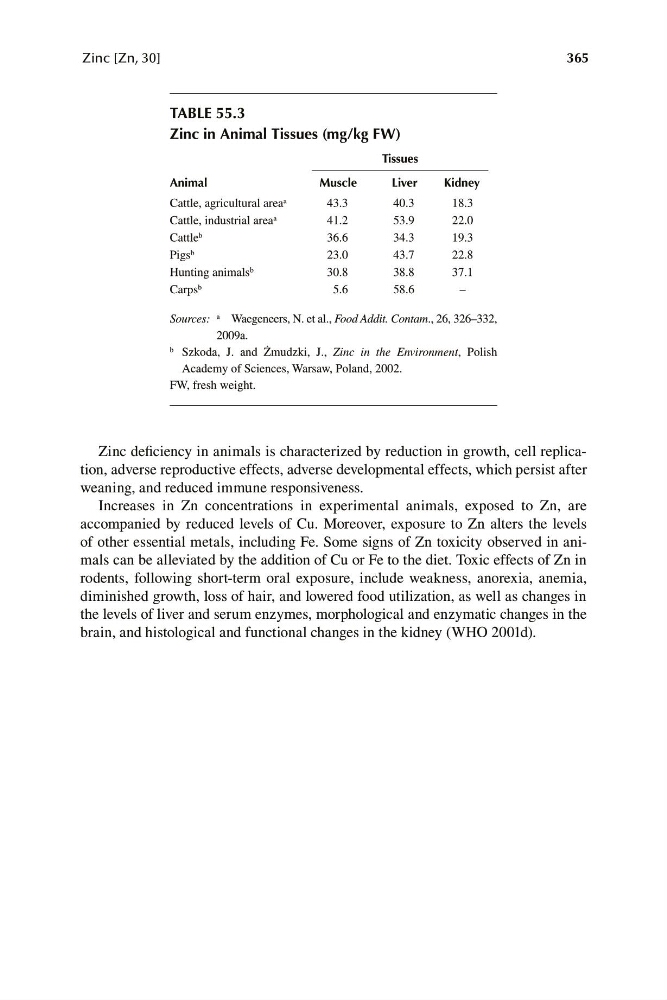
TABLE 55.3
Zinc in Animal Tissues (mg/kg FW)
Animal
Tissues
Muscle
Liver
Kidney
Cattle, agricultural area a
43.3
40.3
18.3
Cattle, industrial area a
41.2
53.9
22.0
Cattle b
36.6
34.3
19.3
Pigs b
23.0
43.7
22.8
Hunting animals b
30.8
38.8
37.1
Carps b
5.6
58.6
–
a
Sources:
Waegeneers, N. et al., Food Addit. Contam., 26, 326–332,
2009a.
b Szkoda, J. and Żmudzki, J., Zinc in the Environment, Polish
Academy of Sciences, Warsaw, Poland, 2002.
FW, fresh weight.
Zinc deficiency in animals is characterized by reduction in growth, cell replication, adverse reproductive effects, adverse developmental effects, which persist after
weaning, and reduced immune responsiveness.
Increases in Zn concentrations in experimental animals, exposed to Zn, are
accompanied by reduced levels of Cu. Moreover, exposure to Zn alters the levels
of other essential metals, including Fe. Some signs of Zn toxicity observed in animals can be alleviated by the addition of Cu or Fe to the diet. Toxic effects of Zn in
rodents, following short-term oral exposure, include weakness, anorexia, anemia,
diminished growth, loss of hair, and lowered food utilization, as well as changes in
the levels of liver and serum enzymes, morphological and enzymatic changes in the
brain, and histological and functional changes in the kidney (WHO 2001d).
365
TABLE 55.3
Zinc in Animal Tissues (mg/kg FW)
Animal
Tissues
Muscle
Liver
Kidney
Cattle, agricultural area a
43.3
40.3
18.3
Cattle, industrial area a
41.2
53.9
22.0
Cattle b
36.6
34.3
19.3
Pigs b
23.0
43.7
22.8
Hunting animals b
30.8
38.8
37.1
Carps b
5.6
58.6
–
a
Sources:
Waegeneers, N. et al., Food Addit. Contam., 26, 326–332,
2009a.
b Szkoda, J. and Żmudzki, J., Zinc in the Environment, Polish
Academy of Sciences, Warsaw, Poland, 2002.
FW, fresh weight.
Zinc deficiency in animals is characterized by reduction in growth, cell replication, adverse reproductive effects, adverse developmental effects, which persist after
weaning, and reduced immune responsiveness.
Increases in Zn concentrations in experimental animals, exposed to Zn, are
accompanied by reduced levels of Cu. Moreover, exposure to Zn alters the levels
of other essential metals, including Fe. Some signs of Zn toxicity observed in animals can be alleviated by the addition of Cu or Fe to the diet. Toxic effects of Zn in
rodents, following short-term oral exposure, include weakness, anorexia, anemia,
diminished growth, loss of hair, and lowered food utilization, as well as changes in
the levels of liver and serum enzymes, morphological and enzymatic changes in the
brain, and histological and functional changes in the kidney (WHO 2001d).