

364
Trace Elements in Abiotic and Biotic Environments
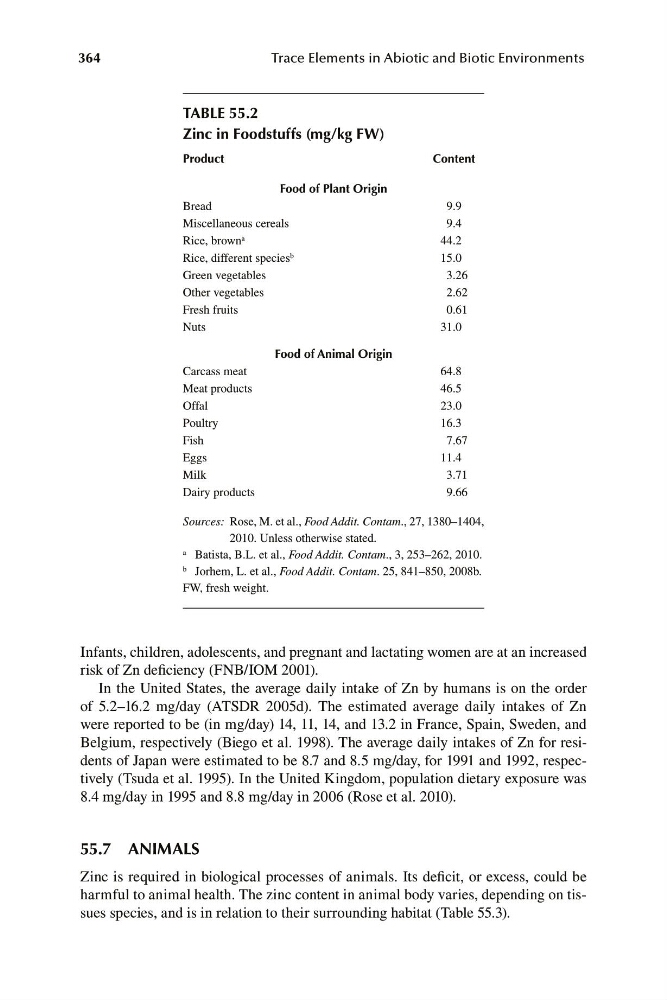
TABLE 55.2
Zinc in Foodstuffs (mg/kg FW)
Product
Content
Food of Plant Origin
Bread
9.9
Miscellaneous cereals
9.4
Rice, brown a
Rice, different species b
Green vegetables
Other vegetables
Fresh fruits
44.2
15.0
3.26
2.62
0.61
Nuts
31.0
Food of Animal Origin
Carcass meat
64.8
Meat products
Offal
46.5
23.0
Poultry
Fish
16.3
7.67
Eggs
Milk
11.4
3.71
Dairy products
9.66
Sources: Rose, M. et al., Food Addit. Contam., 27, 1380–1404,
2010. Unless otherwise stated.
a Batista, B.L. et al., Food Addit. Contam., 3, 253–262, 2010.
b Jorhem, L. et al., Food Addit. Contam. 25, 841–850, 2008b.
FW, fresh weight.
Infants, children, adolescents, and pregnant and lactating women are at an increased
risk of Zn deficiency (FNB/IOM 2001).
In the United States, the average daily intake of Zn by humans is on the order
of 5.2–16.2 mg/day (ATSDR 2005d). The estimated average daily intakes of Zn
were reported to be (in mg/day) 14, 11, 14, and 13.2 in France, Spain, Sweden, and
Belgium, respectively (Biego et al. 1998). The average daily intakes of Zn for residents of Japan were estimated to be 8.7 and 8.5 mg/day, for 1991 and 1992, respectively (Tsuda et al. 1995). In the United Kingdom, population dietary exposure was
8.4 mg/day in 1995 and 8.8 mg/day in 2006 (Rose et al. 2010).
55.7 ANIMALS
Zinc is required in biological processes of animals. Its deficit, or excess, could be
harmful to animal health. The zinc content in animal body varies, depending on tissues species, and is in relation to their surrounding habitat (Table 55.3).
Trace Elements in Abiotic and Biotic Environments
TABLE 55.2
Zinc in Foodstuffs (mg/kg FW)
Product
Content
Food of Plant Origin
Bread
9.9
Miscellaneous cereals
9.4
Rice, brown a
Rice, different species b
Green vegetables
Other vegetables
Fresh fruits
44.2
15.0
3.26
2.62
0.61
Nuts
31.0
Food of Animal Origin
Carcass meat
64.8
Meat products
Offal
46.5
23.0
Poultry
Fish
16.3
7.67
Eggs
Milk
11.4
3.71
Dairy products
9.66
Sources: Rose, M. et al., Food Addit. Contam., 27, 1380–1404,
2010. Unless otherwise stated.
a Batista, B.L. et al., Food Addit. Contam., 3, 253–262, 2010.
b Jorhem, L. et al., Food Addit. Contam. 25, 841–850, 2008b.
FW, fresh weight.
Infants, children, adolescents, and pregnant and lactating women are at an increased
risk of Zn deficiency (FNB/IOM 2001).
In the United States, the average daily intake of Zn by humans is on the order
of 5.2–16.2 mg/day (ATSDR 2005d). The estimated average daily intakes of Zn
were reported to be (in mg/day) 14, 11, 14, and 13.2 in France, Spain, Sweden, and
Belgium, respectively (Biego et al. 1998). The average daily intakes of Zn for residents of Japan were estimated to be 8.7 and 8.5 mg/day, for 1991 and 1992, respectively (Tsuda et al. 1995). In the United Kingdom, population dietary exposure was
8.4 mg/day in 1995 and 8.8 mg/day in 2006 (Rose et al. 2010).
55.7 ANIMALS
Zinc is required in biological processes of animals. Its deficit, or excess, could be
harmful to animal health. The zinc content in animal body varies, depending on tissues species, and is in relation to their surrounding habitat (Table 55.3).