

_
_
_
346
Trace Elements in Abiotic and Biotic Environments
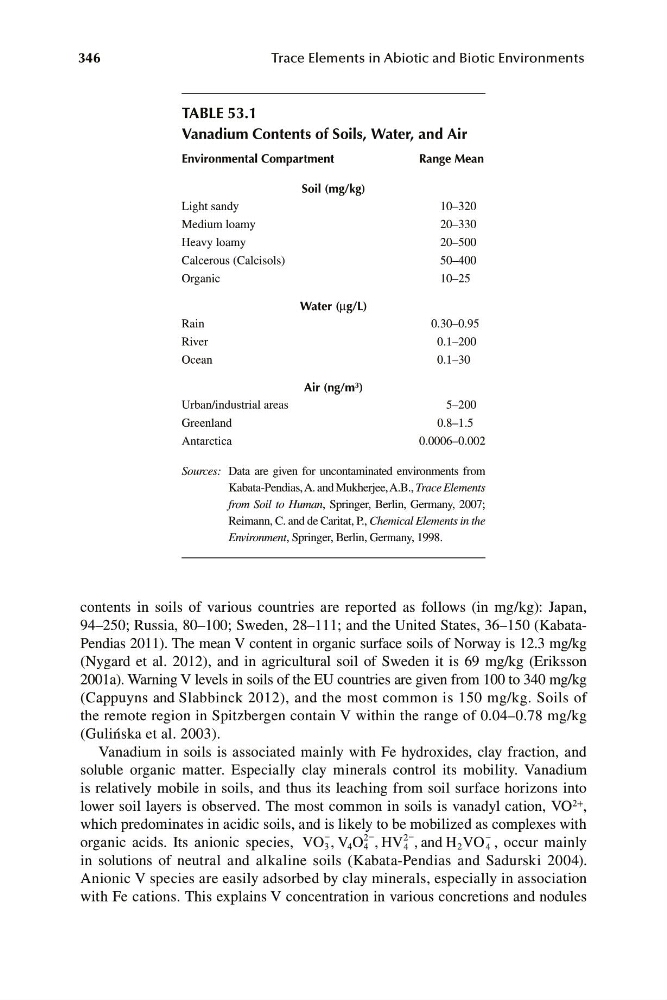
TABLE 53.1
Vanadium Contents of Soils, Water, and Air
Environmental Compartment
Range Mean
Soil (mg/kg)
Light sandy
10–320
Medium loamy
20–330
Heavy loamy
20–500
Calcerous (Calcisols)
50–400
Organic
10–25
Water (μg/L)
Rain
0.30–0.95
River
0.1–200
Ocean
0.1–30
Air (ng/m 3 )
Urban/industrial areas
5–200
Greenland
0.8–1.5
Antarctica
0.0006–0.002
Sources: Data are given for uncontaminated environments from
Kabata-Pendias, A. and Mukherjee, A.B., Trace Elements
from Soil to Human, Springer, Berlin, Germany, 2007;
Reimann, C. and de Caritat, P., Chemical Elements in the
Environment, Springer, Berlin, Germany, 1998.
contents in soils of various countries are reported as follows (in mg/kg): Japan,
94–250; Russia, 80–100; Sweden, 28–111; and the United States, 36–150 (KabataPendias 2011). The mean V content in organic surface soils of Norway is 12.3 mg/kg
(Nygard et al. 2012), and in agricultural soil of Sweden it is 69 mg/kg (Eriksson
2001a). Warning V levels in soils of the EU countries are given from 100 to 340 mg/kg
(Cappuyns and Slabbinck 2012), and the most common is 150 mg/kg. Soils of
the remote region in Spitzbergen contain V within the range of 0.04–0.78 mg/kg
(Gulińska et al. 2003).
Vanadium in soils is associated mainly with Fe hydroxides, clay fraction, and
soluble organic matter. Especially clay minerals control its mobility. Vanadium
is relatively mobile in soils, and thus its leaching from soil surface horizons into
lower soil layers is observed. The most common in soils is vanadyl cation, VO 2+ ,
which predominates in acidic soils, and is likely to be mobilized as complexes with
_
organic acids. Its anionic species, VO , V O
2 , HV
2 , and H VO , occur mainly
3
4 4
4
2
4
in solutions of neutral and alkaline soils (Kabata-Pendias and Sadurski 2004).
Anionic V species are easily adsorbed by clay minerals, especially in association
with Fe cations. This explains V concentration in various concretions and nodules
_
_
346
Trace Elements in Abiotic and Biotic Environments
TABLE 53.1
Vanadium Contents of Soils, Water, and Air
Environmental Compartment
Range Mean
Soil (mg/kg)
Light sandy
10–320
Medium loamy
20–330
Heavy loamy
20–500
Calcerous (Calcisols)
50–400
Organic
10–25
Water (μg/L)
Rain
0.30–0.95
River
0.1–200
Ocean
0.1–30
Air (ng/m 3 )
Urban/industrial areas
5–200
Greenland
0.8–1.5
Antarctica
0.0006–0.002
Sources: Data are given for uncontaminated environments from
Kabata-Pendias, A. and Mukherjee, A.B., Trace Elements
from Soil to Human, Springer, Berlin, Germany, 2007;
Reimann, C. and de Caritat, P., Chemical Elements in the
Environment, Springer, Berlin, Germany, 1998.
contents in soils of various countries are reported as follows (in mg/kg): Japan,
94–250; Russia, 80–100; Sweden, 28–111; and the United States, 36–150 (KabataPendias 2011). The mean V content in organic surface soils of Norway is 12.3 mg/kg
(Nygard et al. 2012), and in agricultural soil of Sweden it is 69 mg/kg (Eriksson
2001a). Warning V levels in soils of the EU countries are given from 100 to 340 mg/kg
(Cappuyns and Slabbinck 2012), and the most common is 150 mg/kg. Soils of
the remote region in Spitzbergen contain V within the range of 0.04–0.78 mg/kg
(Gulińska et al. 2003).
Vanadium in soils is associated mainly with Fe hydroxides, clay fraction, and
soluble organic matter. Especially clay minerals control its mobility. Vanadium
is relatively mobile in soils, and thus its leaching from soil surface horizons into
lower soil layers is observed. The most common in soils is vanadyl cation, VO 2+ ,
which predominates in acidic soils, and is likely to be mobilized as complexes with
_
organic acids. Its anionic species, VO , V O
2 , HV
2 , and H VO , occur mainly
3
4 4
4
2
4
in solutions of neutral and alkaline soils (Kabata-Pendias and Sadurski 2004).
Anionic V species are easily adsorbed by clay minerals, especially in association
with Fe cations. This explains V concentration in various concretions and nodules