

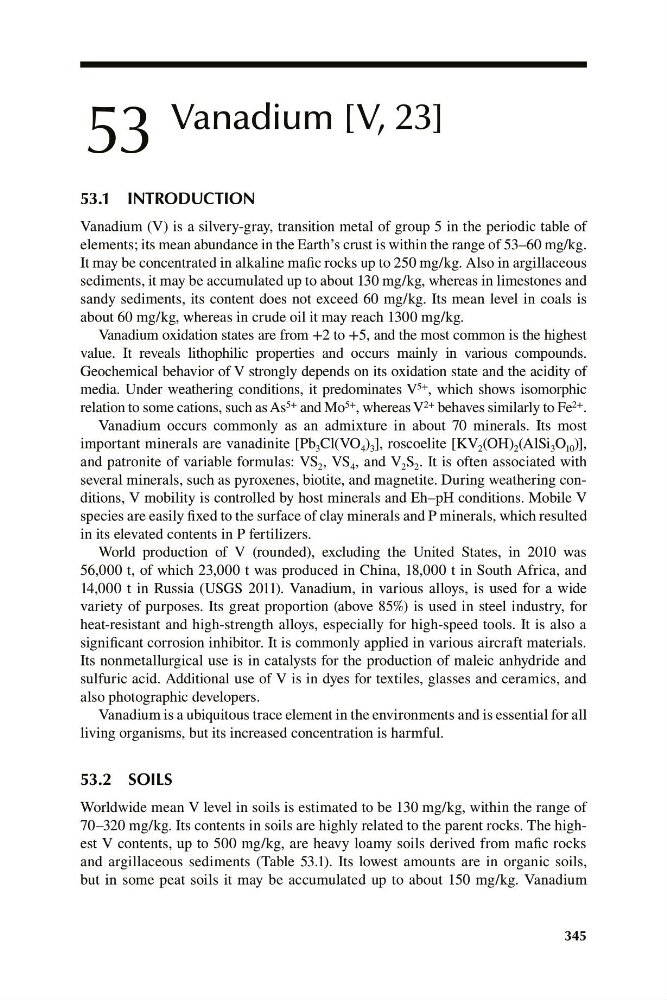
53
Vanadium [V, 23]
53.1 INTRODUCTION
Vanadium (V) is a silvery-gray, transition metal of group 5 in the periodic table of
elements; its mean abundance in the Earth’s crust is within the range of 53–60 mg/kg.
It may be concentrated in alkaline mafic rocks up to 250 mg/kg. Also in argillaceous
sediments, it may be accumulated up to about 130 mg/kg, whereas in limestones and
sandy sediments, its content does not exceed 60 mg/kg. Its mean level in coals is
about 60 mg/kg, whereas in crude oil it may reach 1300 mg/kg.
Vanadium oxidation states are from +2 to +5, and the most common is the highest
value. It reveals lithophilic properties and occurs mainly in various compounds.
Geochemical behavior of V strongly depends on its oxidation state and the acidity of
media. Under weathering conditions, it predominates V 5+ , which shows isomorphic
relation to some cations, such as As 5+ and Mo 5+ , whereas V 2+ behaves similarly to Fe 2+ .
Vanadium occurs commonly as an admixture in about 70 minerals. Its most
important minerals are vanadinite [Pb 3 Cl(VO 4 ) 3 ], roscoelite [KV 2 (OH) 2 (AlSi 3 O 10 )],
and patronite of variable formulas: VS 2 , VS 4 , and V 2 S 2 . It is often associated with
several minerals, such as pyroxenes, biotite, and magnetite. During weathering conditions, V mobility is controlled by host minerals and Eh–pH conditions. Mobile V
species are easily fixed to the surface of clay minerals and P minerals, which resulted
in its elevated contents in P fertilizers.
World production of V (rounded), excluding the United States, in 2010 was
56,000 t, of which 23,000 t was produced in China, 18,000 t in South Africa, and
14,000 t in Russia (USGS 2011). Vanadium, in various alloys, is used for a wide
variety of purposes. Its great proportion (above 85%) is used in steel industry, for
heat-resistant and high-strength alloys, especially for high-speed tools. It is also a
significant corrosion inhibitor. It is commonly applied in various aircraft materials.
Its nonmetallurgical use is in catalysts for the production of maleic anhydride and
sulfuric acid. Additional use of V is in dyes for textiles, glasses and ceramics, and
also photographic developers.
Vanadium is a ubiquitous trace element in the environments and is essential for all
living organisms, but its increased concentration is harmful.
53.2 SOILS
Worldwide mean V level in soils is estimated to be 130 mg/kg, within the range of
70–320 mg/kg. Its contents in soils are highly related to the parent rocks. The highest V contents, up to 500 mg/kg, are heavy loamy soils derived from mafic rocks
and argillaceous sediments (Table 53.1). Its lowest amounts are in organic soils,
but in some peat soils it may be accumulated up to about 150 mg/kg. Vanadium
345