

336
Trace Elements in Abiotic and Biotic Environments
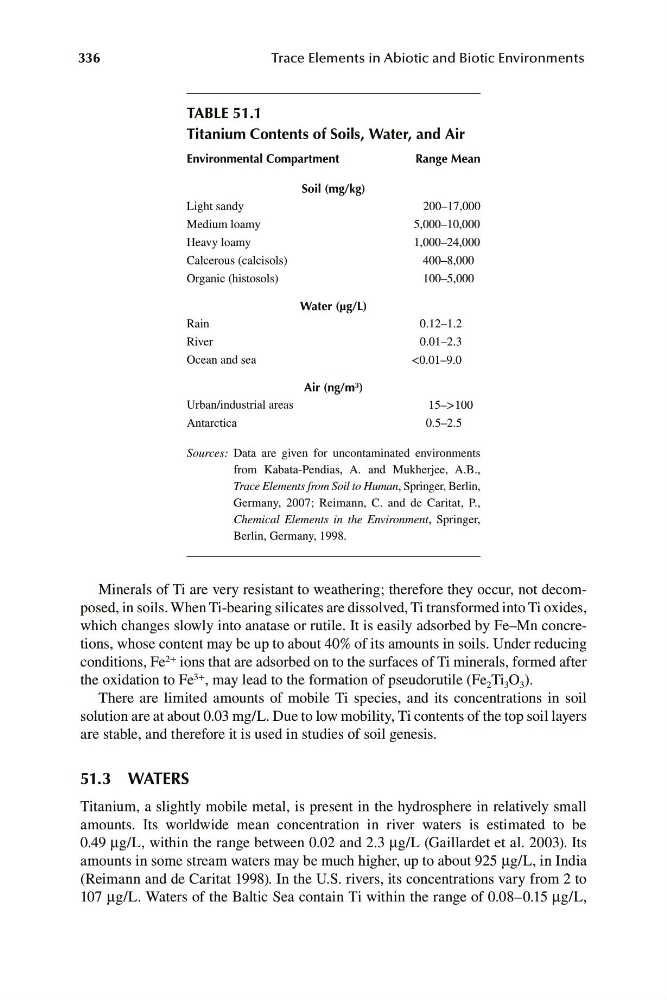
TABLE 51.1
Titanium Contents of Soils, Water, and Air
Environmental Compartment
Range Mean
Soil (mg/kg)
Light sandy
200–17,000
Medium loamy
5,000–10,000
Heavy loamy
1,000–24,000
Calcerous (calcisols)
400–8,000
Organic (histosols)
100–5,000
Water (μg/L)
Rain
0.12–1.2
River
0.01–2.3
Ocean and sea
<0.01–9.0
Air (ng/m 3 )
Urban/industrial areas
15–>100
Antarctica
0.5–2.5
Sources: Data are given for uncontaminated environments
from Kabata-Pendias, A. and Mukherjee, A.B.,
Trace Elements from Soil to Human, Springer, Berlin,
Germany, 2007; Reimann, C. and de Caritat, P.,
Chemical Elements in the Environment, Springer,
Berlin, Germany, 1998.
Minerals of Ti are very resistant to weathering; therefore they occur, not decomposed, in soils. When Ti-bearing silicates are dissolved, Ti transformed into Ti oxides,
which changes slowly into anatase or rutile. It is easily adsorbed by Fe–Mn concretions, whose content may be up to about 40% of its amounts in soils. Under reducing
conditions, Fe 2+ ions that are adsorbed on to the surfaces of Ti minerals, formed after
the oxidation to Fe 3+ , may lead to the formation of pseudorutile (Fe 2 Ti 3 O 3 ).
There are limited amounts of mobile Ti species, and its concentrations in soil
solution are at about 0.03 mg/L. Due to low mobility, Ti contents of the top soil layers
are stable, and therefore it is used in studies of soil genesis.
51.3 WATERS
Titanium, a slightly mobile metal, is present in the hydrosphere in relatively small
amounts. Its worldwide mean concentration in river waters is estimated to be
0.49 μg/L, within the range between 0.02 and 2.3 μg/L (Gaillardet et al. 2003). Its
amounts in some stream waters may be much higher, up to about 925 μg/L, in India
(Reimann and de Caritat 1998). In the U.S. rivers, its concentrations vary from 2 to
107 μg/L. Waters of the Baltic Sea contain Ti within the range of 0.08–0.15 μg/L,