

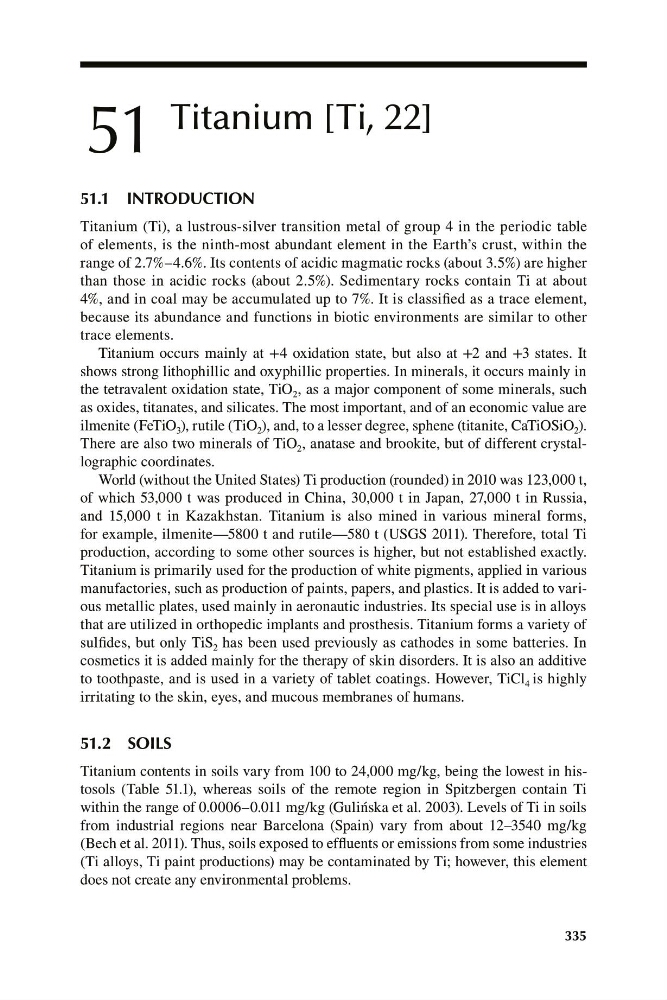
51
Titanium [Ti, 22]
51.1 INTRODUCTION
Titanium (Ti), a lustrous-silver transition metal of group 4 in the periodic table
of elements, is the ninth-most abundant element in the Earth’s crust, within the
range of 2.7%–4.6%. Its contents of acidic magmatic rocks (about 3.5%) are higher
than those in acidic rocks (about 2.5%). Sedimentary rocks contain Ti at about
4%, and in coal may be accumulated up to 7%. It is classified as a trace element,
because its abundance and functions in biotic environments are similar to other
trace elements.
Titanium occurs mainly at +4 oxidation state, but also at +2 and +3 states. It
shows strong lithophillic and oxyphillic properties. In minerals, it occurs mainly in
the tetravalent oxidation state, TiO 2 , as a major component of some minerals, such
as oxides, titanates, and silicates. The most important, and of an economic value are
ilmenite (FeTiO 3 ), rutile (TiO 2 ), and, to a lesser degree, sphene (titanite, CaTiOSiO 2 ).
There are also two minerals of TiO 2 , anatase and brookite, but of different crystallographic coordinates.
World (without the United States) Ti production (rounded) in 2010 was 123,000 t,
of which 53,000 t was produced in China, 30,000 t in Japan, 27,000 t in Russia,
and 15,000 t in Kazakhstan. Titanium is also mined in various mineral forms,
for example, ilmenite—5800 t and rutile—580 t (USGS 2011). Therefore, total Ti
production, according to some other sources is higher, but not established exactly.
Titanium is primarily used for the production of white pigments, applied in various
manufactories, such as production of paints, papers, and plastics. It is added to various metallic plates, used mainly in aeronautic industries. Its special use is in alloys
that are utilized in orthopedic implants and prosthesis. Titanium forms a variety of
sulfides, but only TiS 2 has been used previously as cathodes in some batteries. In
cosmetics it is added mainly for the therapy of skin disorders. It is also an additive
to toothpaste, and is used in a variety of tablet coatings. However, TiCl 4 is highly
irritating to the skin, eyes, and mucous membranes of humans.
51.2 SOILS
Titanium contents in soils vary from 100 to 24,000 mg/kg, being the lowest in histosols (Table 51.1), whereas soils of the remote region in Spitzbergen contain Ti
within the range of 0.0006–0.011 mg/kg (Gulińska et al. 2003). Levels of Ti in soils
from industrial regions near Barcelona (Spain) vary from about 12–3540 mg/kg
(Bech et al. 2011). Thus, soils exposed to effluents or emissions from some industries
(Ti alloys, Ti paint productions) may be contaminated by Ti; however, this element
does not create any environmental problems.
335