

Product
Content
Food of Plant Origin
Cereals and cereal products a
79
Fruits and vegetables a
75
Meadow mushroom (Agaricus campestris), cultivated
10
Meadow mushroom (A. campestris), wild
810
Oyster mushroom (Pleurotus ostreatus), cultivated and wild
30
Sugar
<10
Tea
<10
Food of Animal Origin
Meat
<50
Meat a
85
Offal a
451
Freshwater and seawater fish
<50
Shrimps
70
Fish and fish products a
2370
Eggs
<50
Dairy products
<50
Dairy products a
66
Silver [Ag, 47]
305
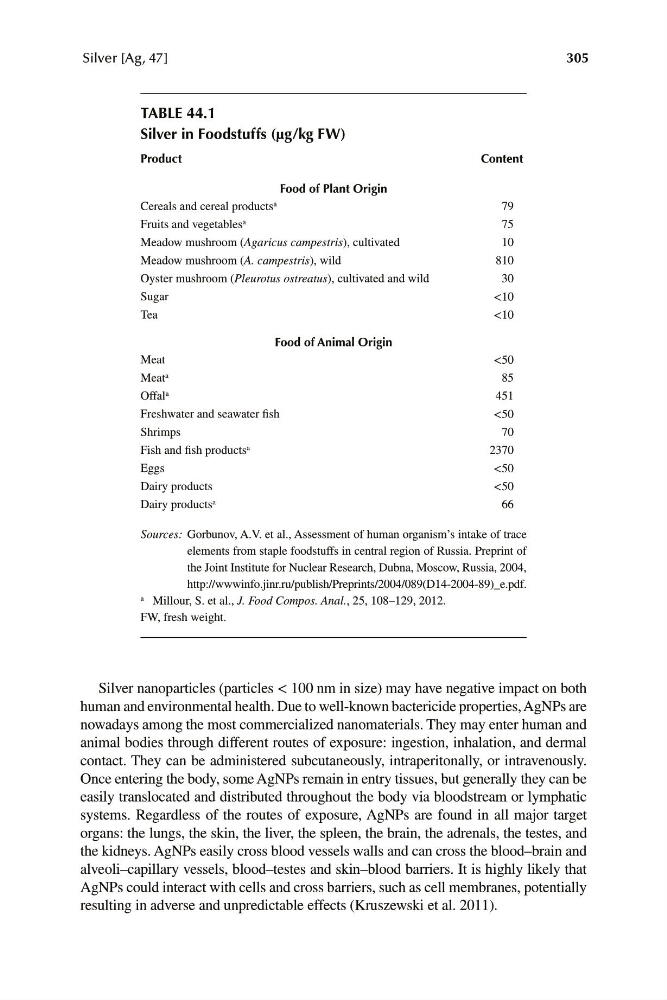
TABLE 44.1
Silver in Foodstuffs (μg/kg FW)
Sources: Gorbunov, A.V. et al., Assessment of human organism’s intake of trace
elements from staple foodstuffs in central region of Russia. Preprint of
the Joint Institute for Nuclear Research, Dubna, Moscow, Russia, 2004,
http://wwwinfo.jinr.ru/publish/Preprints/2004/089(D14-2004-89)_e.pdf.
a Millour, S. et al., J. Food Compos. Anal., 25, 108–129, 2012.
FW, fresh weight.
Silver nanoparticles (particles < 100 nm in size) may have negative impact on both
human and environmental health. Due to well-known bactericide properties, AgNPs are
nowadays among the most commercialized nanomaterials. They may enter human and
animal bodies through different routes of exposure: ingestion, inhalation, and dermal
contact. They can be administered subcutaneously, intraperitonally, or intravenously.
Once entering the body, some AgNPs remain in entry tissues, but generally they can be
easily translocated and distributed throughout the body via bloodstream or lymphatic
systems. Regardless of the routes of exposure, AgNPs are found in all major target
organs: the lungs, the skin, the liver, the spleen, the brain, the adrenals, the testes, and
the kidneys. AgNPs easily cross blood vessels walls and can cross the blood–brain and
alveoli–capillary vessels, blood–testes and skin–blood barriers. It is highly likely that
AgNPs could interact with cells and cross barriers, such as cell membranes, potentially
resulting in adverse and unpredictable effects (Kruszewski et al. 2011).
Content
Food of Plant Origin
Cereals and cereal products a
79
Fruits and vegetables a
75
Meadow mushroom (Agaricus campestris), cultivated
10
Meadow mushroom (A. campestris), wild
810
Oyster mushroom (Pleurotus ostreatus), cultivated and wild
30
Sugar
<10
Tea
<10
Food of Animal Origin
Meat
<50
Meat a
85
Offal a
451
Freshwater and seawater fish
<50
Shrimps
70
Fish and fish products a
2370
Eggs
<50
Dairy products
<50
Dairy products a
66
Silver [Ag, 47]
305
TABLE 44.1
Silver in Foodstuffs (μg/kg FW)
Sources: Gorbunov, A.V. et al., Assessment of human organism’s intake of trace
elements from staple foodstuffs in central region of Russia. Preprint of
the Joint Institute for Nuclear Research, Dubna, Moscow, Russia, 2004,
http://wwwinfo.jinr.ru/publish/Preprints/2004/089(D14-2004-89)_e.pdf.
a Millour, S. et al., J. Food Compos. Anal., 25, 108–129, 2012.
FW, fresh weight.
Silver nanoparticles (particles < 100 nm in size) may have negative impact on both
human and environmental health. Due to well-known bactericide properties, AgNPs are
nowadays among the most commercialized nanomaterials. They may enter human and
animal bodies through different routes of exposure: ingestion, inhalation, and dermal
contact. They can be administered subcutaneously, intraperitonally, or intravenously.
Once entering the body, some AgNPs remain in entry tissues, but generally they can be
easily translocated and distributed throughout the body via bloodstream or lymphatic
systems. Regardless of the routes of exposure, AgNPs are found in all major target
organs: the lungs, the skin, the liver, the spleen, the brain, the adrenals, the testes, and
the kidneys. AgNPs easily cross blood vessels walls and can cross the blood–brain and
alveoli–capillary vessels, blood–testes and skin–blood barriers. It is highly likely that
AgNPs could interact with cells and cross barriers, such as cell membranes, potentially
resulting in adverse and unpredictable effects (Kruszewski et al. 2011).