

Scandium [Sc, 21]
279
41.5 PLANTS
The common Sc contents in plants usually vary within 0.005–0.07 mg/kg, but in
some herb plants, they may be much higher, up to 2 mg/kg. Similar range of Sc,
0.002–0.1 mg/kg, is in food plants (Kabata-Pendias 2011). The broad range of Cs is
reported for fungi, from <0.002 to 0.3 mg/kg (Bowen vide Kabata-Pendias 2011).
Rice straw contains Sc about 0.2 mg/kg, and its amounts increase up to 1 mg/kg
in manure produced from that straw (Goto vide Kabata-Pendias 2011). Scandium is
accumulated in roots and old leaves. Shtangeeva et al. (2004) observed that added Sc
is likely to be concentrated in seedling and roots. Some interactions between Sc and
Na, K, and Ca were observed by these authors.
41.6 HUMANS
The mean Sc content in the human body is estimated to be about 0.2 mg in the blood
8 μg/L and 1 μg/kg in the bone and tissue (Emsley 2011). Scandium has no biological role and is not toxic, although there have been suggestions that some of its compounds might be cancerogenic. It is mostly dangerous in the working environment,
due to the fact that damps and gasses can be inhaled with air. This can cause lung
embolisms, especially during long-term exposure. Scandium can be a threat to the
liver when it accumulates in the human body (Horovitz 2000).
Only trace amounts of Sc are the food chain, so the average person’s daily intake
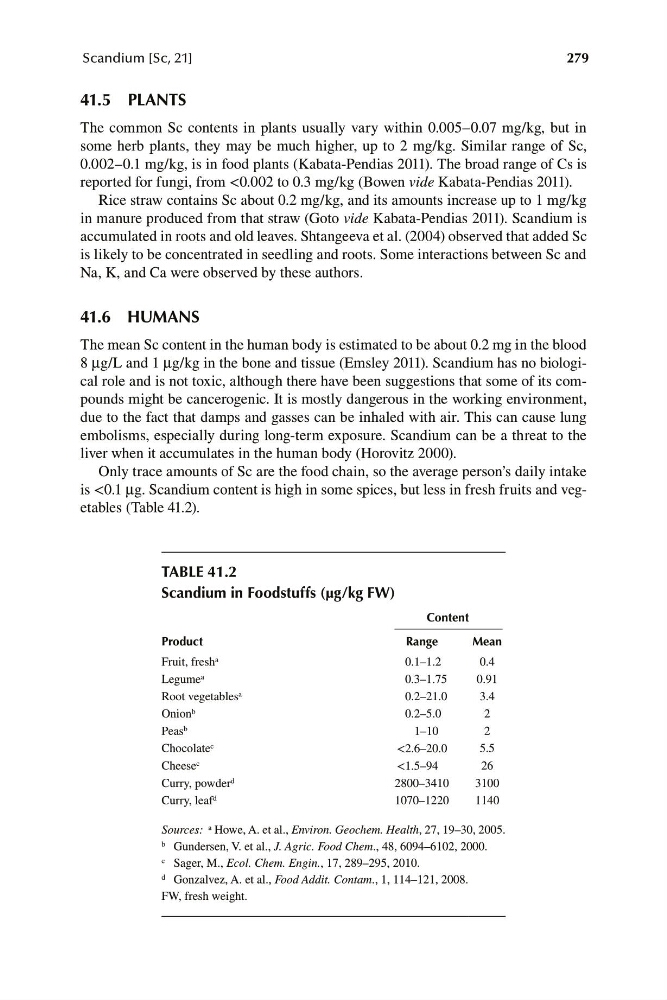
is <0.1 μg. Scandium content is high in some spices, but less in fresh fruits and vegetables (Table 41.2).
TABLE 41.2
Scandium in Foodstuffs (μg/kg FW)
Content
Product
Range
Mean
Fruit, fresh a
0.1–1.2
0.4
Legume a
0.3–1.75
0.91
Root vegetables a
0.2–21.0
3.4
Onion b
0.2–5.0
2
Peas b
1–10
2
Chocolate c
<2.6–20.0
5.5
Cheese c
<1.5–94
26
Curry, powder d
2800–3410
3100
Curry, leaf d
1070–1220
1140
Sources: a Howe, A. et al., Environ. Geochem. Health, 27, 19–30, 2005.
b Gundersen, V. et al., J. Agric. Food Chem., 48, 6094–6102, 2000.
c Sager, M., Ecol. Chem. Engin., 17, 289–295, 2010.
d Gonzalvez, A. et al., Food Addit. Contam., 1, 114–121, 2008.
FW, fresh weight.