

278
Trace Elements in Abiotic and Biotic Environments
TABLE 41.1
Scandium Contents of Soils, Water, and Air
Environmental Compartment
Range
Soil (mg/kg)
Light sandy
0.8–1.5
Medium loamy
3–8
Heavy loamy
2.5–28
Calcerous (calcisols)
6–11
Organic
2–20
Water (ng/L)
Rain
2–1.2
River
60–1800
Sea and ocean a
0.6–1.0
Air (pg/m 3 )
Urban/industrial areas
30–3000
Antarctica
0.06–0.21
Sources: Data are given for uncontaminated environments from
Kabata-Pendias, A. and Mukherjee, A.B., Trace Elements
from Soil to Human, Springer, Berlin, Germany, 2007;
Reimann, C. and de Caritat, P., Chemical Elements in the
Environment, Springer, Berlin, Germany, 1998.
a Range of mean values.
41.3 WATERS
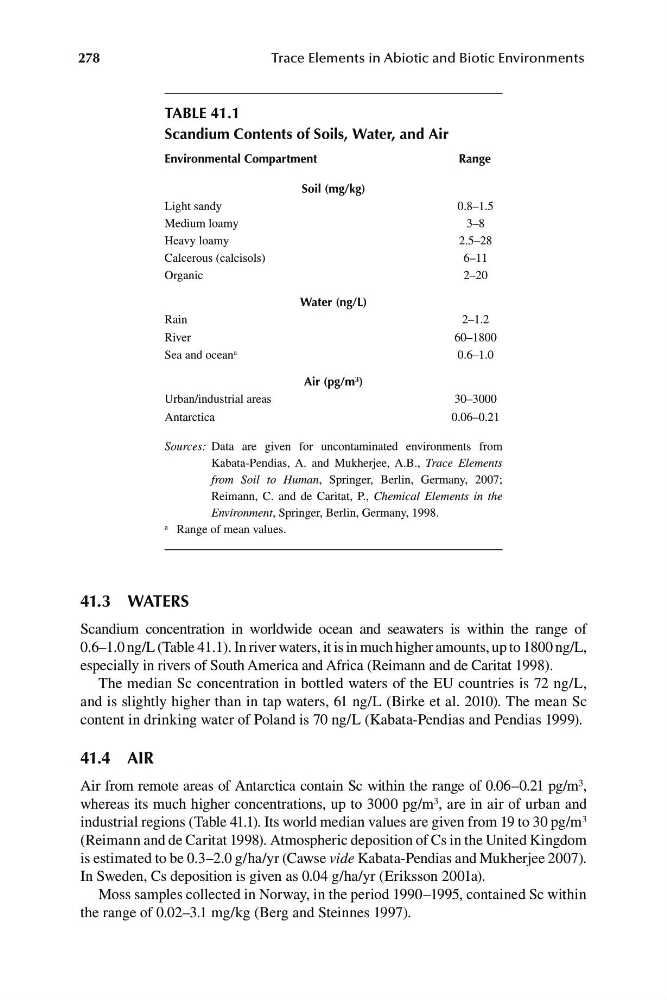
Scandium concentration in worldwide ocean and seawaters is within the range of
0.6–1.0 ng/L (Table 41.1). In river waters, it is in much higher amounts, up to 1800 ng/L,
especially in rivers of South America and Africa (Reimann and de Caritat 1998).
The median Sc concentration in bottled waters of the EU countries is 72 ng/L,
and is slightly higher than in tap waters, 61 ng/L (Birke et al. 2010). The mean Sc
content in drinking water of Poland is 70 ng/L (Kabata-Pendias and Pendias 1999).
41.4 AIR
Air from remote areas of Antarctica contain Sc within the range of 0.06–0.21 pg/m 3 ,
whereas its much higher concentrations, up to 3000 pg/m 3 , are in air of urban and
industrial regions (Table 41.1). Its world median values are given from 19 to 30 pg/m 3
(Reimann and de Caritat 1998). Atmospheric deposition of Cs in the United Kingdom
is estimated to be 0.3–2.0 g/ha/yr (Cawse vide Kabata-Pendias and Mukherjee 2007).
In Sweden, Cs deposition is given as 0.04 g/ha/yr (Eriksson 2001a).
Moss samples collected in Norway, in the period 1990–1995, contained Sc within
the range of 0.02–3.1 mg/kg (Berg and Steinnes 1997).