

Product
a
Content
b
Food of Vegetable Origin
Bread and miscellaneous cereals
<2
<1
Vegetables and green
<2
<0.2
Vegetables and other canned vegetables
<2
0.2
Potatoes
<2
<0.3
Fruits and fresh fruit products
<2
<0.2
Nuts
<2
<1
Food of Animal Origin
Carcass meat and offal
<2
<0.5
Fish
<2
<0.3
Milk
2
<0.2
Dairy products
2
<0.5
274
Trace Elements in Abiotic and Biotic Environments
40.3 RADIONUCLIDES
Two radionuclides, 103 Ru and 106 Ru, are released during nuclear reactions. Both
radionuclides, and particularly 106 Ru, were deposited on soils by the fallout after the
Chernobyl accident. This radionuclide is relatively mobile and migrates down soil
profiles. It is also easily bioavailable and its highest proportion is concentrated in
roots. A significant phytogenetic effect on the variable uptake and accumulation of
both radionuclides by plants is observed.
40.4 HUMANS
There are no data on measurable content of Ru in the human body. Ruthenium anticancer drugs have attracted an increasing interest in the past 20 years and two of
them have entered clinical trials. Recent research shows that Ru complexes have
anticancer properties in vivo, and they might be a good alternative to Pt-based drugs
for anticancer therapy (Antonarakis and Emadi 2010). Compared to Pt drugs, the
complexes based on Ru are often identified as less toxic and capable of overcoming
the resistance induced by Pt drugs in cancer cells (Bergamo and Sava 2011).
Although Pt, Rh, and Ru are used as catalysts of petrol-engined vehicles, which
have elevated their concentration in roadside dust, there is little information about
the biological effects of PGM metals in food. There is not any evidence for adverse
effects of these metals, introduced into environments with exhaust emissions
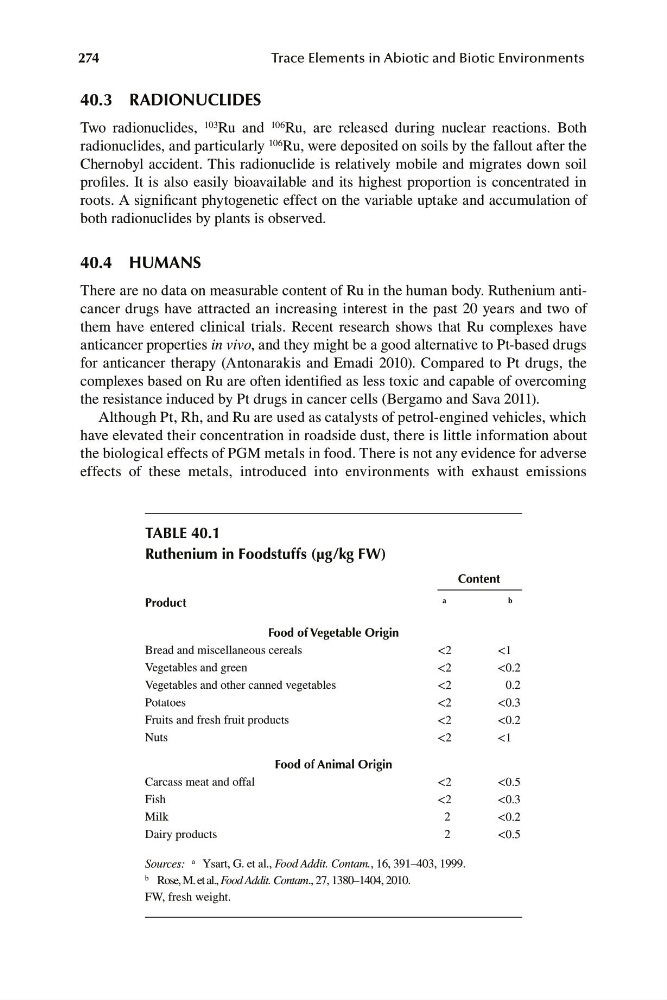
TABLE 40.1
Ruthenium in Foodstuffs (μg/kg FW)
a
Sources: Ysart, G. et al., Food Addit. Contam., 16, 391–403, 1999.
b Rose, M. et al., Food Addit. Contam., 27, 1380–1404, 2010.
FW, fresh weight.
a
Content
b
Food of Vegetable Origin
Bread and miscellaneous cereals
<2
<1
Vegetables and green
<2
<0.2
Vegetables and other canned vegetables
<2
0.2
Potatoes
<2
<0.3
Fruits and fresh fruit products
<2
<0.2
Nuts
<2
<1
Food of Animal Origin
Carcass meat and offal
<2
<0.5
Fish
<2
<0.3
Milk
2
<0.2
Dairy products
2
<0.5
274
Trace Elements in Abiotic and Biotic Environments
40.3 RADIONUCLIDES
Two radionuclides, 103 Ru and 106 Ru, are released during nuclear reactions. Both
radionuclides, and particularly 106 Ru, were deposited on soils by the fallout after the
Chernobyl accident. This radionuclide is relatively mobile and migrates down soil
profiles. It is also easily bioavailable and its highest proportion is concentrated in
roots. A significant phytogenetic effect on the variable uptake and accumulation of
both radionuclides by plants is observed.
40.4 HUMANS
There are no data on measurable content of Ru in the human body. Ruthenium anticancer drugs have attracted an increasing interest in the past 20 years and two of
them have entered clinical trials. Recent research shows that Ru complexes have
anticancer properties in vivo, and they might be a good alternative to Pt-based drugs
for anticancer therapy (Antonarakis and Emadi 2010). Compared to Pt drugs, the
complexes based on Ru are often identified as less toxic and capable of overcoming
the resistance induced by Pt drugs in cancer cells (Bergamo and Sava 2011).
Although Pt, Rh, and Ru are used as catalysts of petrol-engined vehicles, which
have elevated their concentration in roadside dust, there is little information about
the biological effects of PGM metals in food. There is not any evidence for adverse
effects of these metals, introduced into environments with exhaust emissions
TABLE 40.1
Ruthenium in Foodstuffs (μg/kg FW)
a
Sources: Ysart, G. et al., Food Addit. Contam., 16, 391–403, 1999.
b Rose, M. et al., Food Addit. Contam., 27, 1380–1404, 2010.
FW, fresh weight.