

94
Trace Elements in Abiotic and Biotic Environments
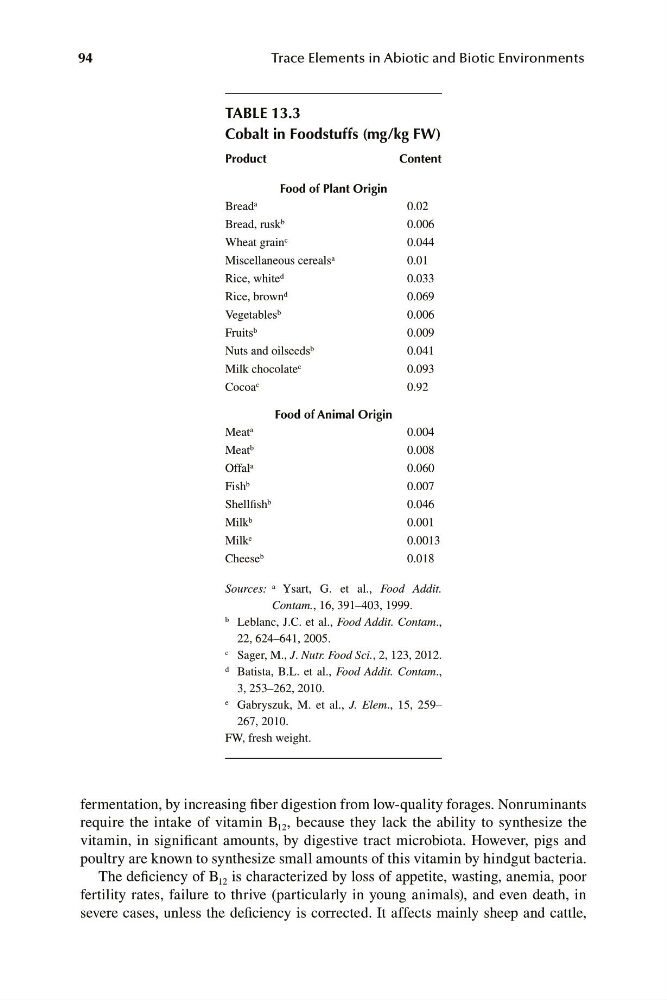
TABLE 13.3
Cobalt in Foodstuffs (mg/kg FW)
Product
Content
Food of Plant Origin
Bread a
0.02
Bread, rusk b
0.006
Wheat grain c
0.044
Miscellaneous cereals a
0.01
Rice, white d
0.033
Rice, brown d
0.069
Vegetables b
0.006
Fruits b
0.009
Nuts and oilseeds b
0.041
Milk chocolate c
0.093
Cocoa c
0.92
Food of Animal Origin
Meat a
0.004
Meat b
0.008
Offal a
0.060
Fish b
0.007
Shellfish b
0.046
Milk b
0.001
Milk e
0.0013
Cheese b
0.018
a
Sources: Ysart, G. et al., Food Addit.
Contam., 16, 391–403, 1999.
b Leblanc, J.C. et al., Food Addit. Contam.,
22, 624–641, 2005.
c Sager, M., J. Nutr. Food Sci., 2, 123, 2012.
d Batista, B.L. et al., Food Addit. Contam.,
3, 253–262, 2010.
e Gabryszuk, M. et al., J. Elem., 15, 259–
267, 2010.
FW, fresh weight.
fermentation, by increasing fiber digestion from low-quality forages. Nonruminants
require the intake of vitamin B 12 , because they lack the ability to synthesize the
vitamin, in significant amounts, by digestive tract microbiota. However, pigs and
poultry are known to synthesize small amounts of this vitamin by hindgut bacteria.
The deficiency of B 12 is characterized by loss of appetite, wasting, anemia, poor
fertility rates, failure to thrive (particularly in young animals), and even death, in
severe cases, unless the deficiency is corrected. It affects mainly sheep and cattle,
Trace Elements in Abiotic and Biotic Environments
TABLE 13.3
Cobalt in Foodstuffs (mg/kg FW)
Product
Content
Food of Plant Origin
Bread a
0.02
Bread, rusk b
0.006
Wheat grain c
0.044
Miscellaneous cereals a
0.01
Rice, white d
0.033
Rice, brown d
0.069
Vegetables b
0.006
Fruits b
0.009
Nuts and oilseeds b
0.041
Milk chocolate c
0.093
Cocoa c
0.92
Food of Animal Origin
Meat a
0.004
Meat b
0.008
Offal a
0.060
Fish b
0.007
Shellfish b
0.046
Milk b
0.001
Milk e
0.0013
Cheese b
0.018
a
Sources: Ysart, G. et al., Food Addit.
Contam., 16, 391–403, 1999.
b Leblanc, J.C. et al., Food Addit. Contam.,
22, 624–641, 2005.
c Sager, M., J. Nutr. Food Sci., 2, 123, 2012.
d Batista, B.L. et al., Food Addit. Contam.,
3, 253–262, 2010.
e Gabryszuk, M. et al., J. Elem., 15, 259–
267, 2010.
FW, fresh weight.
fermentation, by increasing fiber digestion from low-quality forages. Nonruminants
require the intake of vitamin B 12 , because they lack the ability to synthesize the
vitamin, in significant amounts, by digestive tract microbiota. However, pigs and
poultry are known to synthesize small amounts of this vitamin by hindgut bacteria.
The deficiency of B 12 is characterized by loss of appetite, wasting, anemia, poor
fertility rates, failure to thrive (particularly in young animals), and even death, in
severe cases, unless the deficiency is corrected. It affects mainly sheep and cattle,