

89
Cobalt [Co, 27]
Cobalt speciation in soils depends on several factors, of which Eh and pH play
the most significant role. Reduction of soil Eh and decreased soil pH elevate the
Co mobility. Various redox mechanisms may affect the Co sorption by Mn oxides:
(1) oxidation of Co 2+ to Co 3+ , by Mn oxides; (2) formation of hydroxyl species,
Co(OH) 2 , that easily precipitate at Mn oxides surface; (3) reduction of Mn 4+ to
Mn 3+ in the oxides crystal lattice; and (4) replacement of Mn 4+ or Mn 3+ by Co 3+ .
Soil texture, clay minerals, and soluble organic matter (SOM) play an important
role in the behavior of Co in soils. Cobalt is easily fixed by clay minerals, especially
by montmorillonite and illite, and amorphous Fe–Al oxides. Some Co-organic
ligands may stimulate Co sorption by Fe hydroxides, and also increase Co phytoavailability, at the absence of Fe hydroxides. In most soils, Co is rather slightly
mobile, and thus its concentration in soil solution ranges from 0.3 to 87 μg/L.
Its ionic species in soil solution are Co 2+ , Co 3+ , CoOH + , and Co OH
(
) 3
_
(KabataPendias and Sadurski 2004).
Cobalt contents of soils have been for years a great challenge for animal (especially ruminants) farms. Low Co contents of soils, or its low phytoavailability have
affected its deficiency in animal nutrition. Adequate Co supply to animals was when
the ammonium acetic acid–ethylenediaminetetraacetic acid extractable Co contents
of soils are within the range 3.6–4.7 mg/kg (Nassem and Abdalla 2003). According
to these authors, low extractable Co contents in pasture soils may cause its deficiency
in animals. Its deficiency in grazing animals is associated mainly with alkaline and
calcareous soils, light leached soils, and high SOM content. The application of Co
sulfate compounds, or EDTA chelates, to soils are common practices in controlling
the Co deficiency in ruminants.
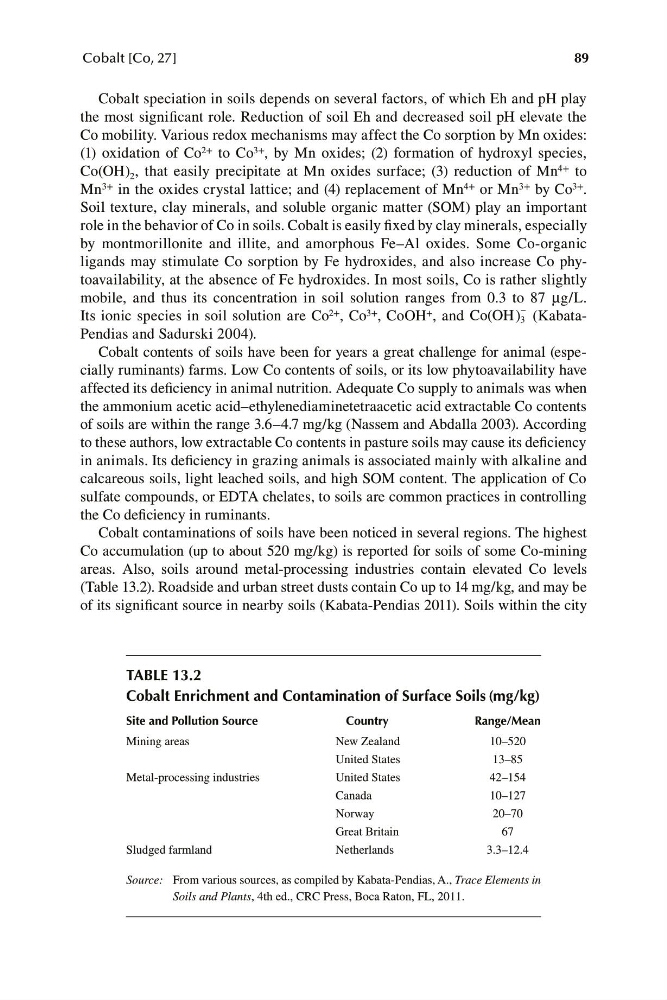
Cobalt contaminations of soils have been noticed in several regions. The highest
Co accumulation (up to about 520 mg/kg) is reported for soils of some Co-mining
areas. Also, soils around metal-processing industries contain elevated Co levels
(Table 13.2). Roadside and urban street dusts contain Co up to 14 mg/kg, and may be
of its significant source in nearby soils (Kabata-Pendias 2011). Soils within the city
TABLE 13.2
Cobalt Enrichment and Contamination of Surface Soils (mg/kg)
Site and Pollution Source
Country
Range/Mean
Mining areas
New Zealand
United States
10–520
13–85
Metal-processing industries
United States
Canada
42–154
10–127
Norway
Great Britain
20–70
67
Sludged farmland
Netherlands
3.3–12.4
Source: From various sources, as compiled by Kabata-Pendias, A., Trace Elements in
Soils and Plants, 4th ed., CRC Press, Boca Raton, FL, 2011.