

88
Trace Elements in Abiotic and Biotic Environments
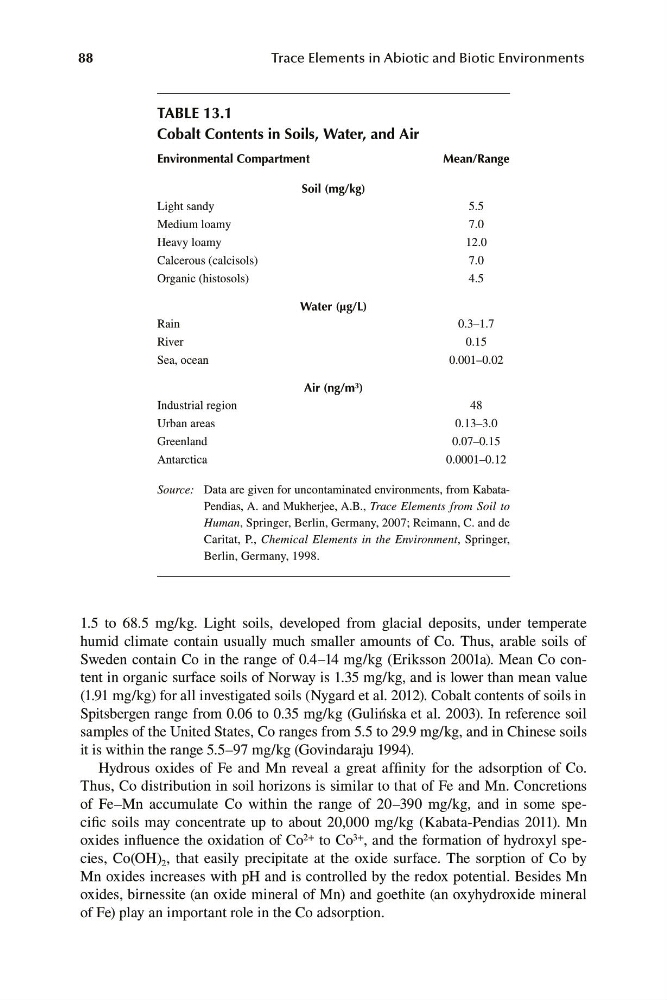
TABLE 13.1
Cobalt Contents in Soils, Water, and Air
Environmental Compartment
Mean/Range
Soil (mg/kg)
Light sandy
5.5
Medium loamy
7.0
Heavy loamy
12.0
Calcerous (calcisols)
7.0
Organic (histosols)
4.5
Water (μg/L)
Rain
0.3–1.7
River
0.15
Sea, ocean
0.001–0.02
Air (ng/m 3 )
Industrial region
48
Urban areas
0.13–3.0
Greenland
0.07–0.15
Antarctica
0.0001–0.12
Source: Data are given for uncontaminated environments, from KabataPendias, A. and Mukherjee, A.B., Trace Elements from Soil to
Human, Springer, Berlin, Germany, 2007; Reimann, C. and de
Caritat, P., Chemical Elements in the Environment, Springer,
Berlin, Germany, 1998.
1.5 to 68.5 mg/kg. Light soils, developed from glacial deposits, under temperate
humid climate contain usually much smaller amounts of Co. Thus, arable soils of
Sweden contain Co in the range of 0.4–14 mg/kg (Eriksson 2001a). Mean Co content in organic surface soils of Norway is 1.35 mg/kg, and is lower than mean value
(1.91 mg/kg) for all investigated soils (Nygard et al. 2012). Cobalt contents of soils in
Spitsbergen range from 0.06 to 0.35 mg/kg (Gulińska et al. 2003). In reference soil
samples of the United States, Co ranges from 5.5 to 29.9 mg/kg, and in Chinese soils
it is within the range 5.5–97 mg/kg (Govindaraju 1994).
Hydrous oxides of Fe and Mn reveal a great affinity for the adsorption of Co.
Thus, Co distribution in soil horizons is similar to that of Fe and Mn. Concretions
of Fe–Mn accumulate Co within the range of 20–390 mg/kg, and in some specific soils may concentrate up to about 20,000 mg/kg (Kabata-Pendias 2011). Mn
oxides influence the oxidation of Co 2+ to Co 3+ , and the formation of hydroxyl species, Co(OH) 2 , that easily precipitate at the oxide surface. The sorption of Co by
Mn oxides increases with pH and is controlled by the redox potential. Besides Mn
oxides, birnessite (an oxide mineral of Mn) and goethite (an oxyhydroxide mineral
of Fe) play an important role in the Co adsorption.