

Figure 12.3
poly(pphenylene) (PPP)
polyacetylene (PA)
polyaniline (PAni)
poly(3,4ethylene dioxythiophene) (PEDOT)
polythiophene (PPt)
polypyrrole (PPy)
n
n
N
(CH = CH)
NH
H
n
O
O
n
n
S
H
(a)
Doped State
Reduction
Oxidation
X
– counterion
H
N
H
N
x
–
+
n
S
H
H
N
Non doped state
H
N
H
N
H
N
(b)
242
Bacterial Cellulose
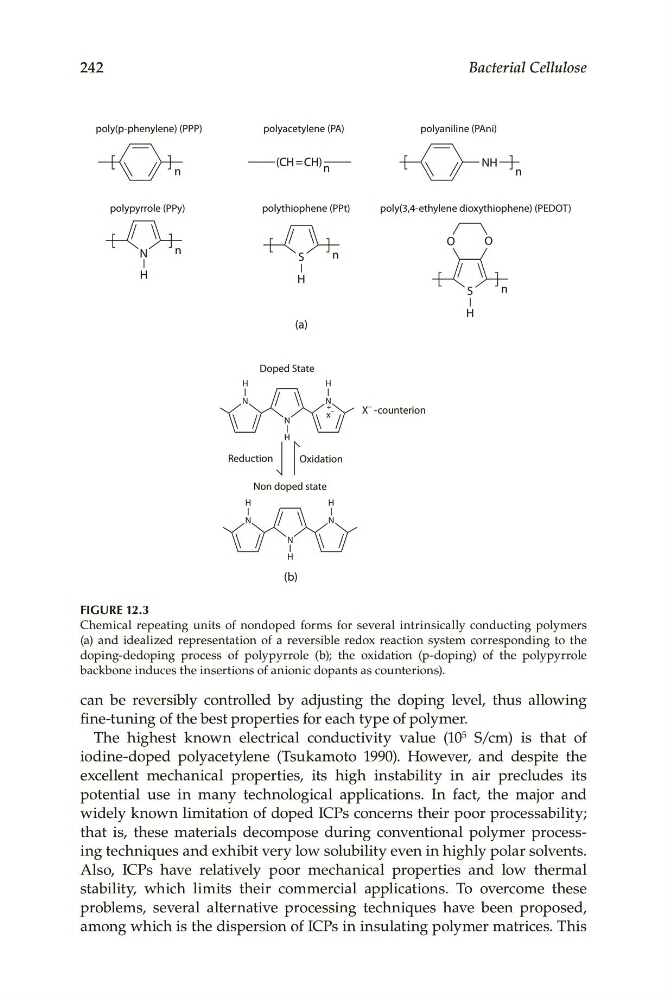
Figure 12.3
Chemical. repeating. units. of. nondoped. forms. for. several. intrinsically. conducting. p . olymers.
(a) and. idealized. representation. of. a. reversible. redox. reaction. system. corresponding. to. the.
. doping-dedoping. process. of. polypyrrole. (b);. the. oxidation. (p-doping). of. the. polypyrrole.
. backbone.induces.the.insertions.of.anionic.dopants.as.counterions).
can. be. reversibly. controlled. by. adjusting. the. doping. level,. thus. allowing.
fine-tuning.of.the.best.properties.for.each.type.of.polymer.
The. highest. known. electrical. conductivity. value. (10 5 . S/cm). is. that. of.
iodine-doped. polyacetylene. (Tsukamoto. 1990).. However,. and. despite. the.
excellent. mechanical. properties,. its. high. instability. in. air. precludes. its.
potential. use. in. many. technological. applications.. In. fact,. the. major. and.
widely.known.limitation.of.doped.ICPs.concerns.their.poor.processability;.
that. is,. these. materials. decompose. during. conventional. polymer. processing.techniques.and.exhibit.very.low.solubility.even.in.highly.polar.solvents..
Also,. ICPs. have. relatively. poor. mechanical. properties. and. low. thermal.
stability,. which. limits. their. commercial. applications.. To. overcome. these.
problems,. several. alternative. processing. techniques. have. been. proposed,.
among.which.is.the.dispersion.of.ICPs.in.insulating.polymer.matrices..This.
poly(pphenylene) (PPP)
polyacetylene (PA)
polyaniline (PAni)
poly(3,4ethylene dioxythiophene) (PEDOT)
polythiophene (PPt)
polypyrrole (PPy)
n
n
N
(CH = CH)
NH
H
n
O
O
n
n
S
H
(a)
Doped State
Reduction
Oxidation
X
– counterion
H
N
H
N
x
–
+
n
S
H
H
N
Non doped state
H
N
H
N
H
N
(b)
242
Bacterial Cellulose
Figure 12.3
Chemical. repeating. units. of. nondoped. forms. for. several. intrinsically. conducting. p . olymers.
(a) and. idealized. representation. of. a. reversible. redox. reaction. system. corresponding. to. the.
. doping-dedoping. process. of. polypyrrole. (b);. the. oxidation. (p-doping). of. the. polypyrrole.
. backbone.induces.the.insertions.of.anionic.dopants.as.counterions).
can. be. reversibly. controlled. by. adjusting. the. doping. level,. thus. allowing.
fine-tuning.of.the.best.properties.for.each.type.of.polymer.
The. highest. known. electrical. conductivity. value. (10 5 . S/cm). is. that. of.
iodine-doped. polyacetylene. (Tsukamoto. 1990).. However,. and. despite. the.
excellent. mechanical. properties,. its. high. instability. in. air. precludes. its.
potential. use. in. many. technological. applications.. In. fact,. the. major. and.
widely.known.limitation.of.doped.ICPs.concerns.their.poor.processability;.
that. is,. these. materials. decompose. during. conventional. polymer. processing.techniques.and.exhibit.very.low.solubility.even.in.highly.polar.solvents..
Also,. ICPs. have. relatively. poor. mechanical. properties. and. low. thermal.
stability,. which. limits. their. commercial. applications.. To. overcome. these.
problems,. several. alternative. processing. techniques. have. been. proposed,.
among.which.is.the.dispersion.of.ICPs.in.insulating.polymer.matrices..This.