

317
Natural Genetic Variation and Disease
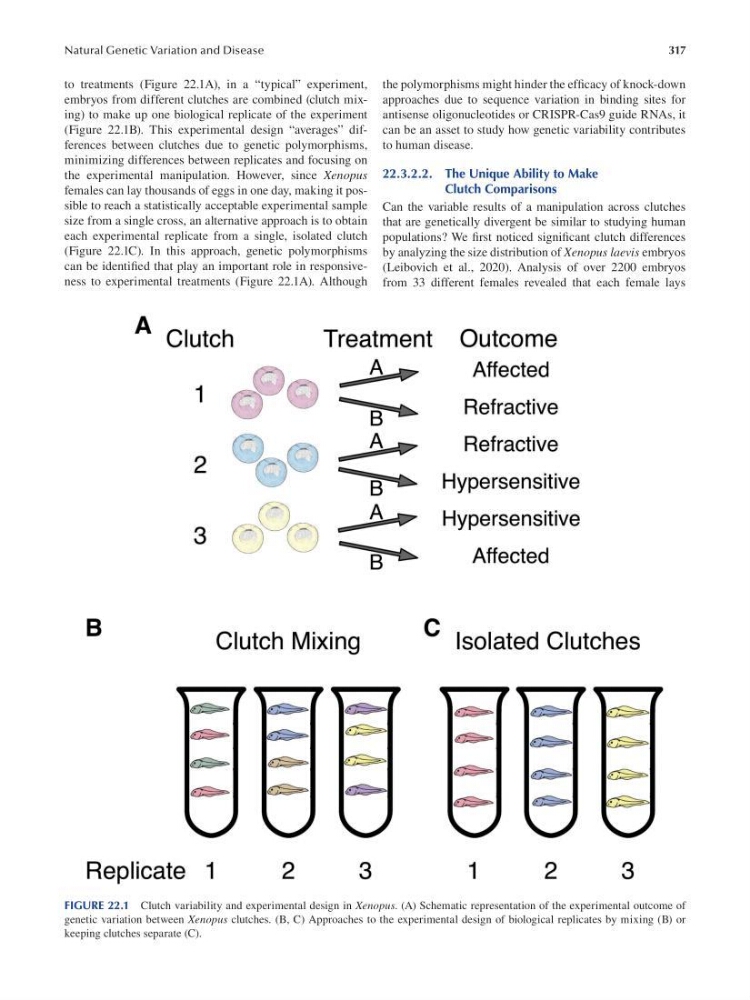
to treatments (Figure 22.1A), in a “typical” experiment,
embryos from different clutches are combined (clutch mixing) to make up one biological replicate of the experiment
(Figure 22.1B). This experimental design “averages” differences between clutches due to genetic polymorphisms,
minimizing differences between replicates and focusing on
the experimental manipulation. However, since Xenopus
females can lay thousands of eggs in one day, making it possible to reach a statistically acceptable experimental sample
size from a single cross, an alternative approach is to obtain
each experimental replicate from a single, isolated clutch
(Figure 22.1C ). In this approach, genetic polymorphisms
can be identifed that play an important role in responsiveness to experimental treatments (Figure 22.1A). Although
the polymorphisms might hinder the effcacy of knock-down
approaches due to sequence variation in binding sites for
antisense oligonucleotides or CRISPR-Cas9 guide RNAs, it
can be an asset to study how genetic variability contributes
to human disease.
22.3.2.2. The Unique Ability to Make
Clutch Comparisons
Can the variable results of a manipulation across clutches
that are genetically divergent be similar to studying human
populations? We frst noticed signifcant clutch differences
by analyzing the size distribution of Xenopus laevis embryos
( Leibovich et al., 2020 ). Analysis of over 2200 embryos
from 33 different females revealed that each female lays
FIGURE 22.1 Clutch variability and experimental design in Xenopus. (A) Schematic representation of the experimental outcome of
genetic variation between Xenopus clutches. (B, C) Approaches to the experimental design of biological replicates by mixing (B) or
keeping clutches separate (C).
Natural Genetic Variation and Disease
to treatments (Figure 22.1A), in a “typical” experiment,
embryos from different clutches are combined (clutch mixing) to make up one biological replicate of the experiment
(Figure 22.1B). This experimental design “averages” differences between clutches due to genetic polymorphisms,
minimizing differences between replicates and focusing on
the experimental manipulation. However, since Xenopus
females can lay thousands of eggs in one day, making it possible to reach a statistically acceptable experimental sample
size from a single cross, an alternative approach is to obtain
each experimental replicate from a single, isolated clutch
(Figure 22.1C ). In this approach, genetic polymorphisms
can be identifed that play an important role in responsiveness to experimental treatments (Figure 22.1A). Although
the polymorphisms might hinder the effcacy of knock-down
approaches due to sequence variation in binding sites for
antisense oligonucleotides or CRISPR-Cas9 guide RNAs, it
can be an asset to study how genetic variability contributes
to human disease.
22.3.2.2. The Unique Ability to Make
Clutch Comparisons
Can the variable results of a manipulation across clutches
that are genetically divergent be similar to studying human
populations? We frst noticed signifcant clutch differences
by analyzing the size distribution of Xenopus laevis embryos
( Leibovich et al., 2020 ). Analysis of over 2200 embryos
from 33 different females revealed that each female lays
FIGURE 22.1 Clutch variability and experimental design in Xenopus. (A) Schematic representation of the experimental outcome of
genetic variation between Xenopus clutches. (B, C) Approaches to the experimental design of biological replicates by mixing (B) or
keeping clutches separate (C).