

262
Xenopus
18.3.1. MATERNAL PRE-PATTERN PHASE
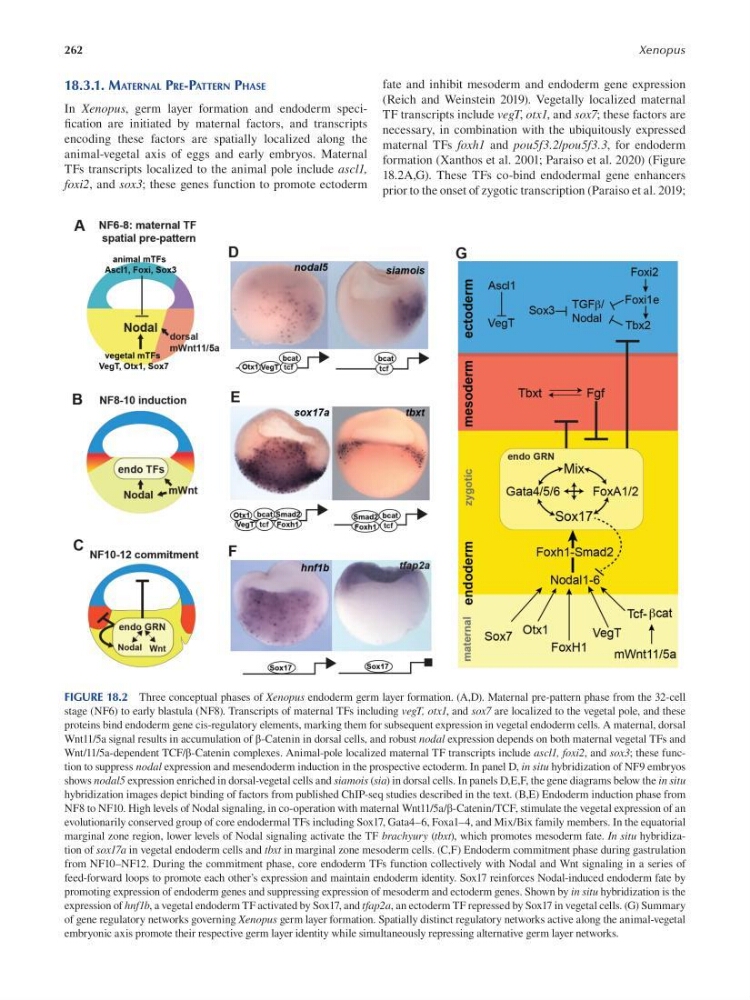
In Xenopus, germ layer formation and endoderm specifcation are initiated by maternal factors, and transcripts
encoding these factors are spatially localized along the
animal-vegetal axis of eggs and early embryos. Maternal
TFs transcripts localized to the animal pole include ascl1,
foxi2, and sox3; these genes function to promote ectoderm
fate and inhibit mesoderm and endoderm gene expression
(Reich and Weinstein 2019). Vegetally localized maternal
TF transcripts include vegT, otx1, and sox7; these factors are
necessary, in combination with the ubiquitously expressed
maternal TFs foxh1 and pou5f3.2/pou5f3.3, for endoderm
formation (Xanthos et al. 2001; Paraiso et al. 2020) (Figure
18.2A,G). These TFs co-bind endodermal gene enhancers
prior to the onset of zygotic transcription (Paraiso et al. 2019;
FIGURE 18.2 Three conceptual phases of Xenopus endoderm germ layer formation. (A,D). Maternal pre-pattern phase from the 32-cell
stage (NF6) to early blastula (NF8). Transcripts of maternal TFs including vegT, otx1, and sox7 are localized to the vegetal pole, and these
proteins bind endoderm gene cis-regulatory elements, marking them for subsequent expression in vegetal endoderm cells. A maternal, dorsal
Wnt11/5a signal results in accumulation of β-Catenin in dorsal cells, and robust nodal expression depends on both maternal vegetal TFs and
Wnt/11/5a-dependent TCF/β-Catenin complexes. Animal-pole localized maternal TF transcripts include ascl1, foxi2, and sox3; these function to suppress nodal expression and mesendoderm induction in the prospective ectoderm. In panel D, in situ hybridization of NF9 embryos
shows nodal5 expression enriched in dorsal-vegetal cells and siamois (sia) in dorsal cells. In panels D,E,F, the gene diagrams below the in situ
hybridization images depict binding of factors from published ChIP-seq studies described in the text. (B,E) Endoderm induction phase from
NF8 to NF10. High levels of Nodal signaling, in co-operation with maternal Wnt11/5a/β-Catenin/TCF, stimulate the vegetal expression of an
evolutionarily conserved group of core endodermal TFs including Sox17, Gata4–6, Foxa1–4, and Mix/Bix family members. In the equatorial
marginal zone region, lower levels of Nodal signaling activate the TF brachyury (tbxt), which promotes mesoderm fate. In situ hybridization of sox17a in vegetal endoderm cells and tbxt in marginal zone mesoderm cells. (C,F) Endoderm commitment phase during gastrulation
from NF10–NF12. During the commitment phase, core endoderm TFs function collectively with Nodal and Wnt signaling in a series of
feed-forward loops to promote each other’s expression and maintain endoderm identity. Sox17 reinforces Nodal-induced endoderm fate by
promoting expression of endoderm genes and suppressing expression of mesoderm and ectoderm genes. Shown by in situ hybridization is the
expression of hnf1b, a vegetal endoderm TF activated by Sox17, and tfap2a, an ectoderm TF repressed by Sox17 in vegetal cells. (G) Summary
of gene regulatory networks governing Xenopus germ layer formation. Spatially distinct regulatory networks active along the animal-vegetal
embryonic axis promote their respective germ layer identity while simultaneously repressing alternative germ layer networks.
Xenopus
18.3.1. MATERNAL PRE-PATTERN PHASE
In Xenopus, germ layer formation and endoderm specifcation are initiated by maternal factors, and transcripts
encoding these factors are spatially localized along the
animal-vegetal axis of eggs and early embryos. Maternal
TFs transcripts localized to the animal pole include ascl1,
foxi2, and sox3; these genes function to promote ectoderm
fate and inhibit mesoderm and endoderm gene expression
(Reich and Weinstein 2019). Vegetally localized maternal
TF transcripts include vegT, otx1, and sox7; these factors are
necessary, in combination with the ubiquitously expressed
maternal TFs foxh1 and pou5f3.2/pou5f3.3, for endoderm
formation (Xanthos et al. 2001; Paraiso et al. 2020) (Figure
18.2A,G). These TFs co-bind endodermal gene enhancers
prior to the onset of zygotic transcription (Paraiso et al. 2019;
FIGURE 18.2 Three conceptual phases of Xenopus endoderm germ layer formation. (A,D). Maternal pre-pattern phase from the 32-cell
stage (NF6) to early blastula (NF8). Transcripts of maternal TFs including vegT, otx1, and sox7 are localized to the vegetal pole, and these
proteins bind endoderm gene cis-regulatory elements, marking them for subsequent expression in vegetal endoderm cells. A maternal, dorsal
Wnt11/5a signal results in accumulation of β-Catenin in dorsal cells, and robust nodal expression depends on both maternal vegetal TFs and
Wnt/11/5a-dependent TCF/β-Catenin complexes. Animal-pole localized maternal TF transcripts include ascl1, foxi2, and sox3; these function to suppress nodal expression and mesendoderm induction in the prospective ectoderm. In panel D, in situ hybridization of NF9 embryos
shows nodal5 expression enriched in dorsal-vegetal cells and siamois (sia) in dorsal cells. In panels D,E,F, the gene diagrams below the in situ
hybridization images depict binding of factors from published ChIP-seq studies described in the text. (B,E) Endoderm induction phase from
NF8 to NF10. High levels of Nodal signaling, in co-operation with maternal Wnt11/5a/β-Catenin/TCF, stimulate the vegetal expression of an
evolutionarily conserved group of core endodermal TFs including Sox17, Gata4–6, Foxa1–4, and Mix/Bix family members. In the equatorial
marginal zone region, lower levels of Nodal signaling activate the TF brachyury (tbxt), which promotes mesoderm fate. In situ hybridization of sox17a in vegetal endoderm cells and tbxt in marginal zone mesoderm cells. (C,F) Endoderm commitment phase during gastrulation
from NF10–NF12. During the commitment phase, core endoderm TFs function collectively with Nodal and Wnt signaling in a series of
feed-forward loops to promote each other’s expression and maintain endoderm identity. Sox17 reinforces Nodal-induced endoderm fate by
promoting expression of endoderm genes and suppressing expression of mesoderm and ectoderm genes. Shown by in situ hybridization is the
expression of hnf1b, a vegetal endoderm TF activated by Sox17, and tfap2a, an ectoderm TF repressed by Sox17 in vegetal cells. (G) Summary
of gene regulatory networks governing Xenopus germ layer formation. Spatially distinct regulatory networks active along the animal-vegetal
embryonic axis promote their respective germ layer identity while simultaneously repressing alternative germ layer networks.