

261
Digestive and Respiratory System
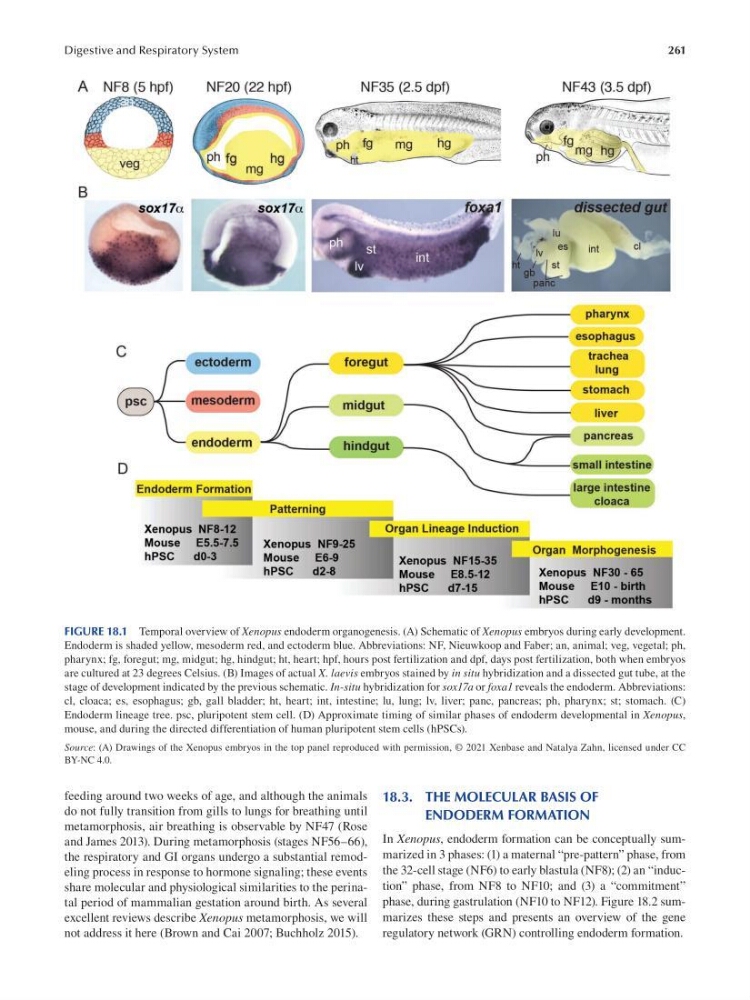
FIGURE 18.1 Temporal overview of Xenopus endoderm organogenesis. (A) Schematic of Xenopus embryos during early development.
Endoderm is shaded yellow, mesoderm red, and ectoderm blue. Abbreviations: NF, Nieuwkoop and Faber; an, animal; veg, vegetal; ph,
pharynx; fg, foregut; mg, midgut; hg, hindgut; ht, heart; hpf, hours post fertilization and dpf, days post fertilization, both when embryos
are cultured at 23 degrees Celsius. (B) Images of actual X. laevis embryos stained by in situ hybridization and a dissected gut tube, at the
stage of development indicated by the previous schematic. In-situ hybridization for sox17a or foxa1 reveals the endoderm. Abbreviations:
cl, cloaca; es, esophagus; gb, gall bladder; ht, heart; int, intestine; lu, lung; lv, liver; panc, pancreas; ph, pharynx; st; stomach. (C)
Endoderm lineage tree. psc, pluripotent stem cell. (D) Approximate timing of similar phases of endoderm developmental in Xenopus,
mouse, and during the directed differentiation of human pluripotent stem cells (hPSCs).
Source: (A) Drawings of the Xenopus embryos in the top panel reproduced with permission, © 2021 Xenbase and Natalya Zahn, licensed under CC
BY-NC 4.0.
feeding around two weeks of age, and although the animals
do not fully transition from gills to lungs for breathing until
metamorphosis, air breathing is observable by NF47 (Rose
and James 2013). During metamorphosis (stages NF56–66),
the respiratory and GI organs undergo a substantial remodeling process in response to hormone signaling; these events
share molecular and physiological similarities to the perinatal period of mammalian gestation around birth. As several
excellent reviews describe Xenopus metamorphosis, we will
not address it here (Brown and Cai 2007; Buchholz 2015).
18.3. THE MOLECULAR BASIS OF
ENDODERM FORMATION
In Xenopus, endoderm formation can be conceptually summarized in 3 phases: (1) a maternal “pre-pattern” phase, from
the 32-cell stage (NF6) to early blastula (NF8); (2) an “induction” phase, from NF8 to NF10; and (3) a “commitment”
phase, during gastrulation (NF10 to NF12). Figure 18.2 summarizes these steps and presents an overview of the gene
regulatory network (GRN) controlling endoderm formation.
Digestive and Respiratory System
FIGURE 18.1 Temporal overview of Xenopus endoderm organogenesis. (A) Schematic of Xenopus embryos during early development.
Endoderm is shaded yellow, mesoderm red, and ectoderm blue. Abbreviations: NF, Nieuwkoop and Faber; an, animal; veg, vegetal; ph,
pharynx; fg, foregut; mg, midgut; hg, hindgut; ht, heart; hpf, hours post fertilization and dpf, days post fertilization, both when embryos
are cultured at 23 degrees Celsius. (B) Images of actual X. laevis embryos stained by in situ hybridization and a dissected gut tube, at the
stage of development indicated by the previous schematic. In-situ hybridization for sox17a or foxa1 reveals the endoderm. Abbreviations:
cl, cloaca; es, esophagus; gb, gall bladder; ht, heart; int, intestine; lu, lung; lv, liver; panc, pancreas; ph, pharynx; st; stomach. (C)
Endoderm lineage tree. psc, pluripotent stem cell. (D) Approximate timing of similar phases of endoderm developmental in Xenopus,
mouse, and during the directed differentiation of human pluripotent stem cells (hPSCs).
Source: (A) Drawings of the Xenopus embryos in the top panel reproduced with permission, © 2021 Xenbase and Natalya Zahn, licensed under CC
BY-NC 4.0.
feeding around two weeks of age, and although the animals
do not fully transition from gills to lungs for breathing until
metamorphosis, air breathing is observable by NF47 (Rose
and James 2013). During metamorphosis (stages NF56–66),
the respiratory and GI organs undergo a substantial remodeling process in response to hormone signaling; these events
share molecular and physiological similarities to the perinatal period of mammalian gestation around birth. As several
excellent reviews describe Xenopus metamorphosis, we will
not address it here (Brown and Cai 2007; Buchholz 2015).
18.3. THE MOLECULAR BASIS OF
ENDODERM FORMATION
In Xenopus, endoderm formation can be conceptually summarized in 3 phases: (1) a maternal “pre-pattern” phase, from
the 32-cell stage (NF6) to early blastula (NF8); (2) an “induction” phase, from NF8 to NF10; and (3) a “commitment”
phase, during gastrulation (NF10 to NF12). Figure 18.2 summarizes these steps and presents an overview of the gene
regulatory network (GRN) controlling endoderm formation.