

248
Xenopus
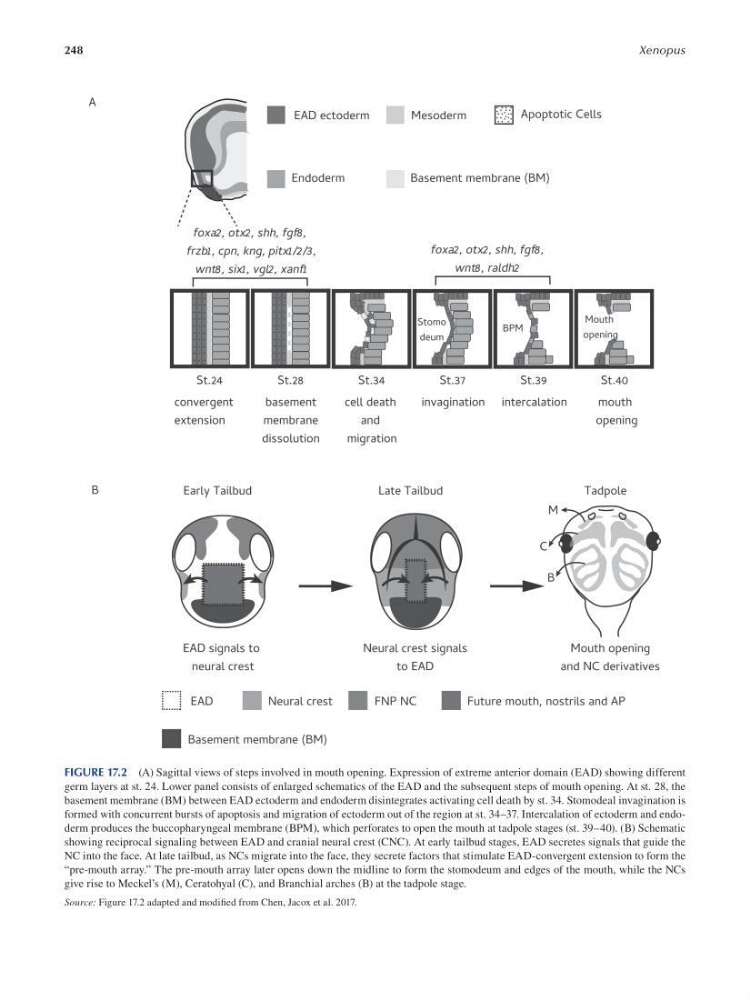
FIGURE 17.2 (A) Sagittal views of steps involved in mouth opening. Expression of extreme anterior domain (EAD) showing different
germ layers at st. 24. Lower panel consists of enlarged schematics of the EAD and the subsequent steps of mouth opening. At st. 28, the
basement membrane (BM) between EAD ectoderm and endoderm disintegrates activating cell death by st. 34. Stomodeal invagination is
formed with concurrent bursts of apoptosis and migration of ectoderm out of the region at st. 34–37. Intercalation of ectoderm and endoderm produces the buccopharyngeal membrane (BPM), which perforates to open the mouth at tadpole stages (st. 39–40). (B) Schematic
showing reciprocal signaling between EAD and cranial neural crest (CNC). At early tailbud stages, EAD secretes signals that guide the
NC into the face. At late tailbud, as NCs migrate into the face, they secrete factors that stimulate EAD-convergent extension to form the
“pre-mouth array.” The pre-mouth array later opens down the midline to form the stomodeum and edges of the mouth, while the NCs
give rise to Meckel’s (M), Ceratohyal (C), and Branchial arches (B) at the tadpole stage.
Source: Figure 17.2 adapted and modifed from Chen, Jacox et al. 2017.
Xenopus
FIGURE 17.2 (A) Sagittal views of steps involved in mouth opening. Expression of extreme anterior domain (EAD) showing different
germ layers at st. 24. Lower panel consists of enlarged schematics of the EAD and the subsequent steps of mouth opening. At st. 28, the
basement membrane (BM) between EAD ectoderm and endoderm disintegrates activating cell death by st. 34. Stomodeal invagination is
formed with concurrent bursts of apoptosis and migration of ectoderm out of the region at st. 34–37. Intercalation of ectoderm and endoderm produces the buccopharyngeal membrane (BPM), which perforates to open the mouth at tadpole stages (st. 39–40). (B) Schematic
showing reciprocal signaling between EAD and cranial neural crest (CNC). At early tailbud stages, EAD secretes signals that guide the
NC into the face. At late tailbud, as NCs migrate into the face, they secrete factors that stimulate EAD-convergent extension to form the
“pre-mouth array.” The pre-mouth array later opens down the midline to form the stomodeum and edges of the mouth, while the NCs
give rise to Meckel’s (M), Ceratohyal (C), and Branchial arches (B) at the tadpole stage.
Source: Figure 17.2 adapted and modifed from Chen, Jacox et al. 2017.