

229
Formation of the Left-Right Axis
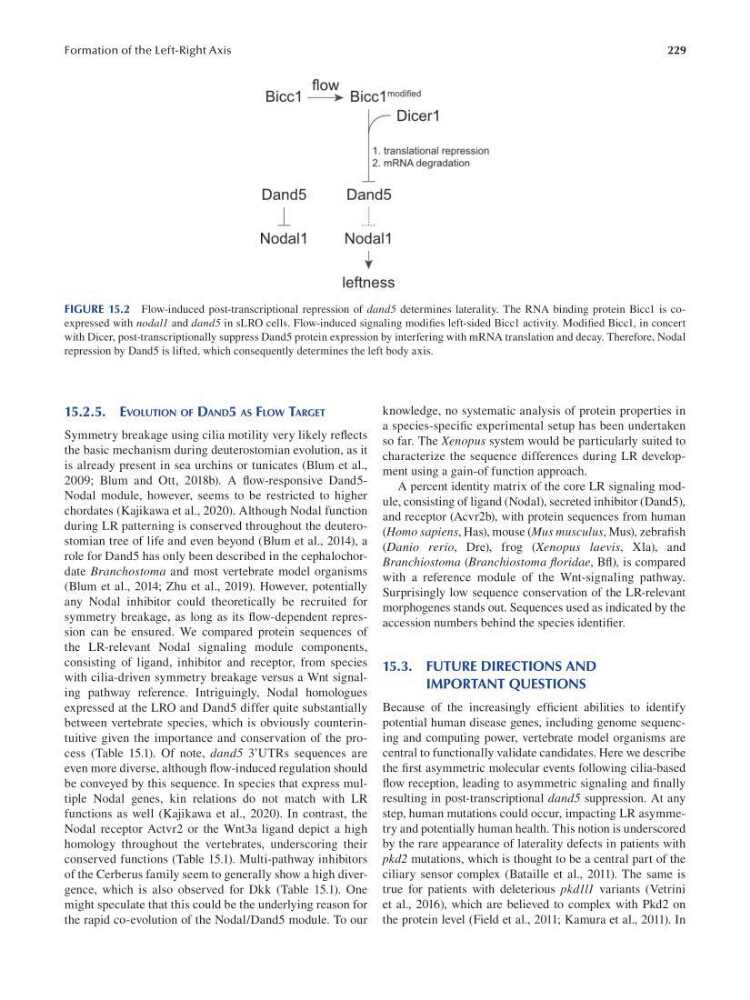
FIGURE 15.2 Flow-induced post-transcriptional repression of dand5 determines laterality. The RNA binding protein Bicc1 is coexpressed with nodal1 and dand5 in sLRO cells. Flow-induced signaling modifes left-sided Bicc1 activity. Modifed Bicc1, in concert
with Dicer, post-transcriptionally suppress Dand5 protein expression by interfering with mRNA translation and decay. Therefore, Nodal
repression by Dand5 is lifted, which consequently determines the left body axis.
15.2.5. EVOLUTION OF DAND5 AS FLOW TARGET
Symmetry breakage using cilia motility very likely ref ects
the basic mechanism during deuterostomian evolution, as it
is already present in sea urchins or tunicates (Blum et al.,
2009; Blum and Ott, 2018b). A f ow-responsive Dand5Nodal module, however, seems to be restricted to higher
chordates (Kajikawa et al., 2020). Although Nodal function
during LR patterning is conserved throughout the deuterostomian tree of life and even beyond (Blum et al., 2014), a
role for Dand5 has only been described in the cephalochordate Branchostoma and most vertebrate model organisms
(Blum et al., 2014; Zhu et al., 2019). However, potentially
any Nodal inhibitor could theoretically be recruited for
symmetry breakage, as long as its f ow-dependent repression can be ensured. We compared protein sequences of
the LR-relevant Nodal signaling module components,
consisting of ligand, inhibitor and receptor, from species
with cilia-driven symmetry breakage versus a Wnt signaling pathway reference. Intriguingly, Nodal homologues
expressed at the LRO and Dand5 differ quite substantially
between vertebrate species, which is obviously counterintuitive given the importance and conservation of the process (Table 15.1). Of note, dand5 3’UTRs sequences are
even more diverse, although fow-induced regulation should
be conveyed by this sequence. In species that express multiple Nodal genes, kin relations do not match with LR
functions as well (Kajikawa et al., 2020). In contrast, the
Nodal receptor Actvr2 or the Wnt3a ligand depict a high
homology throughout the vertebrates, underscoring their
conserved functions (Table 15.1). Multi-pathway inhibitors
of the Cerberus family seem to generally show a high divergence, which is also observed for Dkk (Table 15.1). One
might speculate that this could be the underlying reason for
the rapid co-evolution of the Nodal/Dand5 module. To our
knowledge, no systematic analysis of protein properties in
a species-specifc experimental setup has been undertaken
so far. The Xenopus system would be particularly suited to
characterize the sequence differences during LR development using a gain-of function approach.
A percent identity matrix of the core LR signaling module, consisting of ligand (Nodal), secreted inhibitor (Dand5),
and receptor (Acvr2b), with protein sequences from human
(Homo sapiens, Has), mouse (Mus musculus, Mus), zebraf sh
(Danio rerio, Dre), frog (Xenopus laevis, Xla), and
Branchiostoma (Branchiostoma foridae, Bf), is compared
with a reference module of the Wnt-signaling pathway.
Surprisingly low sequence conservation of the LR-relevant
morphogenes stands out. Sequences used as indicated by the
accession numbers behind the species identif er.
15.3. FUTURE DIRECTIONS AND
IMPORTANT QUESTIONS
Because of the increasingly effcient abilities to identify
potential human disease genes, including genome sequencing and computing power, vertebrate model organisms are
central to functionally validate candidates. Here we describe
the f rst asymmetric molecular events following cilia-based
fow reception, leading to asymmetric signaling and f nally
resulting in post-transcriptional dand5 suppression. At any
step, human mutations could occur, impacting LR asymmetry and potentially human health. This notion is underscored
by the rare appearance of laterality defects in patients with
pkd2 mutations, which is thought to be a central part of the
ciliary sensor complex (Bataille et al., 2011). The same is
true for patients with deleterious pkd1l1 variants (Vetrini
et al., 2016), which are believed to complex with Pkd2 on
the protein level (Field et al., 2011; Kamura et al., 2011). In
Formation of the Left-Right Axis
FIGURE 15.2 Flow-induced post-transcriptional repression of dand5 determines laterality. The RNA binding protein Bicc1 is coexpressed with nodal1 and dand5 in sLRO cells. Flow-induced signaling modifes left-sided Bicc1 activity. Modifed Bicc1, in concert
with Dicer, post-transcriptionally suppress Dand5 protein expression by interfering with mRNA translation and decay. Therefore, Nodal
repression by Dand5 is lifted, which consequently determines the left body axis.
15.2.5. EVOLUTION OF DAND5 AS FLOW TARGET
Symmetry breakage using cilia motility very likely ref ects
the basic mechanism during deuterostomian evolution, as it
is already present in sea urchins or tunicates (Blum et al.,
2009; Blum and Ott, 2018b). A f ow-responsive Dand5Nodal module, however, seems to be restricted to higher
chordates (Kajikawa et al., 2020). Although Nodal function
during LR patterning is conserved throughout the deuterostomian tree of life and even beyond (Blum et al., 2014), a
role for Dand5 has only been described in the cephalochordate Branchostoma and most vertebrate model organisms
(Blum et al., 2014; Zhu et al., 2019). However, potentially
any Nodal inhibitor could theoretically be recruited for
symmetry breakage, as long as its f ow-dependent repression can be ensured. We compared protein sequences of
the LR-relevant Nodal signaling module components,
consisting of ligand, inhibitor and receptor, from species
with cilia-driven symmetry breakage versus a Wnt signaling pathway reference. Intriguingly, Nodal homologues
expressed at the LRO and Dand5 differ quite substantially
between vertebrate species, which is obviously counterintuitive given the importance and conservation of the process (Table 15.1). Of note, dand5 3’UTRs sequences are
even more diverse, although fow-induced regulation should
be conveyed by this sequence. In species that express multiple Nodal genes, kin relations do not match with LR
functions as well (Kajikawa et al., 2020). In contrast, the
Nodal receptor Actvr2 or the Wnt3a ligand depict a high
homology throughout the vertebrates, underscoring their
conserved functions (Table 15.1). Multi-pathway inhibitors
of the Cerberus family seem to generally show a high divergence, which is also observed for Dkk (Table 15.1). One
might speculate that this could be the underlying reason for
the rapid co-evolution of the Nodal/Dand5 module. To our
knowledge, no systematic analysis of protein properties in
a species-specifc experimental setup has been undertaken
so far. The Xenopus system would be particularly suited to
characterize the sequence differences during LR development using a gain-of function approach.
A percent identity matrix of the core LR signaling module, consisting of ligand (Nodal), secreted inhibitor (Dand5),
and receptor (Acvr2b), with protein sequences from human
(Homo sapiens, Has), mouse (Mus musculus, Mus), zebraf sh
(Danio rerio, Dre), frog (Xenopus laevis, Xla), and
Branchiostoma (Branchiostoma foridae, Bf), is compared
with a reference module of the Wnt-signaling pathway.
Surprisingly low sequence conservation of the LR-relevant
morphogenes stands out. Sequences used as indicated by the
accession numbers behind the species identif er.
15.3. FUTURE DIRECTIONS AND
IMPORTANT QUESTIONS
Because of the increasingly effcient abilities to identify
potential human disease genes, including genome sequencing and computing power, vertebrate model organisms are
central to functionally validate candidates. Here we describe
the f rst asymmetric molecular events following cilia-based
fow reception, leading to asymmetric signaling and f nally
resulting in post-transcriptional dand5 suppression. At any
step, human mutations could occur, impacting LR asymmetry and potentially human health. This notion is underscored
by the rare appearance of laterality defects in patients with
pkd2 mutations, which is thought to be a central part of the
ciliary sensor complex (Bataille et al., 2011). The same is
true for patients with deleterious pkd1l1 variants (Vetrini
et al., 2016), which are believed to complex with Pkd2 on
the protein level (Field et al., 2011; Kamura et al., 2011). In