

dll1
notch1/psen1/RBPJ
Gene
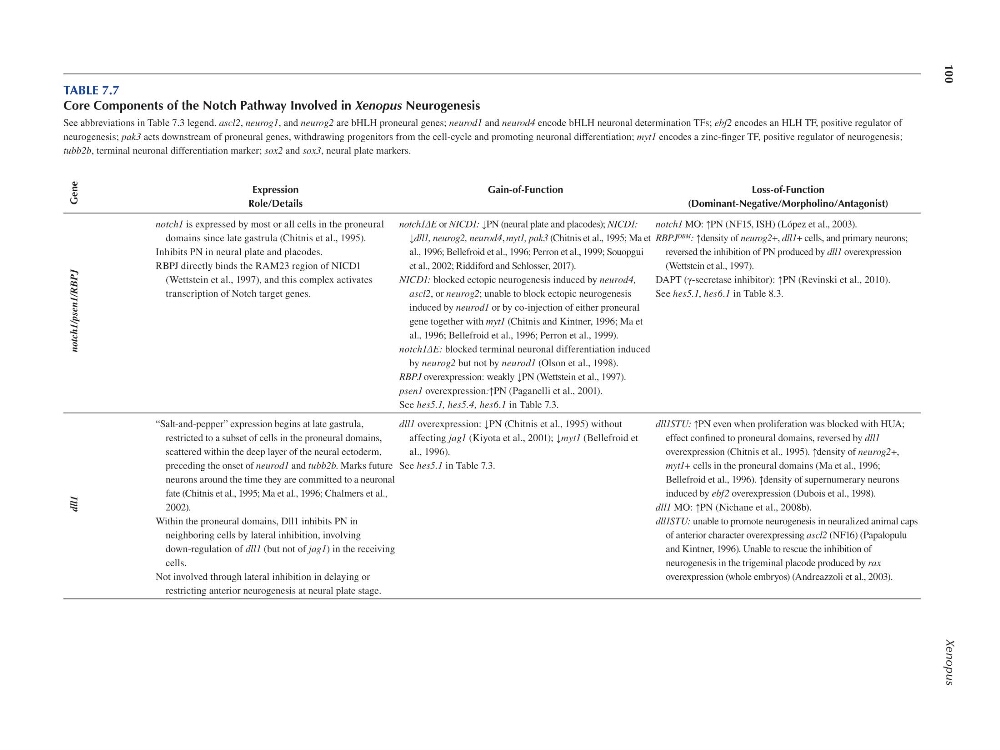
TABLE 7.7
Core Components of the Notch Pathway Involved in Xenopus Neurogenesis
See abbreviations in Table 7.3 legend. ascl2, neurog1, and neurog2 are bHLH proneural genes; neurod1 and neurod4 encode bHLH neuronal determination TFs; ebf2 encodes an HLH TF, positive regulator of
neurogenesis; pak3 acts downstream of proneural genes, withdrawing progenitors from the cell-cycle and promoting neuronal differentiation; myt1 encodes a zinc-f nger TF, positive regulator of neurogenesis;
tubb2b, terminal neuronal differentiation marker; sox2 and sox3, neural plate markers.
Expression
Gain-of-Function
Loss-of-Function
Role/Details
(Dominant-Negative/Morpholino/Antagonist)
notch1 is expressed by most or all cells in the proneural
domains since late gastrula (Chitnis et al., 1995 ).
Inhibits PN in neural plate and placodes.
RBPJ directly binds the RAM23 region of NICD1
(Wettstein et al., 1997), and this complex activates
transcription of Notch target genes.
notch1ΔE or NICD1: ↓PN (neural plate and placodes); NICD1:
↓
neurog2, neurod4
dll1,
, myt1, pak3 (Chitnis et al., 1995; Ma et
al., 1996; Bellefroid et al., 1996; Perron et al., 1999; Souopgui
et al., 2002; Riddiford and Schlosser, 2017).
NICD1: blocked ectopic neurogenesis induced by neurod4,
ascl2, or neurog2; unable to block ectopic neurogenesis
induced by neurod1 or by co-injection of either proneural
gene together with myt1 (Chitnis and Kintner, 1996; Ma et
al., 1996; Bellefroid et al., 1996; Perron et al., 1999).
notch1ΔE: blocked terminal neuronal differentiation induced
by neurog2 but not by neurod1 (Olson et al., 1998).
RBPJ overexpression: weakly ↓PN ( Wettstein et al., 1997 ).
psen1 overexpression:↑PN (Paganelli et al., 2001).
See hes5.1, hes5.4, hes6.1 in Table 7.3 .
notch1 MO: ↑PN (NF15, ISH) (López et al., 2003).
RBPJ DBM : ↑density of neurog2+, dll1+ cells, and primary neurons;
reversed the inhibition of PN produced by dll1 overexpression
( Wettstein et al., 1997 ).
DAPT ( γ -secretase inhibitor): ↑PN ( Revinski et al., 2010 ).
See hes5.1, hes6.1 in Table 8.3.
“Salt-and-pepper” expression begins at late gastrula,
restricted to a subset of cells in the proneural domains,
scattered within the deep layer of the neural ectoderm,
preceding the onset of neurod1 and tubb2b. Marks future
neurons around the time they are committed to a neuronal
fate (Chitnis et al., 1995; Ma et al., 1996; Chalmers et al.,
2002 ).
Within the proneural domains, Dll1 inhibits PN in
neighboring cells by lateral inhibition, involving
down-regulation of dll1 (but not of jag1) in the receiving
cells.
Not involved through lateral inhibition in delaying or
restricting anterior neurogenesis at neural plate stage.
dll1 overexpression: ↓PN (Chitnis et al., 1995 ) without
affecting jag1 (Kiyota et al., 2001); ↓myt1 ( Bellefroid et
al., 1996).
See hes5.1 in Table 7.3 .
dll1 STU : ↑PN even when proliferation was blocked with HUA;
effect conf ned to proneural domains, reversed by dll1
overexpression (Chitnis et al., 1995 ). ↑density of neurog2+,
myt1+ cells in the proneural domains (Ma et al., 1996;
Bellefroid et al., 1996). ↑density of supernumerary neurons
induced by ebf2 overexpression (Dubois et al., 1998).
dll1 MO: ↑PN (Nichane et al., 2008b).
dll1 STU : unable to promote neurogenesis in neuralized animal caps
of anterior character overexpressing ascl2 (NF16) ( Papalopulu
and Kintner, 1996). Unable to rescue the inhibition of
neurogenesis in the trigeminal placode produced by rax
overexpression (whole embryos) (Andreazzoli et al., 2003).
100
Xenopus
notch1/psen1/RBPJ
Gene
TABLE 7.7
Core Components of the Notch Pathway Involved in Xenopus Neurogenesis
See abbreviations in Table 7.3 legend. ascl2, neurog1, and neurog2 are bHLH proneural genes; neurod1 and neurod4 encode bHLH neuronal determination TFs; ebf2 encodes an HLH TF, positive regulator of
neurogenesis; pak3 acts downstream of proneural genes, withdrawing progenitors from the cell-cycle and promoting neuronal differentiation; myt1 encodes a zinc-f nger TF, positive regulator of neurogenesis;
tubb2b, terminal neuronal differentiation marker; sox2 and sox3, neural plate markers.
Expression
Gain-of-Function
Loss-of-Function
Role/Details
(Dominant-Negative/Morpholino/Antagonist)
notch1 is expressed by most or all cells in the proneural
domains since late gastrula (Chitnis et al., 1995 ).
Inhibits PN in neural plate and placodes.
RBPJ directly binds the RAM23 region of NICD1
(Wettstein et al., 1997), and this complex activates
transcription of Notch target genes.
notch1ΔE or NICD1: ↓PN (neural plate and placodes); NICD1:
↓
neurog2, neurod4
dll1,
, myt1, pak3 (Chitnis et al., 1995; Ma et
al., 1996; Bellefroid et al., 1996; Perron et al., 1999; Souopgui
et al., 2002; Riddiford and Schlosser, 2017).
NICD1: blocked ectopic neurogenesis induced by neurod4,
ascl2, or neurog2; unable to block ectopic neurogenesis
induced by neurod1 or by co-injection of either proneural
gene together with myt1 (Chitnis and Kintner, 1996; Ma et
al., 1996; Bellefroid et al., 1996; Perron et al., 1999).
notch1ΔE: blocked terminal neuronal differentiation induced
by neurog2 but not by neurod1 (Olson et al., 1998).
RBPJ overexpression: weakly ↓PN ( Wettstein et al., 1997 ).
psen1 overexpression:↑PN (Paganelli et al., 2001).
See hes5.1, hes5.4, hes6.1 in Table 7.3 .
notch1 MO: ↑PN (NF15, ISH) (López et al., 2003).
RBPJ DBM : ↑density of neurog2+, dll1+ cells, and primary neurons;
reversed the inhibition of PN produced by dll1 overexpression
( Wettstein et al., 1997 ).
DAPT ( γ -secretase inhibitor): ↑PN ( Revinski et al., 2010 ).
See hes5.1, hes6.1 in Table 8.3.
“Salt-and-pepper” expression begins at late gastrula,
restricted to a subset of cells in the proneural domains,
scattered within the deep layer of the neural ectoderm,
preceding the onset of neurod1 and tubb2b. Marks future
neurons around the time they are committed to a neuronal
fate (Chitnis et al., 1995; Ma et al., 1996; Chalmers et al.,
2002 ).
Within the proneural domains, Dll1 inhibits PN in
neighboring cells by lateral inhibition, involving
down-regulation of dll1 (but not of jag1) in the receiving
cells.
Not involved through lateral inhibition in delaying or
restricting anterior neurogenesis at neural plate stage.
dll1 overexpression: ↓PN (Chitnis et al., 1995 ) without
affecting jag1 (Kiyota et al., 2001); ↓myt1 ( Bellefroid et
al., 1996).
See hes5.1 in Table 7.3 .
dll1 STU : ↑PN even when proliferation was blocked with HUA;
effect conf ned to proneural domains, reversed by dll1
overexpression (Chitnis et al., 1995 ). ↑density of neurog2+,
myt1+ cells in the proneural domains (Ma et al., 1996;
Bellefroid et al., 1996). ↑density of supernumerary neurons
induced by ebf2 overexpression (Dubois et al., 1998).
dll1 MO: ↑PN (Nichane et al., 2008b).
dll1 STU : unable to promote neurogenesis in neuralized animal caps
of anterior character overexpressing ascl2 (NF16) ( Papalopulu
and Kintner, 1996). Unable to rescue the inhibition of
neurogenesis in the trigeminal placode produced by rax
overexpression (whole embryos) (Andreazzoli et al., 2003).
100
Xenopus