

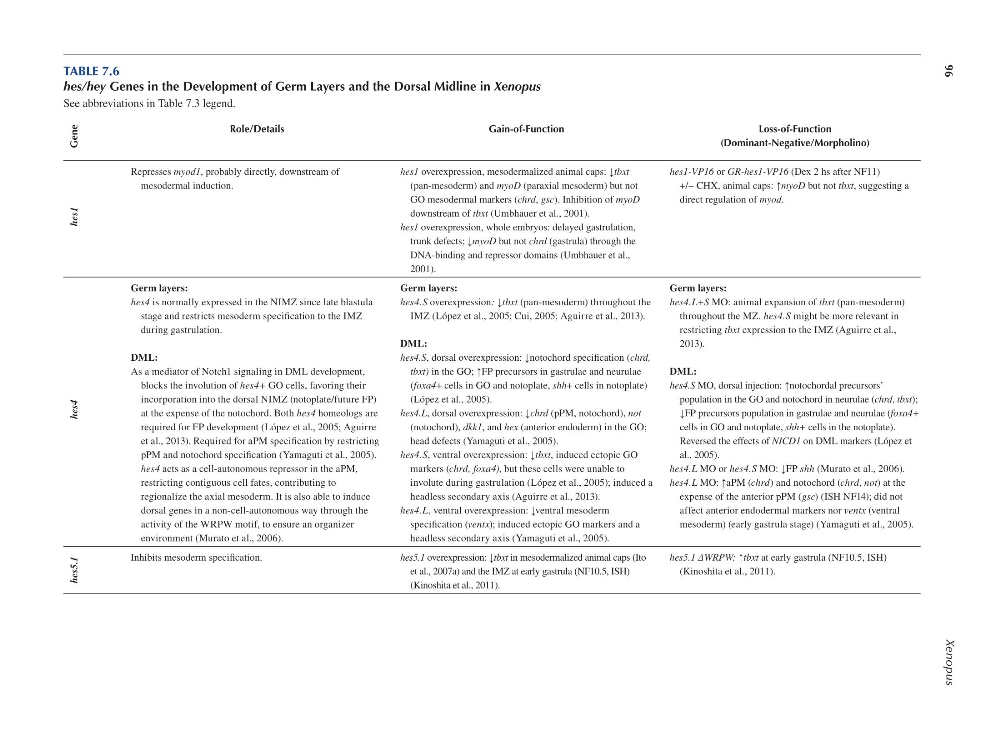
TABLE 7.6
hes/hey Genes in the Development of Germ Layers and the Dorsal Midline in Xenopus
See abbreviations in Table 7.3 legend.
Role/Details
Gain-of-Function
Loss-of-Function
(Dominant-Negative/Morpholino)
hes5.1
hes4
hes1
Gene
Represses myod1, probably directly, downstream of
mesodermal induction.
hes1 overexpression, mesodermalized animal caps: ↓tbxt
(pan-mesoderm) and myoD (paraxial mesoderm) but not
GO mesodermal markers ( chrd, gsc). Inhibition of myoD
downstream of tbxt ( Umbhauer et al., 2001 ).
hes1 overexpression, whole embryos: delayed gastrulation,
trunk defects; ↓myoD but not chrd (gastrula) through the
DNA-binding and repressor domains ( Umbhauer et al.,
2001 ).
hes1-VP16 or GR-hes1-VP16 (Dex 2 hs after NF11)
+/− CHX, animal caps: ↑myoD but not tbxt, suggesting a
direct regulation of myod.
Germ layers:
hes4 is normally expressed in the NIMZ since late blastula
stage and restricts mesoderm specif cation to the IMZ
during gastrulation.
DML:
As a mediator of Notch1 signaling in DML development,
blocks the involution of hes4+ GO cells, favoring their
incorporation into the dorsal NIMZ (notoplate/future FP)
at the expense of the notochord. Both hes4 homeologs are
required for FP development (López et al., 2005; Aguirre
et al., 2013). Required for aPM specif cation by restricting
pPM and notochord specif cation (Yamaguti et al., 2005 ).
hes4 acts as a cell-autonomous repressor in the aPM,
restricting contiguous cell fates, contributing to
regionalize the axial mesoderm. It is also able to induce
dorsal genes in a non-cell-autonomous way through the
activity of the WRPW motif, to ensure an organizer
environment (Murato et al., 2006).
Germ layers:
hes4.S overexpression: ↓tbxt (pan-mesoderm) throughout the
IMZ (López et al., 2005; Cui, 2005; Aguirre et al., 2013).
DML:
hes4.S, dorsal overexpression: ↓notochord specif cation ( chrd,
tbxt) in the GO; ↑FP precursors in gastrulae and neurulae
(foxa4+ cells in GO and notoplate, shh+ cells in notoplate)
( López et al., 2005 ).
hes4.L, dorsal overexpression : ↓chrd (pPM, notochord), not
(notochord), dkk1, and hex (anterior endoderm) in the GO;
head defects ( Yamaguti et al., 2005 ).
hes4.S, ventral overexpression: ↓tbxt, induced ectopic GO
markers (chrd, foxa4), but these cells were unable to
involute during gastrulation (López et al., 2005 ); induced a
headless secondary axis (Aguirre et al., 2013).
hes4.L, ventral overexpression: ↓ventral mesoderm
specif cation (ventx); induced ectopic GO markers and a
headless secondary axis (Yamaguti et al., 2005 ).
Germ layers:
hes4.L+S MO: animal expansion of tbxt (pan-mesoderm)
throughout the MZ. hes4.S might be more relevant in
restricting tbxt expression to the IMZ (Aguirre et al.,
2013 ).
DML:
hes4.S MO, dorsal injection : ↑notochordal precursors’
population in the GO and notochord in neurulae (chrd, tbxt);
↓ precursors population in gastrulae and neurulae (
FP
foxa4+
cells in GO and notoplate, shh+ cells in the notoplate).
Reversed the effects of NICD1 on DML markers ( López et
al., 2005 ).
hes4.L MO or hes4.S MO: ↓FP shh (Murato et al., 2006).
hes4.L MO: ↑aPM (chrd) and notochord (chrd, not) at the
expense of the anterior pPM (gsc) (ISH NF14); did not
affect anterior endodermal markers nor ventx (ventral
mesoderm) (early gastrula stage) (Yamaguti et al., 2005 ).
Inhibits mesoderm specif cation.
hes5.1 overexpression: ↓tbxt in mesodermalized animal caps ( Ito
hes5.1 ΔWRPW: ↑tbxt at early gastrula (NF10.5, ISH)
et al., 2007a ) and the IMZ at early gastrula (NF10.5, ISH)
( Kinoshita et al., 2011 ).
( Kinoshita et al., 2011 ).
96
Xenopus
hes/hey Genes in the Development of Germ Layers and the Dorsal Midline in Xenopus
See abbreviations in Table 7.3 legend.
Role/Details
Gain-of-Function
Loss-of-Function
(Dominant-Negative/Morpholino)
hes5.1
hes4
hes1
Gene
Represses myod1, probably directly, downstream of
mesodermal induction.
hes1 overexpression, mesodermalized animal caps: ↓tbxt
(pan-mesoderm) and myoD (paraxial mesoderm) but not
GO mesodermal markers ( chrd, gsc). Inhibition of myoD
downstream of tbxt ( Umbhauer et al., 2001 ).
hes1 overexpression, whole embryos: delayed gastrulation,
trunk defects; ↓myoD but not chrd (gastrula) through the
DNA-binding and repressor domains ( Umbhauer et al.,
2001 ).
hes1-VP16 or GR-hes1-VP16 (Dex 2 hs after NF11)
+/− CHX, animal caps: ↑myoD but not tbxt, suggesting a
direct regulation of myod.
Germ layers:
hes4 is normally expressed in the NIMZ since late blastula
stage and restricts mesoderm specif cation to the IMZ
during gastrulation.
DML:
As a mediator of Notch1 signaling in DML development,
blocks the involution of hes4+ GO cells, favoring their
incorporation into the dorsal NIMZ (notoplate/future FP)
at the expense of the notochord. Both hes4 homeologs are
required for FP development (López et al., 2005; Aguirre
et al., 2013). Required for aPM specif cation by restricting
pPM and notochord specif cation (Yamaguti et al., 2005 ).
hes4 acts as a cell-autonomous repressor in the aPM,
restricting contiguous cell fates, contributing to
regionalize the axial mesoderm. It is also able to induce
dorsal genes in a non-cell-autonomous way through the
activity of the WRPW motif, to ensure an organizer
environment (Murato et al., 2006).
Germ layers:
hes4.S overexpression: ↓tbxt (pan-mesoderm) throughout the
IMZ (López et al., 2005; Cui, 2005; Aguirre et al., 2013).
DML:
hes4.S, dorsal overexpression: ↓notochord specif cation ( chrd,
tbxt) in the GO; ↑FP precursors in gastrulae and neurulae
(foxa4+ cells in GO and notoplate, shh+ cells in notoplate)
( López et al., 2005 ).
hes4.L, dorsal overexpression : ↓chrd (pPM, notochord), not
(notochord), dkk1, and hex (anterior endoderm) in the GO;
head defects ( Yamaguti et al., 2005 ).
hes4.S, ventral overexpression: ↓tbxt, induced ectopic GO
markers (chrd, foxa4), but these cells were unable to
involute during gastrulation (López et al., 2005 ); induced a
headless secondary axis (Aguirre et al., 2013).
hes4.L, ventral overexpression: ↓ventral mesoderm
specif cation (ventx); induced ectopic GO markers and a
headless secondary axis (Yamaguti et al., 2005 ).
Germ layers:
hes4.L+S MO: animal expansion of tbxt (pan-mesoderm)
throughout the MZ. hes4.S might be more relevant in
restricting tbxt expression to the IMZ (Aguirre et al.,
2013 ).
DML:
hes4.S MO, dorsal injection : ↑notochordal precursors’
population in the GO and notochord in neurulae (chrd, tbxt);
↓ precursors population in gastrulae and neurulae (
FP
foxa4+
cells in GO and notoplate, shh+ cells in the notoplate).
Reversed the effects of NICD1 on DML markers ( López et
al., 2005 ).
hes4.L MO or hes4.S MO: ↓FP shh (Murato et al., 2006).
hes4.L MO: ↑aPM (chrd) and notochord (chrd, not) at the
expense of the anterior pPM (gsc) (ISH NF14); did not
affect anterior endodermal markers nor ventx (ventral
mesoderm) (early gastrula stage) (Yamaguti et al., 2005 ).
Inhibits mesoderm specif cation.
hes5.1 overexpression: ↓tbxt in mesodermalized animal caps ( Ito
hes5.1 ΔWRPW: ↑tbxt at early gastrula (NF10.5, ISH)
et al., 2007a ) and the IMZ at early gastrula (NF10.5, ISH)
( Kinoshita et al., 2011 ).
( Kinoshita et al., 2011 ).
96
Xenopus