

ANALYSIS OF OILS USING FLUORESCENCE.
5
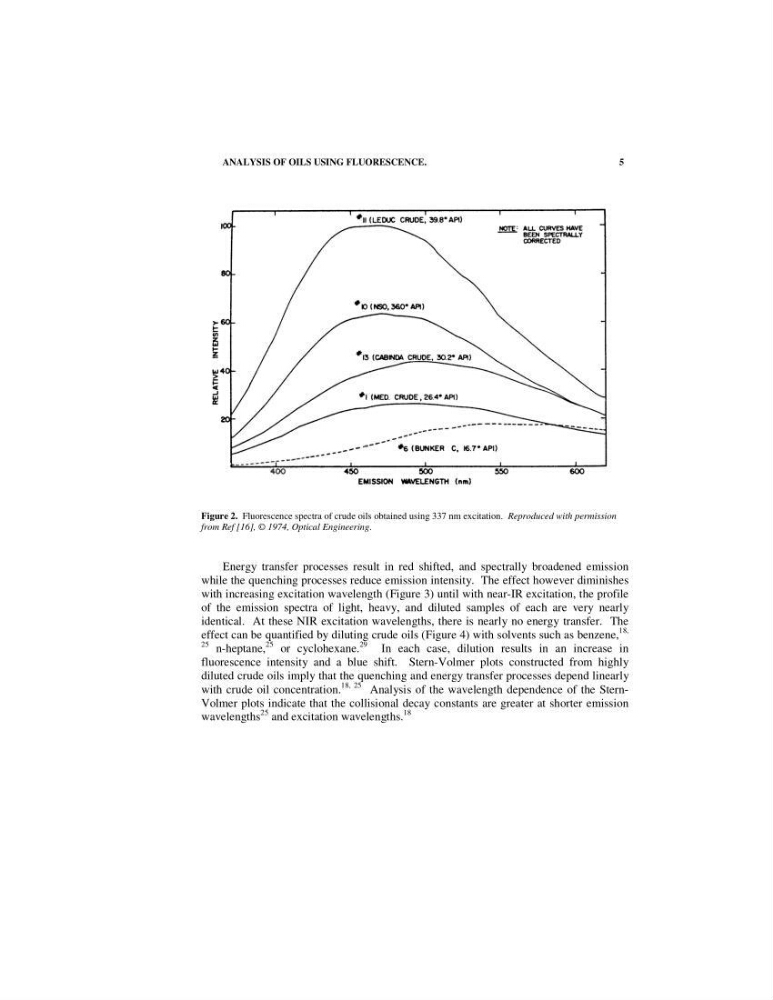
Figure 2. Fluorescence spectra of crude oils obtained using 337 nm excitation. Reproduced with permission
from Ref [16], © 1974, Optical Engineering.
Energy transfer processes result in red shifted, and spectrally broadened emission
while the quenching processes reduce emission intensity. The effect however diminishes
with increasing excitation wavelength (Figure 3) until with near-IR excitation, the profile
of the emission spectra of light, heavy, and diluted samples of each are very nearly
identical. At these NIR excitation wavelengths, there is nearly no energy transfer. The
effect can be quantified by diluting crude oils (Figure 4) with solvents such as benzene,
18,
25 n-heptane,
25 or cyclohexane.
29
In each case, dilution results in an increase in
fluorescence intensity and a blue shift. Stern-Volmer plots constructed from highly
diluted crude oils imply that the quenching and energy transfer processes depend linearly
with crude oil concentration.
18, 25 Analysis of the wavelength dependence of the SternVolmer plots indicate that the collisional decay constants are greater at shorter emission
wavelengths
25 and excitation wavelengths.
18
5
Figure 2. Fluorescence spectra of crude oils obtained using 337 nm excitation. Reproduced with permission
from Ref [16], © 1974, Optical Engineering.
Energy transfer processes result in red shifted, and spectrally broadened emission
while the quenching processes reduce emission intensity. The effect however diminishes
with increasing excitation wavelength (Figure 3) until with near-IR excitation, the profile
of the emission spectra of light, heavy, and diluted samples of each are very nearly
identical. At these NIR excitation wavelengths, there is nearly no energy transfer. The
effect can be quantified by diluting crude oils (Figure 4) with solvents such as benzene,
18,
25 n-heptane,
25 or cyclohexane.
29
In each case, dilution results in an increase in
fluorescence intensity and a blue shift. Stern-Volmer plots constructed from highly
diluted crude oils imply that the quenching and energy transfer processes depend linearly
with crude oil concentration.
18, 25 Analysis of the wavelength dependence of the SternVolmer plots indicate that the collisional decay constants are greater at shorter emission
wavelengths
25 and excitation wavelengths.
18