

4
A. G. RYDER
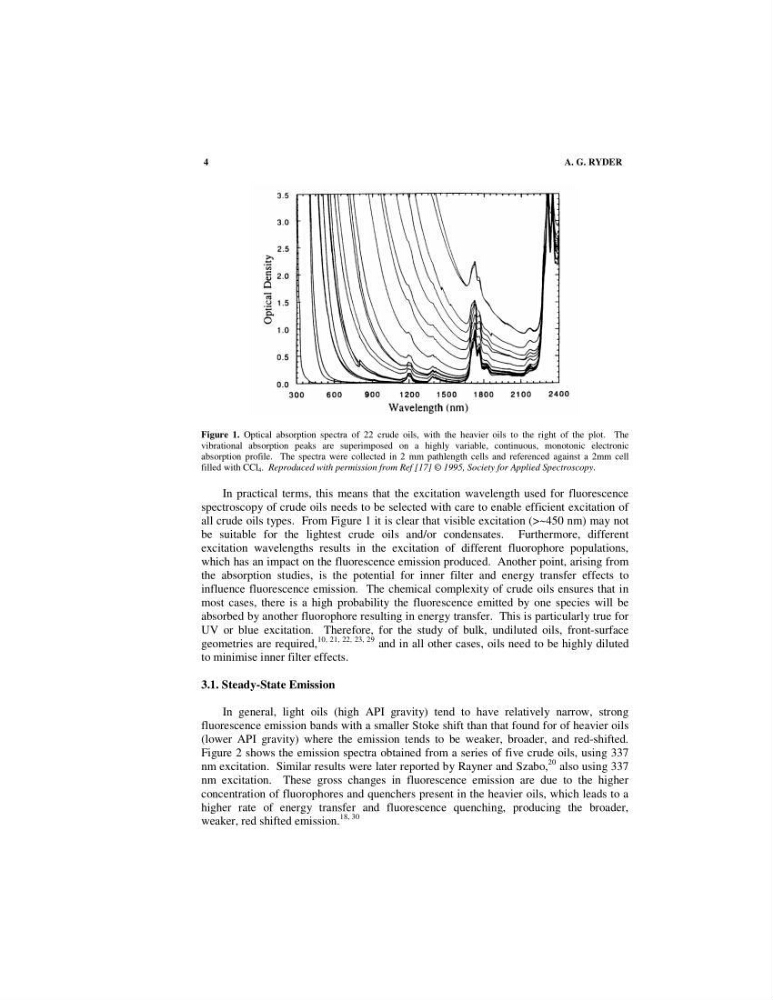
Figure 1. Optical absorption spectra of 22 crude oils, with the heavier oils to the right of the plot. The
vibrational absorption peaks are superimposed on a highly variable, continuous, monotonic electronic
absorption profile. The spectra were collected in 2 mm pathlength cells and referenced against a 2mm cell
filled with CCl 4 . Reproduced with permission from Ref [17] © 1995, Society for Applied Spectroscopy.
In practical terms, this means that the excitation wavelength used for fluorescence
spectroscopy of crude oils needs to be selected with care to enable efficient excitation of
all crude oils types. From Figure 1 it is clear that visible excitation (>~450 nm) may not
be suitable for the lightest crude oils and/or condensates. Furthermore, different
excitation wavelengths results in the excitation of different fluorophore populations,
which has an impact on the fluorescence emission produced. Another point, arising from
the absorption studies, is the potential for inner filter and energy transfer effects to
influence fluorescence emission. The chemical complexity of crude oils ensures that in
most cases, there is a high probability the fluorescence emitted by one species will be
absorbed by another fluorophore resulting in energy transfer. This is particularly true for
UV or blue excitation. Therefore, for the study of bulk, undiluted oils, front-surface
geometries are required,
10, 21, 22, 23, 29 and in all other cases, oils need to be highly diluted
to minimise inner filter effects.
3.1. Steady-State Emission
In general, light oils (high API gravity) tend to have relatively narrow, strong
fluorescence emission bands with a smaller Stoke shift than that found for of heavier oils
(lower API gravity) where the emission tends to be weaker, broader, and red-shifted.
Figure 2 shows the emission spectra obtained from a series of five crude oils, using 337
nm excitation. Similar results were later reported by Rayner and Szabo,
20 also using 337
nm excitation. These gross changes in fluorescence emission are due to the higher
concentration of fluorophores and quenchers present in the heavier oils, which leads to a
higher rate of energy transfer and fluorescence quenching, producing the broader,
weaker, red shifted emission.
18, 30
A. G. RYDER
Figure 1. Optical absorption spectra of 22 crude oils, with the heavier oils to the right of the plot. The
vibrational absorption peaks are superimposed on a highly variable, continuous, monotonic electronic
absorption profile. The spectra were collected in 2 mm pathlength cells and referenced against a 2mm cell
filled with CCl 4 . Reproduced with permission from Ref [17] © 1995, Society for Applied Spectroscopy.
In practical terms, this means that the excitation wavelength used for fluorescence
spectroscopy of crude oils needs to be selected with care to enable efficient excitation of
all crude oils types. From Figure 1 it is clear that visible excitation (>~450 nm) may not
be suitable for the lightest crude oils and/or condensates. Furthermore, different
excitation wavelengths results in the excitation of different fluorophore populations,
which has an impact on the fluorescence emission produced. Another point, arising from
the absorption studies, is the potential for inner filter and energy transfer effects to
influence fluorescence emission. The chemical complexity of crude oils ensures that in
most cases, there is a high probability the fluorescence emitted by one species will be
absorbed by another fluorophore resulting in energy transfer. This is particularly true for
UV or blue excitation. Therefore, for the study of bulk, undiluted oils, front-surface
geometries are required,
10, 21, 22, 23, 29 and in all other cases, oils need to be highly diluted
to minimise inner filter effects.
3.1. Steady-State Emission
In general, light oils (high API gravity) tend to have relatively narrow, strong
fluorescence emission bands with a smaller Stoke shift than that found for of heavier oils
(lower API gravity) where the emission tends to be weaker, broader, and red-shifted.
Figure 2 shows the emission spectra obtained from a series of five crude oils, using 337
nm excitation. Similar results were later reported by Rayner and Szabo,
20 also using 337
nm excitation. These gross changes in fluorescence emission are due to the higher
concentration of fluorophores and quenchers present in the heavier oils, which leads to a
higher rate of energy transfer and fluorescence quenching, producing the broader,
weaker, red shifted emission.
18, 30