

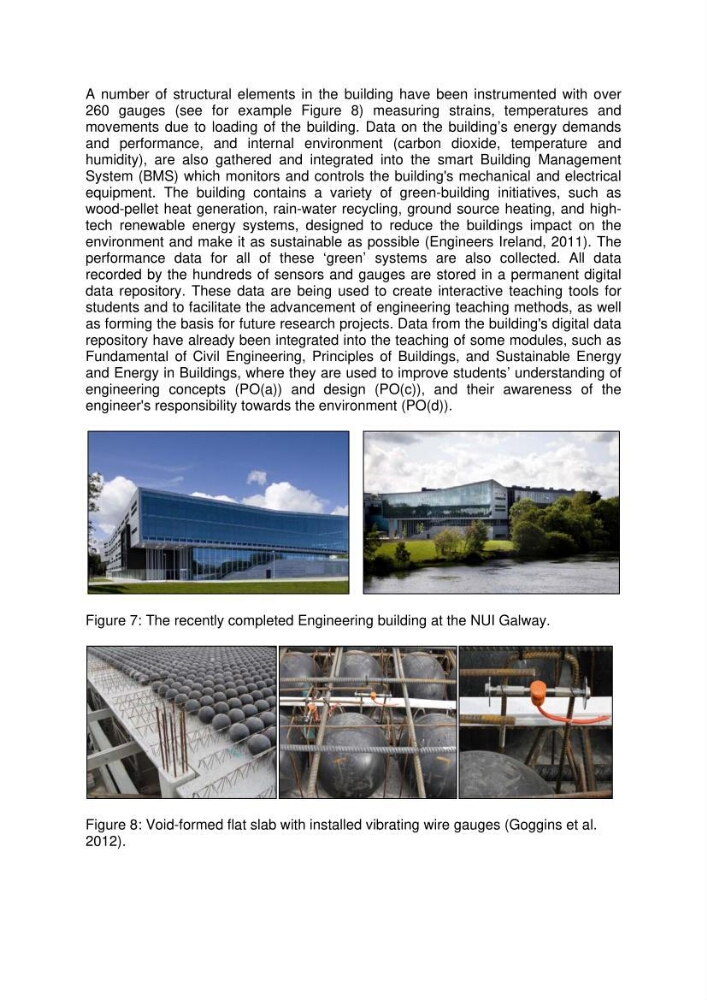
A number of structural elements in the building have been instrumented with over
260 gauges (see for example Figure 8) measuring strains, temperatures and
movements due to loading of the building. Data on the building’s energy demands
and performance, and internal environment (carbon dioxide, temperature and
humidity), are also gathered and integrated into the smart Building Management
System (BMS) which monitors and controls the building's mechanical and electrical
equipment. The building contains a variety of green-building initiatives, such as
wood-pellet heat generation, rain-water recycling, ground source heating, and hightech renewable energy systems, designed to reduce the buildings impact on the
environment and make it as sustainable as possible (Engineers Ireland, 2011). The
performance data for all of these ‘green’ systems are also collected. All data
recorded by the hundreds of sensors and gauges are stored in a permanent digital
data repository. These data are being used to create interactive teaching tools for
students and to facilitate the advancement of engineering teaching methods, as well
as forming the basis for future research projects. Data from the building's digital data
repository have already been integrated into the teaching of some modules, such as
Fundamental of Civil Engineering, Principles of Buildings, and Sustainable Energy
and Energy in Buildings, where they are used to improve students’ understanding of
engineering concepts (PO(a)) and design (PO(c)), and their awareness of the
engineer's responsibility towards the environment (PO(d)).
Figure 7: The recently completed Engineering building at the NUI Galway.
Figure 8: Void-formed flat slab with installed vibrating wire gauges (Goggins et al.
2012).
260 gauges (see for example Figure 8) measuring strains, temperatures and
movements due to loading of the building. Data on the building’s energy demands
and performance, and internal environment (carbon dioxide, temperature and
humidity), are also gathered and integrated into the smart Building Management
System (BMS) which monitors and controls the building's mechanical and electrical
equipment. The building contains a variety of green-building initiatives, such as
wood-pellet heat generation, rain-water recycling, ground source heating, and hightech renewable energy systems, designed to reduce the buildings impact on the
environment and make it as sustainable as possible (Engineers Ireland, 2011). The
performance data for all of these ‘green’ systems are also collected. All data
recorded by the hundreds of sensors and gauges are stored in a permanent digital
data repository. These data are being used to create interactive teaching tools for
students and to facilitate the advancement of engineering teaching methods, as well
as forming the basis for future research projects. Data from the building's digital data
repository have already been integrated into the teaching of some modules, such as
Fundamental of Civil Engineering, Principles of Buildings, and Sustainable Energy
and Energy in Buildings, where they are used to improve students’ understanding of
engineering concepts (PO(a)) and design (PO(c)), and their awareness of the
engineer's responsibility towards the environment (PO(d)).
Figure 7: The recently completed Engineering building at the NUI Galway.
Figure 8: Void-formed flat slab with installed vibrating wire gauges (Goggins et al.
2012).