

Electronic classroom response systems are interactive technologies which allow
students to use wireless transmitters, or clickers, to answer questions posed by the
instructor. Answers are then collated via a USB receiver and supporting software on
the instructor's PC and a graphical summary of student answers is produced and
shown to the students. The technology has been successfully integrated in the
teaching of Elementary Hydraulics to facilitate peer instruction, a teaching approach
developed by the leading Harvard physics lecturer Eric Mazur (Mazur, 1997). The
peer instruction process can be explained as follows. A particular engineering
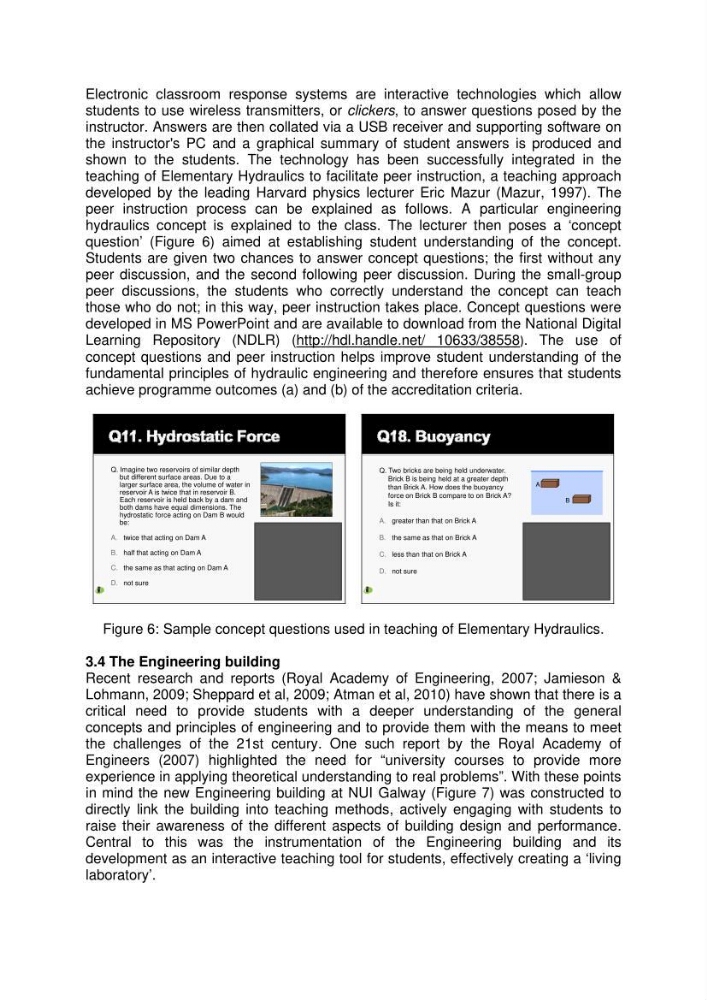
hydraulics concept is explained to the class. The lecturer then poses a ‘concept
question’ (Figure 6) aimed at establishing student understanding of the concept.
Students are given two chances to answer concept questions; the first without any
peer discussion, and the second following peer discussion. During the small-group
peer discussions, the students who correctly understand the concept can teach
those who do not; in this way, peer instruction takes place. Concept questions were
developed in MS PowerPoint and are available to download from the National Digital
Learning Repository (NDLR) (http://hdl.handle.net/ 10633/38558). The use of
concept questions and peer instruction helps improve student understanding of the
fundamental principles of hydraulic engineering and therefore ensures that students
achieve programme outcomes (a) and (b) of the accreditation criteria.
Q. Imagine two reservoirs of similar depth
but different surface areas. Due to a
larger surface area, the volume of water in
reservoir A is twice that in reservoir B.
Each reservoir is held back by a dam and
both dams have equal dimensions. The
hydrostatic force acting on Dam B would
be:
A. twice that acting on Dam A
B. half that acting on Dam A
C. the same as that acting on Dam A
D. not sure
Q. Two bricks are being held underwater.
Brick B is being held at a greater depth
than Brick A. How does the buoyancy
force on Brick B compare to on Brick A?
Is it:
A. greater than that on Brick A
B. the same as that on Brick A
C. less than that on Brick A
D. not sure
A
B
Figure 6: Sample concept questions used in teaching of Elementary Hydraulics.
3.4 The Engineering building
Recent research and reports (Royal Academy of Engineering, 2007; Jamieson &
Lohmann, 2009; Sheppard et al, 2009; Atman et al, 2010) have shown that there is a
critical need to provide students with a deeper understanding of the general
concepts and principles of engineering and to provide them with the means to meet
the challenges of the 21st century. One such report by the Royal Academy of
Engineers (2007) highlighted the need for “university courses to provide more
experience in applying theoretical understanding to real problems”. With these points
in mind the new Engineering building at NUI Galway (Figure 7) was constructed to
directly link the building into teaching methods, actively engaging with students to
raise their awareness of the different aspects of building design and performance.
Central to this was the instrumentation of the Engineering building and its
development as an interactive teaching tool for students, effectively creating a ‘living
laboratory’.
students to use wireless transmitters, or clickers, to answer questions posed by the
instructor. Answers are then collated via a USB receiver and supporting software on
the instructor's PC and a graphical summary of student answers is produced and
shown to the students. The technology has been successfully integrated in the
teaching of Elementary Hydraulics to facilitate peer instruction, a teaching approach
developed by the leading Harvard physics lecturer Eric Mazur (Mazur, 1997). The
peer instruction process can be explained as follows. A particular engineering
hydraulics concept is explained to the class. The lecturer then poses a ‘concept
question’ (Figure 6) aimed at establishing student understanding of the concept.
Students are given two chances to answer concept questions; the first without any
peer discussion, and the second following peer discussion. During the small-group
peer discussions, the students who correctly understand the concept can teach
those who do not; in this way, peer instruction takes place. Concept questions were
developed in MS PowerPoint and are available to download from the National Digital
Learning Repository (NDLR) (http://hdl.handle.net/ 10633/38558). The use of
concept questions and peer instruction helps improve student understanding of the
fundamental principles of hydraulic engineering and therefore ensures that students
achieve programme outcomes (a) and (b) of the accreditation criteria.
Q. Imagine two reservoirs of similar depth
but different surface areas. Due to a
larger surface area, the volume of water in
reservoir A is twice that in reservoir B.
Each reservoir is held back by a dam and
both dams have equal dimensions. The
hydrostatic force acting on Dam B would
be:
A. twice that acting on Dam A
B. half that acting on Dam A
C. the same as that acting on Dam A
D. not sure
Q. Two bricks are being held underwater.
Brick B is being held at a greater depth
than Brick A. How does the buoyancy
force on Brick B compare to on Brick A?
Is it:
A. greater than that on Brick A
B. the same as that on Brick A
C. less than that on Brick A
D. not sure
A
B
Figure 6: Sample concept questions used in teaching of Elementary Hydraulics.
3.4 The Engineering building
Recent research and reports (Royal Academy of Engineering, 2007; Jamieson &
Lohmann, 2009; Sheppard et al, 2009; Atman et al, 2010) have shown that there is a
critical need to provide students with a deeper understanding of the general
concepts and principles of engineering and to provide them with the means to meet
the challenges of the 21st century. One such report by the Royal Academy of
Engineers (2007) highlighted the need for “university courses to provide more
experience in applying theoretical understanding to real problems”. With these points
in mind the new Engineering building at NUI Galway (Figure 7) was constructed to
directly link the building into teaching methods, actively engaging with students to
raise their awareness of the different aspects of building design and performance.
Central to this was the instrumentation of the Engineering building and its
development as an interactive teaching tool for students, effectively creating a ‘living
laboratory’.