

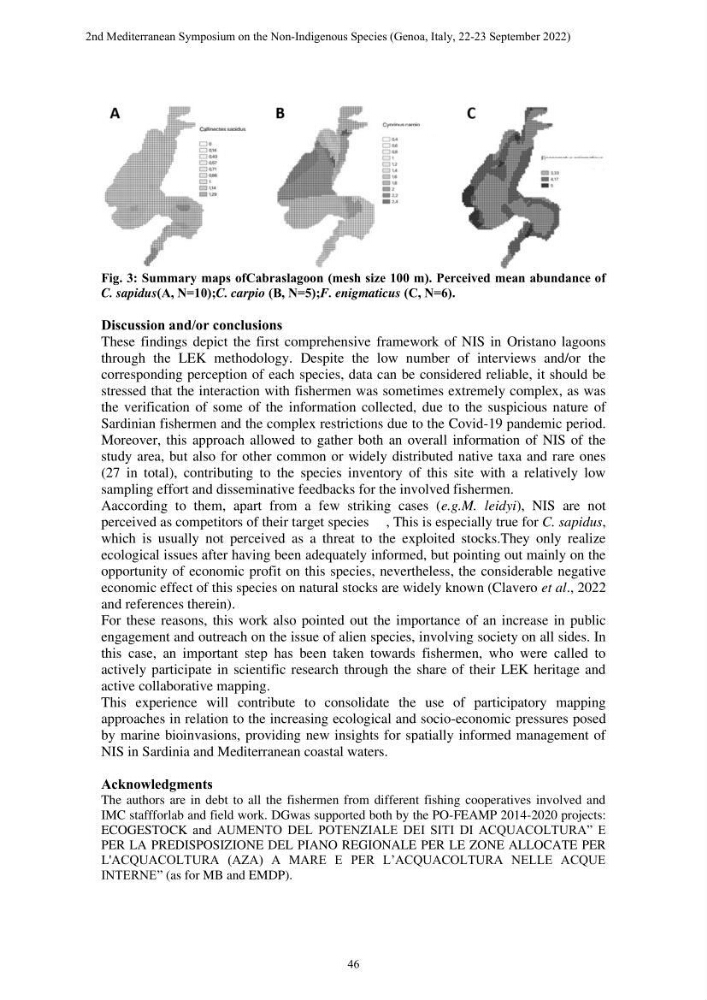
Fig. 3: Summary maps ofCabraslagoon (mesh size 100 m). Perceived mean abundance of
C. sapidus(A, N=10);C. carpio (B, N=5);F. enigmaticus (C, N=6).
Discussion and/or conclusions
These findings depict the first comprehensive framework of NIS in Oristano lagoons
through the LEK methodology. Despite the low number of interviews and/or the
corresponding perception of each species, data can be considered reliable, it should be
stressed that the interaction with fishermen was sometimes extremely complex, as was
the verification of some of the information collected, due to the suspicious nature of
Sardinian fishermen and the complex restrictions due to the Covid-19 pandemic period.
Moreover, this approach allowed to gather both an overall information of NIS of the
study area, but also for other common or widely distributed native taxa and rare ones
(27 in total), contributing to the species inventory of this site with a relatively low
sampling effort and disseminative feedbacks for the involved fishermen.
Aaccording to them, apart from a few striking cases (e.g.M. leidyi), NIS are not
perceived as competitors of their target species , This is especially true for C. sapidus,
which is usually not perceived as a threat to the exploited stocks.They only realize
ecological issues after having been adequately informed, but pointing out mainly on the
opportunity of economic profit on this species, nevertheless, the considerable negative
economic effect of this species on natural stocks are widely known (Clavero et al., 2022
and references therein).
For these reasons, this work also pointed out the importance of an increase in public
engagement and outreach on the issue of alien species, involving society on all sides. In
this case, an important step has been taken towards fishermen, who were called to
actively participate in scientific research through the share of their LEK heritage and
active collaborative mapping.
This experience will contribute to consolidate the use of participatory mapping
approaches in relation to the increasing ecological and socio-economic pressures posed
by marine bioinvasions, providing new insights for spatially informed management of
NIS in Sardinia and Mediterranean coastal waters.
Acknowledgments
The authors are in debt to all the fishermen from different fishing cooperatives involved and
IMC staffforlab and field work. DGwas supported both by the PO-FEAMP 2014-2020 projects:
ECOGESTOCK and AUMENTO DEL POTENZIALE DEI SITI DI ACQUACOLTURA” E
PER LA PREDISPOSIZIONE DEL PIANO REGIONALE PER LE ZONE ALLOCATE PER
L'ACQUACOLTURA (AZA) A MARE E PER L’ACQUACOLTURA NELLE ACQUE
INTERNE” (as for MB and EMDP).
2nd Mediterranean Symposium on the Non-Indigenous Species (Genoa, Italy, 22-23 September 2022)
46
C. sapidus(A, N=10);C. carpio (B, N=5);F. enigmaticus (C, N=6).
Discussion and/or conclusions
These findings depict the first comprehensive framework of NIS in Oristano lagoons
through the LEK methodology. Despite the low number of interviews and/or the
corresponding perception of each species, data can be considered reliable, it should be
stressed that the interaction with fishermen was sometimes extremely complex, as was
the verification of some of the information collected, due to the suspicious nature of
Sardinian fishermen and the complex restrictions due to the Covid-19 pandemic period.
Moreover, this approach allowed to gather both an overall information of NIS of the
study area, but also for other common or widely distributed native taxa and rare ones
(27 in total), contributing to the species inventory of this site with a relatively low
sampling effort and disseminative feedbacks for the involved fishermen.
Aaccording to them, apart from a few striking cases (e.g.M. leidyi), NIS are not
perceived as competitors of their target species , This is especially true for C. sapidus,
which is usually not perceived as a threat to the exploited stocks.They only realize
ecological issues after having been adequately informed, but pointing out mainly on the
opportunity of economic profit on this species, nevertheless, the considerable negative
economic effect of this species on natural stocks are widely known (Clavero et al., 2022
and references therein).
For these reasons, this work also pointed out the importance of an increase in public
engagement and outreach on the issue of alien species, involving society on all sides. In
this case, an important step has been taken towards fishermen, who were called to
actively participate in scientific research through the share of their LEK heritage and
active collaborative mapping.
This experience will contribute to consolidate the use of participatory mapping
approaches in relation to the increasing ecological and socio-economic pressures posed
by marine bioinvasions, providing new insights for spatially informed management of
NIS in Sardinia and Mediterranean coastal waters.
Acknowledgments
The authors are in debt to all the fishermen from different fishing cooperatives involved and
IMC staffforlab and field work. DGwas supported both by the PO-FEAMP 2014-2020 projects:
ECOGESTOCK and AUMENTO DEL POTENZIALE DEI SITI DI ACQUACOLTURA” E
PER LA PREDISPOSIZIONE DEL PIANO REGIONALE PER LE ZONE ALLOCATE PER
L'ACQUACOLTURA (AZA) A MARE E PER L’ACQUACOLTURA NELLE ACQUE
INTERNE” (as for MB and EMDP).
2nd Mediterranean Symposium on the Non-Indigenous Species (Genoa, Italy, 22-23 September 2022)
46