

an overall overview. Summarizing maps for the most abundant species were provided
for the study area.
Results
This contribution allowed mapping the occurrence and abundance of NIS Oristano
lagoons through the LEK of fishermen. In Sardinia at least 66 NIS taxa were reported in
literature up to 2020, 71% of them were saltwater-brackish and 29% freshwater. Of
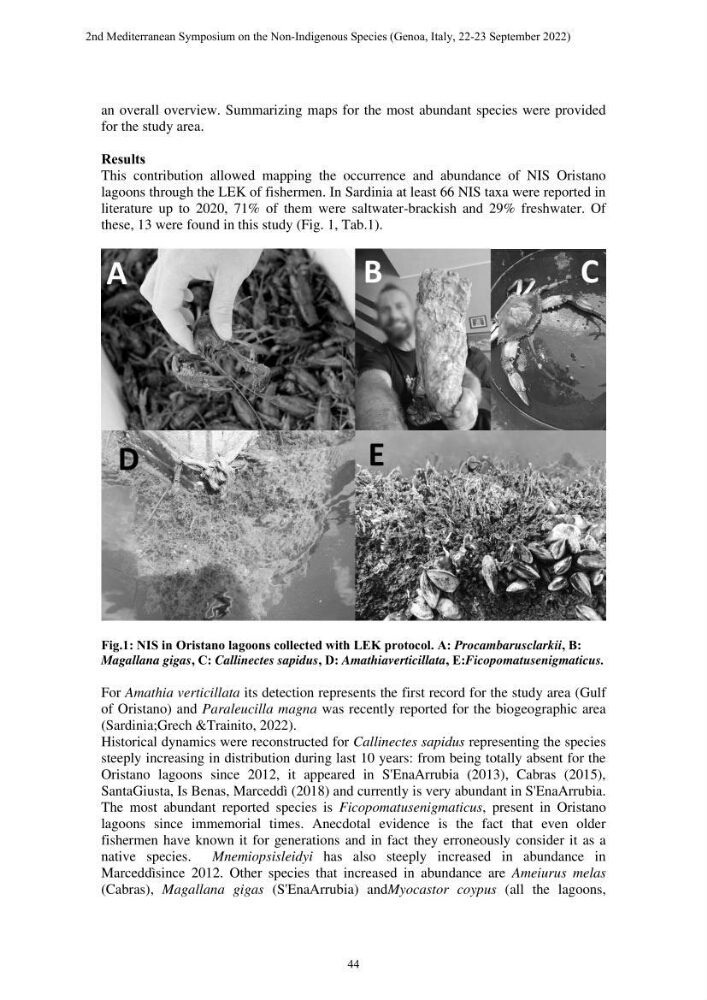
these, 13 were found in this study (Fig. 1, Tab.1).
Fig.1: NIS in Oristano lagoons collected with LEK protocol. A: Procambarusclarkii, B:
Magallana gigas, C: Callinectes sapidus, D: Amathiaverticillata, E:Ficopomatusenigmaticus.
For Amathia verticillata its detection represents the first record for the study area (Gulf
of Oristano) and Paraleucilla magna was recently reported for the biogeographic area
(Sardinia;Grech &Trainito, 2022).
Historical dynamics were reconstructed for Callinectes sapidus representing the species
steeply increasing in distribution during last 10 years: from being totally absent for the
Oristano lagoons since 2012, it appeared in S'EnaArrubia (2013), Cabras (2015),
SantaGiusta, Is Benas, Marceddì (2018) and currently is very abundant in S'EnaArrubia.
The most abundant reported species is Ficopomatusenigmaticus, present in Oristano
lagoons since immemorial times. Anecdotal evidence is the fact that even older
fishermen have known it for generations and in fact they erroneously consider it as a
native species. Mnemiopsisleidyi has also steeply increased in abundance in
Marceddìsince 2012. Other species that increased in abundance are Ameiurus melas
(Cabras), Magallana gigas (S'EnaArrubia) andMyocastor coypus (all the lagoons,
2nd Mediterranean Symposium on the Non-Indigenous Species (Genoa, Italy, 22-23 September 2022)
44
for the study area.
Results
This contribution allowed mapping the occurrence and abundance of NIS Oristano
lagoons through the LEK of fishermen. In Sardinia at least 66 NIS taxa were reported in
literature up to 2020, 71% of them were saltwater-brackish and 29% freshwater. Of
these, 13 were found in this study (Fig. 1, Tab.1).
Fig.1: NIS in Oristano lagoons collected with LEK protocol. A: Procambarusclarkii, B:
Magallana gigas, C: Callinectes sapidus, D: Amathiaverticillata, E:Ficopomatusenigmaticus.
For Amathia verticillata its detection represents the first record for the study area (Gulf
of Oristano) and Paraleucilla magna was recently reported for the biogeographic area
(Sardinia;Grech &Trainito, 2022).
Historical dynamics were reconstructed for Callinectes sapidus representing the species
steeply increasing in distribution during last 10 years: from being totally absent for the
Oristano lagoons since 2012, it appeared in S'EnaArrubia (2013), Cabras (2015),
SantaGiusta, Is Benas, Marceddì (2018) and currently is very abundant in S'EnaArrubia.
The most abundant reported species is Ficopomatusenigmaticus, present in Oristano
lagoons since immemorial times. Anecdotal evidence is the fact that even older
fishermen have known it for generations and in fact they erroneously consider it as a
native species. Mnemiopsisleidyi has also steeply increased in abundance in
Marceddìsince 2012. Other species that increased in abundance are Ameiurus melas
(Cabras), Magallana gigas (S'EnaArrubia) andMyocastor coypus (all the lagoons,
2nd Mediterranean Symposium on the Non-Indigenous Species (Genoa, Italy, 22-23 September 2022)
44