

Materials and methods
Between February 2012 and May 2016, 594 exotic and native fish specimens were
sampled from the Gulf of Gabès and the Gulf of Aqaba and examined. Parasites were
identified to the lowest taxonomic level possible. We searched literature databases for
published records of additional parasite species from the Mediterranean Sea and the
Red Sea. Patterns of structure (prevalence, abundance, richness) of parasite
communities of exotic (Siganus rivulatus, S. lurius, Sphyraena chrysotaenia, Fistularia
commersonii, Etrumeus golanii) and native fish (Sarpa salpa, Sparisoma cretense,
Sphyraena sphyraena). In the case of exotic fishes, comparative analyses were carried
out through generalized linear models and multivariate analyses, comparing exotic
(Mediterranean) and native (Red Sea) populations.
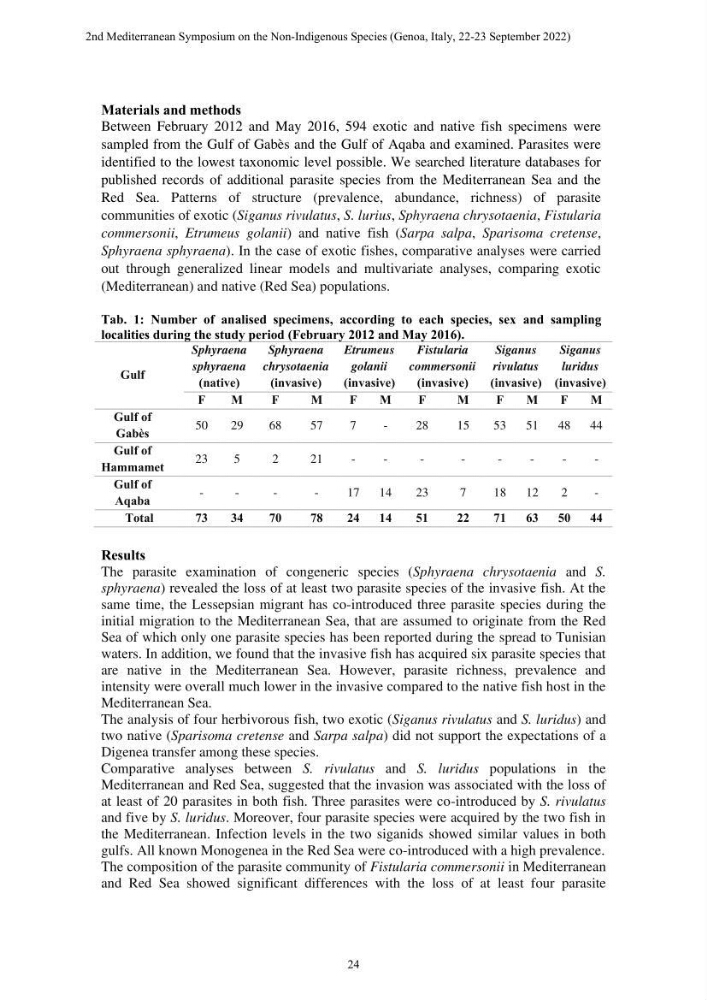
Tab. 1: Number of analised specimens, according to each species, sex and sampling
localities during the study period (February 2012 and May 2016).
Gulf
Sphyraena
sphyraena
(native)
Sphyraena
chrysotaenia
(invasive)
Etrumeus
golanii
(invasive)
Fistularia
commersonii
(invasive)
Siganus
rivulatus
(invasive)
Siganus
luridus
(invasive)
F
M
F
M
F
M
F
M
F
M
F
M
Gulf of
Gabès
50
29
68
57
7
-
28
15
53
51
48
44
Gulf of
Hammamet
23
5
2
21
-
-
-
-
-
-
-
-
Gulf of
Aqaba
-
-
-
-
17
14
23
7
18
12
2
-
Total
73
34
70
78
24
14
51
22
71
63
50
44
Results
The parasite examination of congeneric species (Sphyraena chrysotaenia and S.
sphyraena) revealed the loss of at least two parasite species of the invasive fish. At the
same time, the Lessepsian migrant has co-introduced three parasite species during the
initial migration to the Mediterranean Sea, that are assumed to originate from the Red
Sea of which only one parasite species has been reported during the spread to Tunisian
waters. In addition, we found that the invasive fish has acquired six parasite species that
are native in the Mediterranean Sea. However, parasite richness, prevalence and
intensity were overall much lower in the invasive compared to the native fish host in the
Mediterranean Sea.
The analysis of four herbivorous fish, two exotic (Siganus rivulatus and S. luridus) and
two native (Sparisoma cretense and Sarpa salpa) did not support the expectations of a
Digenea transfer among these species.
Comparative analyses between S. rivulatus and S. luridus populations in the
Mediterranean and Red Sea, suggested that the invasion was associated with the loss of
at least of 20 parasites in both fish. Three parasites were co-introduced by S. rivulatus
and five by S. luridus. Moreover, four parasite species were acquired by the two fish in
the Mediterranean. Infection levels in the two siganids showed similar values in both
gulfs. All known Monogenea in the Red Sea were co-introduced with a high prevalence.
The composition of the parasite community of Fistularia commersonii in Mediterranean
and Red Sea showed significant differences with the loss of at least four parasite
2nd Mediterranean Symposium on the Non-Indigenous Species (Genoa, Italy, 22-23 September 2022)
24
Between February 2012 and May 2016, 594 exotic and native fish specimens were
sampled from the Gulf of Gabès and the Gulf of Aqaba and examined. Parasites were
identified to the lowest taxonomic level possible. We searched literature databases for
published records of additional parasite species from the Mediterranean Sea and the
Red Sea. Patterns of structure (prevalence, abundance, richness) of parasite
communities of exotic (Siganus rivulatus, S. lurius, Sphyraena chrysotaenia, Fistularia
commersonii, Etrumeus golanii) and native fish (Sarpa salpa, Sparisoma cretense,
Sphyraena sphyraena). In the case of exotic fishes, comparative analyses were carried
out through generalized linear models and multivariate analyses, comparing exotic
(Mediterranean) and native (Red Sea) populations.
Tab. 1: Number of analised specimens, according to each species, sex and sampling
localities during the study period (February 2012 and May 2016).
Gulf
Sphyraena
sphyraena
(native)
Sphyraena
chrysotaenia
(invasive)
Etrumeus
golanii
(invasive)
Fistularia
commersonii
(invasive)
Siganus
rivulatus
(invasive)
Siganus
luridus
(invasive)
F
M
F
M
F
M
F
M
F
M
F
M
Gulf of
Gabès
50
29
68
57
7
-
28
15
53
51
48
44
Gulf of
Hammamet
23
5
2
21
-
-
-
-
-
-
-
-
Gulf of
Aqaba
-
-
-
-
17
14
23
7
18
12
2
-
Total
73
34
70
78
24
14
51
22
71
63
50
44
Results
The parasite examination of congeneric species (Sphyraena chrysotaenia and S.
sphyraena) revealed the loss of at least two parasite species of the invasive fish. At the
same time, the Lessepsian migrant has co-introduced three parasite species during the
initial migration to the Mediterranean Sea, that are assumed to originate from the Red
Sea of which only one parasite species has been reported during the spread to Tunisian
waters. In addition, we found that the invasive fish has acquired six parasite species that
are native in the Mediterranean Sea. However, parasite richness, prevalence and
intensity were overall much lower in the invasive compared to the native fish host in the
Mediterranean Sea.
The analysis of four herbivorous fish, two exotic (Siganus rivulatus and S. luridus) and
two native (Sparisoma cretense and Sarpa salpa) did not support the expectations of a
Digenea transfer among these species.
Comparative analyses between S. rivulatus and S. luridus populations in the
Mediterranean and Red Sea, suggested that the invasion was associated with the loss of
at least of 20 parasites in both fish. Three parasites were co-introduced by S. rivulatus
and five by S. luridus. Moreover, four parasite species were acquired by the two fish in
the Mediterranean. Infection levels in the two siganids showed similar values in both
gulfs. All known Monogenea in the Red Sea were co-introduced with a high prevalence.
The composition of the parasite community of Fistularia commersonii in Mediterranean
and Red Sea showed significant differences with the loss of at least four parasite
2nd Mediterranean Symposium on the Non-Indigenous Species (Genoa, Italy, 22-23 September 2022)
24