

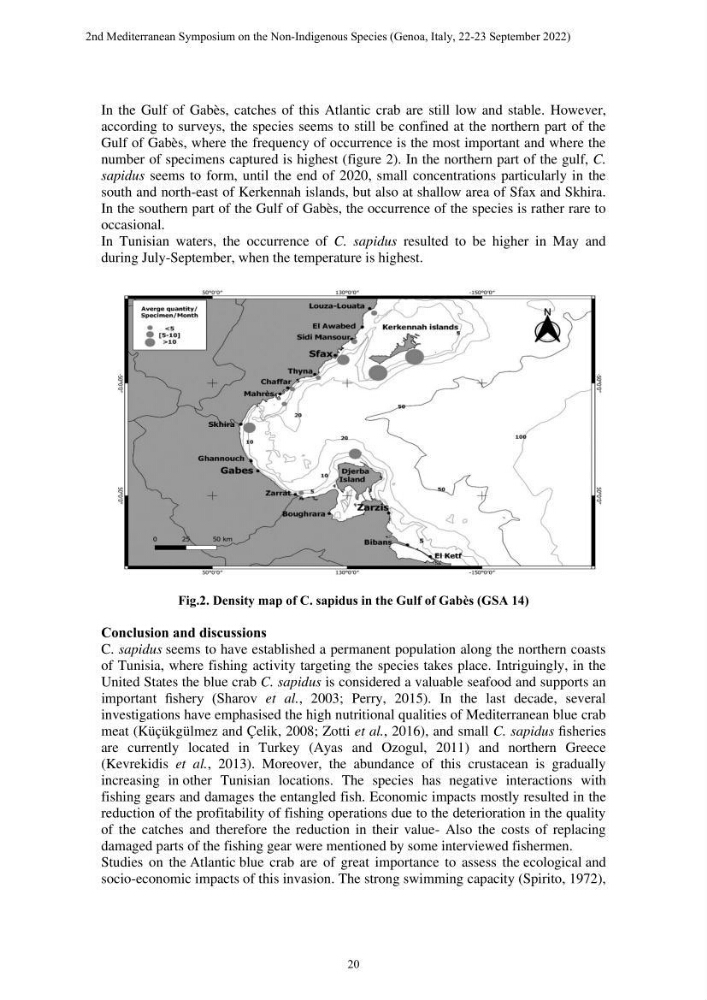
In the Gulf of Gabès, catches of this Atlantic crab are still low and stable. However,
according to surveys, the species seems to still be confined at the northern part of the
Gulf of Gabès, where the frequency of occurrence is the most important and where the
number of specimens captured is highest (figure 2). In the northern part of the gulf, C.
sapidus seems to form, until the end of 2020, small concentrations particularly in the
south and north-east of Kerkennah islands, but also at shallow area of Sfax and Skhira.
In the southern part of the Gulf of Gabès, the occurrence of the species is rather rare to
occasional.
In Tunisian waters, the occurrence of C. sapidus resulted to be higher in May and
during July-September, when the temperature is highest.
Fig.2. Density map of C. sapidus in the Gulf of Gabès (GSA 14)
Conclusion and discussions
C. sapidus seems to have established a permanent population along the northern coasts
of Tunisia, where fishing activity targeting the species takes place. Intriguingly, in the
United States the blue crab C. sapidus is considered a valuable seafood and supports an
important fishery (Sharov et al., 2003; Perry, 2015). In the last decade, several
investigations have emphasised the high nutritional qualities of Mediterranean blue crab
meat (Küçükgülmez and Çelik, 2008; Zotti et al., 2016), and small C. sapidus fisheries
are currently located in Turkey (Ayas and Ozogul, 2011) and northern Greece
(Kevrekidis et al., 2013). Moreover, the abundance of this crustacean is gradually
increasing in other Tunisian locations. The species has negative interactions with
fishing gears and damages the entangled fish. Economic impacts mostly resulted in the
reduction of the profitability of fishing operations due to the deterioration in the quality
of the catches and therefore the reduction in their value- Also the costs of replacing
damaged parts of the fishing gear were mentioned by some interviewed fishermen.
Studies on the Atlantic blue crab are of great importance to assess the ecological and
socio-economic impacts of this invasion. The strong swimming capacity (Spirito, 1972),
2nd Mediterranean Symposium on the Non-Indigenous Species (Genoa, Italy, 22-23 September 2022)
20
according to surveys, the species seems to still be confined at the northern part of the
Gulf of Gabès, where the frequency of occurrence is the most important and where the
number of specimens captured is highest (figure 2). In the northern part of the gulf, C.
sapidus seems to form, until the end of 2020, small concentrations particularly in the
south and north-east of Kerkennah islands, but also at shallow area of Sfax and Skhira.
In the southern part of the Gulf of Gabès, the occurrence of the species is rather rare to
occasional.
In Tunisian waters, the occurrence of C. sapidus resulted to be higher in May and
during July-September, when the temperature is highest.
Fig.2. Density map of C. sapidus in the Gulf of Gabès (GSA 14)
Conclusion and discussions
C. sapidus seems to have established a permanent population along the northern coasts
of Tunisia, where fishing activity targeting the species takes place. Intriguingly, in the
United States the blue crab C. sapidus is considered a valuable seafood and supports an
important fishery (Sharov et al., 2003; Perry, 2015). In the last decade, several
investigations have emphasised the high nutritional qualities of Mediterranean blue crab
meat (Küçükgülmez and Çelik, 2008; Zotti et al., 2016), and small C. sapidus fisheries
are currently located in Turkey (Ayas and Ozogul, 2011) and northern Greece
(Kevrekidis et al., 2013). Moreover, the abundance of this crustacean is gradually
increasing in other Tunisian locations. The species has negative interactions with
fishing gears and damages the entangled fish. Economic impacts mostly resulted in the
reduction of the profitability of fishing operations due to the deterioration in the quality
of the catches and therefore the reduction in their value- Also the costs of replacing
damaged parts of the fishing gear were mentioned by some interviewed fishermen.
Studies on the Atlantic blue crab are of great importance to assess the ecological and
socio-economic impacts of this invasion. The strong swimming capacity (Spirito, 1972),
2nd Mediterranean Symposium on the Non-Indigenous Species (Genoa, Italy, 22-23 September 2022)
20