

Hose, Farmer III, Hickman & Fanning, 1981, Pseudo-nitzschia australis Frenguelli,
1939, Pseudo-nitzschia multistriata (Takano) Takano, 1995.
Table 1: Number of NIS at the regional and subregional level and their establishment
success
(Sub)region
NIS
Established
Casual
Unknown
EMED
786
570
175
41
CMED
286
180
73
33
ADRIA
207
140
43
24
WMED
322
221
74
27
MED
1011
748
224
39
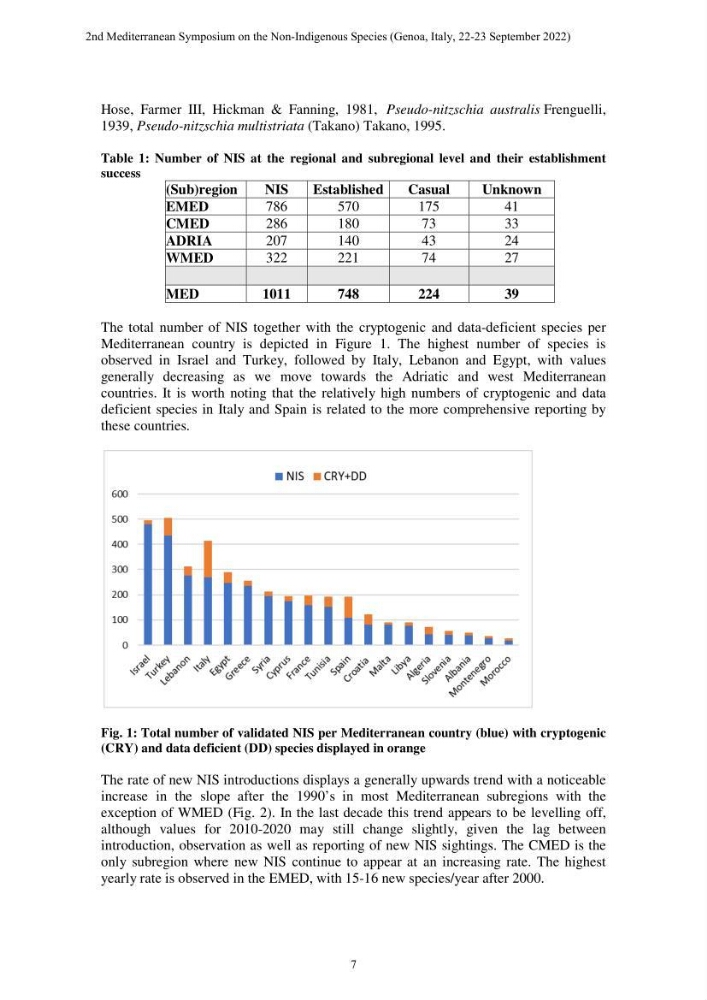
The total number of NIS together with the cryptogenic and data-deficient species per
Mediterranean country is depicted in Figure 1. The highest number of species is
observed in Israel and Turkey, followed by Italy, Lebanon and Egypt, with values
generally decreasing as we move towards the Adriatic and west Mediterranean
countries. It is worth noting that the relatively high numbers of cryptogenic and data
deficient species in Italy and Spain is related to the more comprehensive reporting by
these countries.
Fig. 1: Total number of validated NIS per Mediterranean country (blue) with cryptogenic
(CRY) and data deficient (DD) species displayed in orange
The rate of new NIS introductions displays a generally upwards trend with a noticeable
increase in the slope after the 1990’s in most Mediterranean subregions with the
exception of WMED (Fig. 2). In the last decade this trend appears to be levelling off,
although values for 2010-2020 may still change slightly, given the lag between
introduction, observation as well as reporting of new NIS sightings. The CMED is the
only subregion where new NIS continue to appear at an increasing rate. The highest
yearly rate is observed in the EMED, with 15-16 new species/year after 2000.
2nd Mediterranean Symposium on the Non-Indigenous Species (Genoa, Italy, 22-23 September 2022)
7
1939, Pseudo-nitzschia multistriata (Takano) Takano, 1995.
Table 1: Number of NIS at the regional and subregional level and their establishment
success
(Sub)region
NIS
Established
Casual
Unknown
EMED
786
570
175
41
CMED
286
180
73
33
ADRIA
207
140
43
24
WMED
322
221
74
27
MED
1011
748
224
39
The total number of NIS together with the cryptogenic and data-deficient species per
Mediterranean country is depicted in Figure 1. The highest number of species is
observed in Israel and Turkey, followed by Italy, Lebanon and Egypt, with values
generally decreasing as we move towards the Adriatic and west Mediterranean
countries. It is worth noting that the relatively high numbers of cryptogenic and data
deficient species in Italy and Spain is related to the more comprehensive reporting by
these countries.
Fig. 1: Total number of validated NIS per Mediterranean country (blue) with cryptogenic
(CRY) and data deficient (DD) species displayed in orange
The rate of new NIS introductions displays a generally upwards trend with a noticeable
increase in the slope after the 1990’s in most Mediterranean subregions with the
exception of WMED (Fig. 2). In the last decade this trend appears to be levelling off,
although values for 2010-2020 may still change slightly, given the lag between
introduction, observation as well as reporting of new NIS sightings. The CMED is the
only subregion where new NIS continue to appear at an increasing rate. The highest
yearly rate is observed in the EMED, with 15-16 new species/year after 2000.
2nd Mediterranean Symposium on the Non-Indigenous Species (Genoa, Italy, 22-23 September 2022)
7