

78
CHAPTER 3. PRINCIPLES OF SIMILITUDE
L
- wavelength
g
- gravity
T
— wave period
h
- water depth
The prototype-to-model ratio of wavelength is given as
[L=^unh(^)l
L_ _ _ _ _ _ _ _ _ _ _ _ _ _ _ _ _ _ J p
b=Æunh(^)]
L
J m
In terms of scale ratios (noting that N^_
Nh and using the definitions Nh = hPlhm
and N^_ = Lp/L™) *
we get
= Ng • Nt2 ■
l“h (^-T^r)
(3.35)
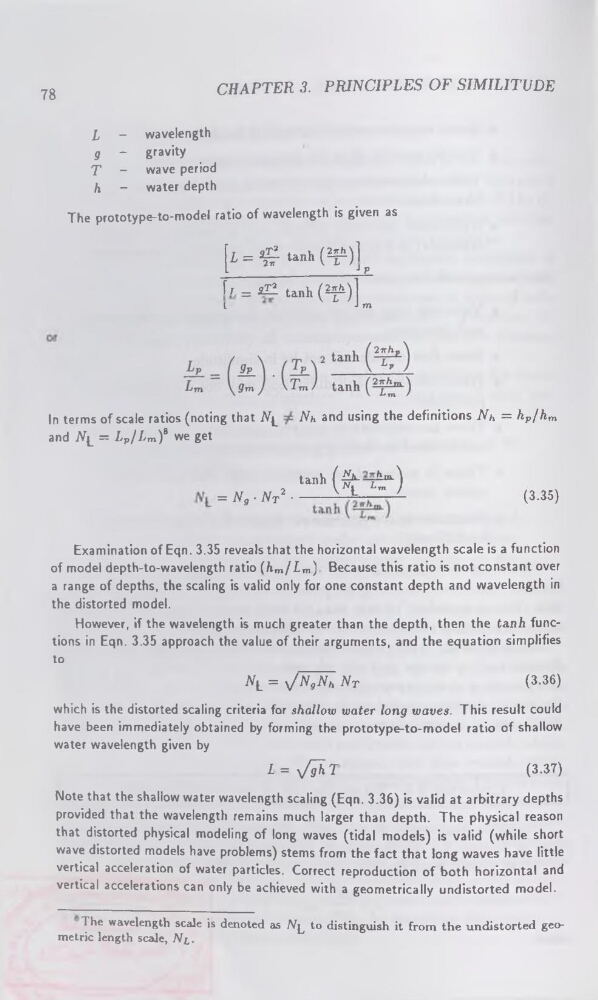
Examination of Eqn. 3.35 reveals that the horizontal wavelength scale is a function
of model depth-to-wavelength ratio (hm/Lm). Because this ratio is not constant over
a range of depths, the scaling is valid only for one constant depth and wavelength in
the distorted model.
However, if the wavelength is much greater than the depth, then the tanh functions in Eqn. 3.35 approach the value of their arguments, and the equation simplifies
to
Nl = y/NgNh Nt
(3-36)
which is the distorted scaling criteria for shallow water long waves. This result could
have been immediately obtained by forming the prototype-to-model ratio of shallow
water wavelength given by
L=yfir
(3.37)
Note that the shallow water wavelength scaling (Eqn. 3.36) is valid at arbitrary depths
provided that the wavelength remains much larger than depth. The physical reason
that distorted physical modeling of long waves (tidal models) is valid (while short
wave distorted models have problems) stems from the fact that long waves have little
vertical acceleration of water particles. Correct reproduction of both horizontal and
vertical accelerations can only be achieved with a geometrically undistorted model.
The wavelength scale is denoted as N^ to distinguish it from the undistorted geometric length scale, N^.
CHAPTER 3. PRINCIPLES OF SIMILITUDE
L
- wavelength
g
- gravity
T
— wave period
h
- water depth
The prototype-to-model ratio of wavelength is given as
[L=^unh(^)l
L_ _ _ _ _ _ _ _ _ _ _ _ _ _ _ _ _ _ J p
b=Æunh(^)]
L
J m
In terms of scale ratios (noting that N^_
Nh and using the definitions Nh = hPlhm
and N^_ = Lp/L™) *
we get
= Ng • Nt2 ■
l“h (^-T^r)
(3.35)
Examination of Eqn. 3.35 reveals that the horizontal wavelength scale is a function
of model depth-to-wavelength ratio (hm/Lm). Because this ratio is not constant over
a range of depths, the scaling is valid only for one constant depth and wavelength in
the distorted model.
However, if the wavelength is much greater than the depth, then the tanh functions in Eqn. 3.35 approach the value of their arguments, and the equation simplifies
to
Nl = y/NgNh Nt
(3-36)
which is the distorted scaling criteria for shallow water long waves. This result could
have been immediately obtained by forming the prototype-to-model ratio of shallow
water wavelength given by
L=yfir
(3.37)
Note that the shallow water wavelength scaling (Eqn. 3.36) is valid at arbitrary depths
provided that the wavelength remains much larger than depth. The physical reason
that distorted physical modeling of long waves (tidal models) is valid (while short
wave distorted models have problems) stems from the fact that long waves have little
vertical acceleration of water particles. Correct reproduction of both horizontal and
vertical accelerations can only be achieved with a geometrically undistorted model.
The wavelength scale is denoted as N^ to distinguish it from the undistorted geometric length scale, N^.