

3.3. HYDRAULIC SIMILITUDE
77
• Space requirements of the model are reduced.
• Smaller models allow for reduced operation costs.
• Water slopes are exaggerated in the model, and thus, easier
to measure.
• Additional modeling criteria, such as needed for sediment
transport in a movable-bed model, may be accommodated.
Disadvantages of distorted models include:
• Velocities may not be correctly reproduced in magnitude
and direction.
• Some flow details will not be in similitude.
• Wave refraction and diffraction may not be correctly reproduced.
• There are unfavorable psychological effects on the observer
accustomed to viewing geometrically correct models.
• There is potential for unknown scale effects to influence
model results.
• Determining the appropriate degree of distortion can often
be difficult.
Distortion in a physical model may arise from consideration of the differential equations governing the process, from empirical observations that
arise from comparison of field data, or from results of a scale series (geometrically similar tests conducted at different scales).
Munson, et al. (1990) stated that the success of using distorted models
depends largely on the skill and experience of the model engineer and the
interpretation of results obtained from the distorted model. Geometrically
distorted hydraulic models are widely used, and the design and operation
of distorted hydraulic models are discussed in greater detail in Chapter 4.
Example 3.9. Wave Motion in Distorted Models
The scaling requirements for wave motion in geometrically undistorted models was
shown in Example 3.3. Requirements for distorted model wave action are developed
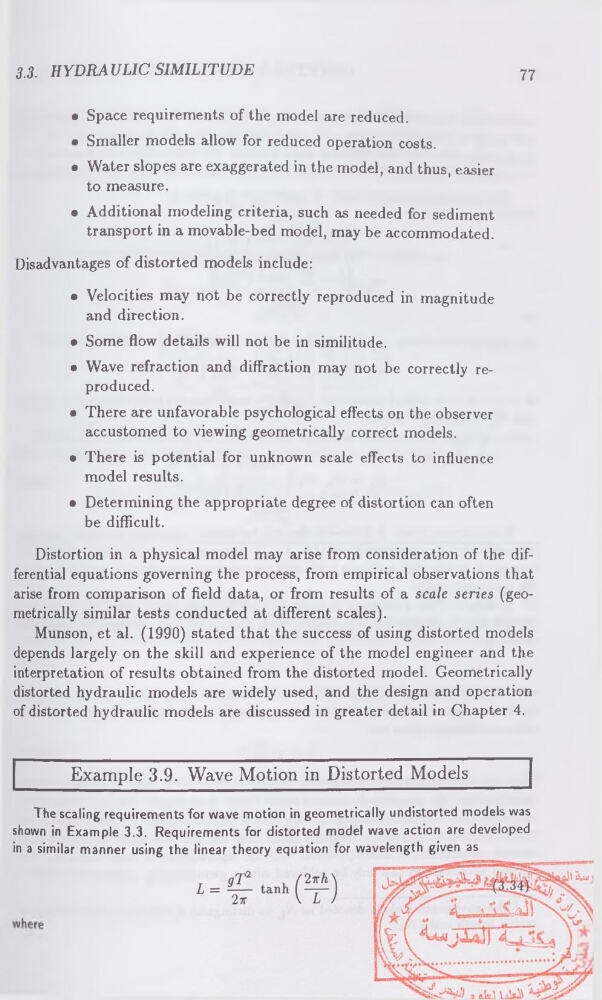
in a similar manner using the linear theory equation for wavelength given as
77
• Space requirements of the model are reduced.
• Smaller models allow for reduced operation costs.
• Water slopes are exaggerated in the model, and thus, easier
to measure.
• Additional modeling criteria, such as needed for sediment
transport in a movable-bed model, may be accommodated.
Disadvantages of distorted models include:
• Velocities may not be correctly reproduced in magnitude
and direction.
• Some flow details will not be in similitude.
• Wave refraction and diffraction may not be correctly reproduced.
• There are unfavorable psychological effects on the observer
accustomed to viewing geometrically correct models.
• There is potential for unknown scale effects to influence
model results.
• Determining the appropriate degree of distortion can often
be difficult.
Distortion in a physical model may arise from consideration of the differential equations governing the process, from empirical observations that
arise from comparison of field data, or from results of a scale series (geometrically similar tests conducted at different scales).
Munson, et al. (1990) stated that the success of using distorted models
depends largely on the skill and experience of the model engineer and the
interpretation of results obtained from the distorted model. Geometrically
distorted hydraulic models are widely used, and the design and operation
of distorted hydraulic models are discussed in greater detail in Chapter 4.
Example 3.9. Wave Motion in Distorted Models
The scaling requirements for wave motion in geometrically undistorted models was
shown in Example 3.3. Requirements for distorted model wave action are developed
in a similar manner using the linear theory equation for wavelength given as