

3.3. HYDRAULIC SIMILITUDE
75
The real difficulty in satisfying this model criterion is finding a model
fluid that has the appropriate kinematic viscosity. For example, with a
geometric length scale of Nl = 10, the model fluid must have kinematic
viscosity that is about l/30th of the prototype fluid. Assuming the prototype fluid is water, no fluid exists that will satisfy this criterion.
Example 3.8. Centrifuge Scale Model
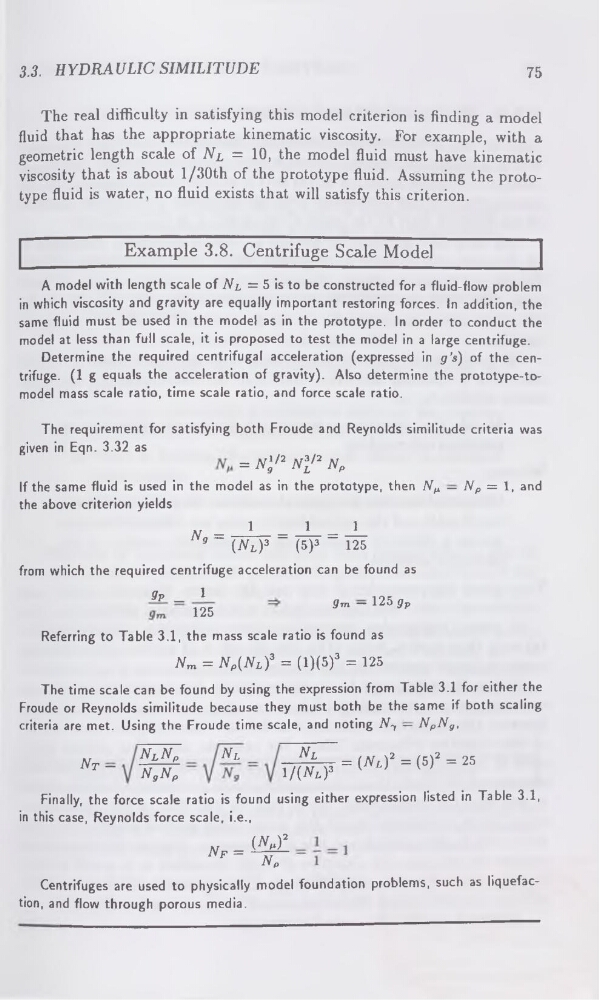
A model with length scale of Nl = 5 is to be constructed for a fluid-flow problem
in which viscosity and gravity are equally important restoring forces. In addition, the
same fluid must be used in the model as in the prototype. In order to conduct the
model at less than full scale, it is proposed to test the model in a large centrifuge.
Determine the required centrifugal acceleration (expressed in g’s) of the centrifuge. (1 g equals the acceleration of gravity). Also determine the prototype-tomodel mass scale ratio, time scale ratio, and force scale ratio.
The requirement for satisfying both Froude and Reynolds similitude criteria was
given in Eqn. 3.32 as
= Aj/2 N3 l/2 Np
If the same fluid is used in the model as in the prototype, then Np — Np = 1, and
the above criterion yields
N = _L_ = J_ = J_
9 (Nl)3
(5)3
125
from which the required centrifuge acceleration can be found as
9p _
1
125
9m — 125 gp
Referring to Table 3.1, the mass scale ratio is found as
Nm = Np(Nl)3 = (1)(5)3 = 125
The time scale can be found by using the expression from Table 3.1 for either the
Froude or Reynolds similitude because they must both be the same if both scaling
criteria are met. Using the Froude time scale, and noting Ny — NpNg,
Nt —
NlNp
NgNp
Nl
Nl
V(Al)3
= (Al)2 = (5)2 = 25
Finally, the force scale ratio is found using either expression listed in Table 3.1,
in this case, Reynolds force scale, i.e.,
Nf =
(Am)2
NP
Centrifuges are used to physically model foundation problems, such as liquefaction, and flow through porous media.
75
The real difficulty in satisfying this model criterion is finding a model
fluid that has the appropriate kinematic viscosity. For example, with a
geometric length scale of Nl = 10, the model fluid must have kinematic
viscosity that is about l/30th of the prototype fluid. Assuming the prototype fluid is water, no fluid exists that will satisfy this criterion.
Example 3.8. Centrifuge Scale Model
A model with length scale of Nl = 5 is to be constructed for a fluid-flow problem
in which viscosity and gravity are equally important restoring forces. In addition, the
same fluid must be used in the model as in the prototype. In order to conduct the
model at less than full scale, it is proposed to test the model in a large centrifuge.
Determine the required centrifugal acceleration (expressed in g’s) of the centrifuge. (1 g equals the acceleration of gravity). Also determine the prototype-tomodel mass scale ratio, time scale ratio, and force scale ratio.
The requirement for satisfying both Froude and Reynolds similitude criteria was
given in Eqn. 3.32 as
= Aj/2 N3 l/2 Np
If the same fluid is used in the model as in the prototype, then Np — Np = 1, and
the above criterion yields
N = _L_ = J_ = J_
9 (Nl)3
(5)3
125
from which the required centrifuge acceleration can be found as
9p _
1
125
9m — 125 gp
Referring to Table 3.1, the mass scale ratio is found as
Nm = Np(Nl)3 = (1)(5)3 = 125
The time scale can be found by using the expression from Table 3.1 for either the
Froude or Reynolds similitude because they must both be the same if both scaling
criteria are met. Using the Froude time scale, and noting Ny — NpNg,
Nt —
NlNp
NgNp
Nl
Nl
V(Al)3
= (Al)2 = (5)2 = 25
Finally, the force scale ratio is found using either expression listed in Table 3.1,
in this case, Reynolds force scale, i.e.,
Nf =
(Am)2
NP
Centrifuges are used to physically model foundation problems, such as liquefaction, and flow through porous media.