

74
CHAPTER 3. PRINCIPLES OF SIMILITUDE
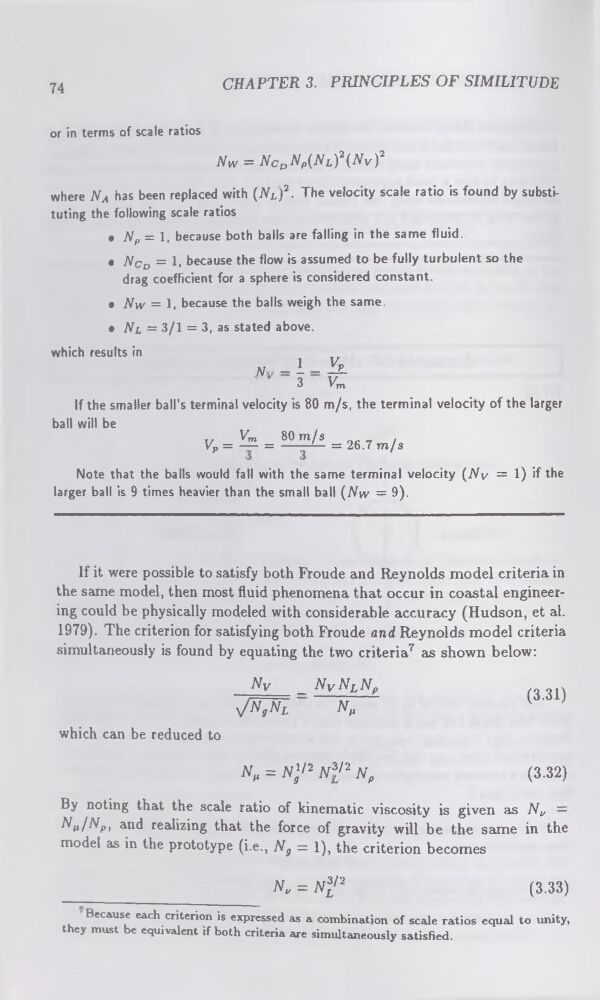
or in terms of scale ratios
Nw = NcdNp(Nl)\Nv)2
where NA has been replaced with (Nl)2. The velocity scale ratio is found by substituting the following scale ratios
• Np = 1, because both balls are falling in the same fluid.
• NCd = 1. because the flow is assumed to be fully turbulent so the
drag coefficient for a sphere is considered constant.
• Nw = 1, because the balls weigh the same.
• Nl = 3/1 = 3, as stated above.
which results in
n -1-Ik
3
Vm
If the smaller ball’s terminal velocity is 80 m/s, the terminal velocity of the larger
ball will be
Vm
80 m/s
.
Vp = — = ---- = 26.7 m/s
Note that the balls would fall with the same terminal velocity (Ny = 1) if the
larger ball is 9 times heavier than the small ball (Nw = 9).
If it were possible to satisfy both Froude and Reynolds model criteria in
the same model, then most fluid phenomena that occur in coastal engineering could be physically modeled with considerable accuracy (Hudson, et al.
1979). The criterion for satisfying both Froude and Reynolds model criteria
simultaneously is found by equating the two criteria7 as shown below:
Ny
_ NvNlNp
y/N^I
N,
which can be reduced to
N, = ATj/2 ^3/2 Np
(3.31)
(3.32)
By noting that the scale ratio of kinematic viscosity is given as Np —
Np/Np, and realizing that the force of gravity will be the same in the
model as in the prototype (i.e., Ng = 1), the criterion becomes
Np = N3 l/2
(3.33)
Because each criterion is expressed as a combination of scale ratios equal to unity,
they must be equivalent if both criteria are simultaneously satisfied.
CHAPTER 3. PRINCIPLES OF SIMILITUDE
or in terms of scale ratios
Nw = NcdNp(Nl)\Nv)2
where NA has been replaced with (Nl)2. The velocity scale ratio is found by substituting the following scale ratios
• Np = 1, because both balls are falling in the same fluid.
• NCd = 1. because the flow is assumed to be fully turbulent so the
drag coefficient for a sphere is considered constant.
• Nw = 1, because the balls weigh the same.
• Nl = 3/1 = 3, as stated above.
which results in
n -1-Ik
3
Vm
If the smaller ball’s terminal velocity is 80 m/s, the terminal velocity of the larger
ball will be
Vm
80 m/s
.
Vp = — = ---- = 26.7 m/s
Note that the balls would fall with the same terminal velocity (Ny = 1) if the
larger ball is 9 times heavier than the small ball (Nw = 9).
If it were possible to satisfy both Froude and Reynolds model criteria in
the same model, then most fluid phenomena that occur in coastal engineering could be physically modeled with considerable accuracy (Hudson, et al.
1979). The criterion for satisfying both Froude and Reynolds model criteria
simultaneously is found by equating the two criteria7 as shown below:
Ny
_ NvNlNp
y/N^I
N,
which can be reduced to
N, = ATj/2 ^3/2 Np
(3.31)
(3.32)
By noting that the scale ratio of kinematic viscosity is given as Np —
Np/Np, and realizing that the force of gravity will be the same in the
model as in the prototype (i.e., Ng = 1), the criterion becomes
Np = N3 l/2
(3.33)
Because each criterion is expressed as a combination of scale ratios equal to unity,
they must be equivalent if both criteria are simultaneously satisfied.