

2.3. DIMENSIONAL ANALYSIS METHODOLOGY
41
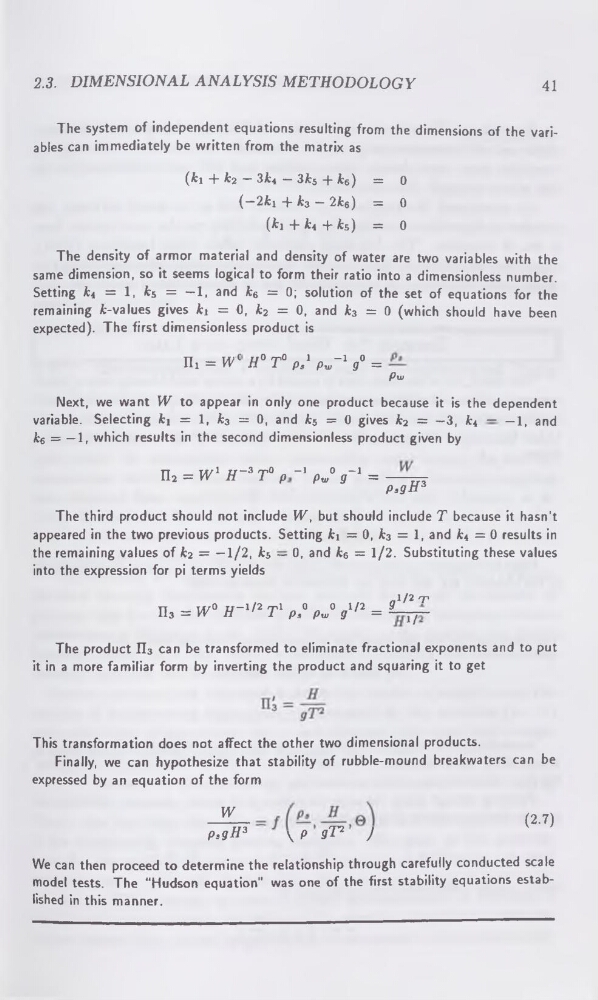
The system of independent equations resulting from the dimensions of the variables can immediately be written from the matrix as
(ki 4- k2 — 3&4 — 3&5 4- ke) = 0
(—2k\ 4- ka — 2fcs) = 0
(fci + ki 4- ke) = 0
The density of armor material and density of water are two variables with the
same dimension, so it seems logical to form their ratio into a dimensionless number.
Setting k4 = 1, k5 = -1, and k6 = 0; solution of the set of equations for the
remaining ^-values gives ki = 0, k2 = 0, and k3 = 0 (which should have been
expected). The first dimensionless product is
IIi = Wa H° T° p,1 pw~' g° =
Pw
Next, we want W to appear in only one product because it is the dependent
variable. Selecting ki = 1, k3 = 0, and k5 = 0 gives k2 = —3, k4 — —1, and
ke = — 1, which results in the second dimensionless product given by
n2 = W1 H~3 T° p~x pw° g-1 =
PsgE3
The third product should not include W, but should include T because it hasn't
appeared in the two previous products. Setting ki = 0, k3 = 1, and k4 = 0 results in
the remaining values of k2 = —1/2, ke — 0, and ke = 1/2. Substituting these values
into the expression for pi terms yields
_l/2 '-p
nrrrO U —1/2 r7”'l 0
0 1/2
g
3 =w H ' T pa pw g ' = —1y-The product II3 can be transformed to eliminate fractional exponents and to put
it in a more familiar form by inverting the product and squaring it to get
(2.7)
\ p gT2
J
relationship through carefully conducted scale
was one of the first stability equations estabThis transformation does not affect the other two dimensional products.
Finally, we can hypothesize that stability of rubble-mound breakwaters can be
expressed by an equation of the form
W
psgH3
We can then proceed to determine the
model tests. The "Hudson equation”
lished in this manner.
41
The system of independent equations resulting from the dimensions of the variables can immediately be written from the matrix as
(ki 4- k2 — 3&4 — 3&5 4- ke) = 0
(—2k\ 4- ka — 2fcs) = 0
(fci + ki 4- ke) = 0
The density of armor material and density of water are two variables with the
same dimension, so it seems logical to form their ratio into a dimensionless number.
Setting k4 = 1, k5 = -1, and k6 = 0; solution of the set of equations for the
remaining ^-values gives ki = 0, k2 = 0, and k3 = 0 (which should have been
expected). The first dimensionless product is
IIi = Wa H° T° p,1 pw~' g° =
Pw
Next, we want W to appear in only one product because it is the dependent
variable. Selecting ki = 1, k3 = 0, and k5 = 0 gives k2 = —3, k4 — —1, and
ke = — 1, which results in the second dimensionless product given by
n2 = W1 H~3 T° p~x pw° g-1 =
PsgE3
The third product should not include W, but should include T because it hasn't
appeared in the two previous products. Setting ki = 0, k3 = 1, and k4 = 0 results in
the remaining values of k2 = —1/2, ke — 0, and ke = 1/2. Substituting these values
into the expression for pi terms yields
_l/2 '-p
nrrrO U —1/2 r7”'l 0
0 1/2
g
3 =w H ' T pa pw g ' = —1y-The product II3 can be transformed to eliminate fractional exponents and to put
it in a more familiar form by inverting the product and squaring it to get
(2.7)
\ p gT2
J
relationship through carefully conducted scale
was one of the first stability equations estabThis transformation does not affect the other two dimensional products.
Finally, we can hypothesize that stability of rubble-mound breakwaters can be
expressed by an equation of the form
W
psgH3
We can then proceed to determine the
model tests. The "Hudson equation”
lished in this manner.