

40
CHAPTER 2. DIMENSIONAL ANALYSIS
Froude number, etc. Then other empirical results from related fluid flow problems may be useful.
4. Transformations of dimensionless products (pi terms) can
be performed provided that the transformation results in
the same number of new independent products as the number of original products. Transformations may be beneficial in order to isolate certain parameters for greater experimental control. Langhaar (1951) explains the transformation technique.
To help keep track of the important variables while performing dimensional analysis, it is recommended that the matrix of variables and dimensions be set up so that the first variable is the dependent variable, the
second variable is that which is easiest to regulate experimentally, the third
variable is the next easiest to regulate experimentally, and so on.
The following example illustrates some of the above considerations.
Example 2.7. Stability of Rubble-Mound Armor Stone
Parameters thought to be important in the stability of rubble-mound structures
subjected to hydrodynamic wave loading are
W -
average weight of the armor stone
ps
- mass density of armor stone material
Pw
~ mass density of water
0
- slope of structure
H
- wave height
T
- wave period
g
- gravitational acceleration
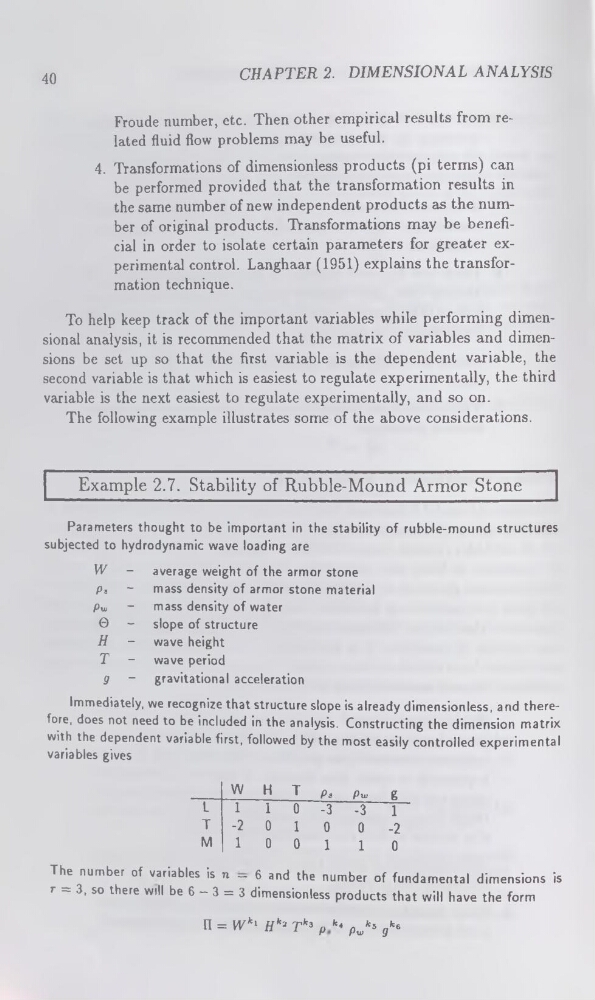
Immediately, we recognize that structure slope is already dimensionless, and therefore, does not need to be included in the analysis. Constructing the dimension matrix
with the dependent variable first, followed by the most easily controlled experimental
variables gives
W
1
-2
1
L
T
M
H T Ps Pw g
10-3-3
1
0 10
0-2
0 0
110
The number of variables is n — 6 and the number of fundamental dimensions is
r = 3, so there will be 6 - 3 = 3 dimensionless products that will have the form
n = Wkl Hk2 Tk3 pk* pwk* gk*
CHAPTER 2. DIMENSIONAL ANALYSIS
Froude number, etc. Then other empirical results from related fluid flow problems may be useful.
4. Transformations of dimensionless products (pi terms) can
be performed provided that the transformation results in
the same number of new independent products as the number of original products. Transformations may be beneficial in order to isolate certain parameters for greater experimental control. Langhaar (1951) explains the transformation technique.
To help keep track of the important variables while performing dimensional analysis, it is recommended that the matrix of variables and dimensions be set up so that the first variable is the dependent variable, the
second variable is that which is easiest to regulate experimentally, the third
variable is the next easiest to regulate experimentally, and so on.
The following example illustrates some of the above considerations.
Example 2.7. Stability of Rubble-Mound Armor Stone
Parameters thought to be important in the stability of rubble-mound structures
subjected to hydrodynamic wave loading are
W -
average weight of the armor stone
ps
- mass density of armor stone material
Pw
~ mass density of water
0
- slope of structure
H
- wave height
T
- wave period
g
- gravitational acceleration
Immediately, we recognize that structure slope is already dimensionless, and therefore, does not need to be included in the analysis. Constructing the dimension matrix
with the dependent variable first, followed by the most easily controlled experimental
variables gives
W
1
-2
1
L
T
M
H T Ps Pw g
10-3-3
1
0 10
0-2
0 0
110
The number of variables is n — 6 and the number of fundamental dimensions is
r = 3, so there will be 6 - 3 = 3 dimensionless products that will have the form
n = Wkl Hk2 Tk3 pk* pwk* gk*