

529
A.5. SI PREFIXES
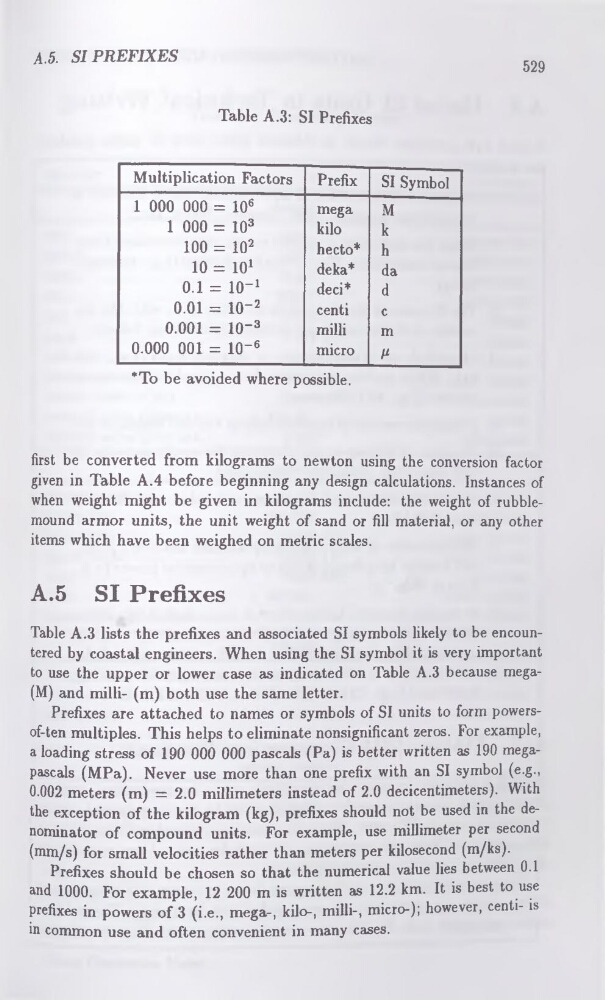
Table A.3: SI Prefixes
*To be avoided where possible.
Multiplication Factors
Prefix
SI Symbol
1 000 000 = 106
mega
M
1 000 = 103
kilo
k
100 = 102
hecto *
h
10 = 101
deka *
da
0.1 = 10-1
deci *
d
0.01 = IO-2
centi
c
0.001 = 10-3
milli
m
0.000 001 = 10-6
micro
V
first be converted from kilograms to newton using the conversion factor
given in Table A.4 before beginning any design calculations. Instances of
when weight might be given in kilograms include: the weight of rubblemound armor units, the unit weight of sand or fill material, or any other
items which have been weighed on metric scales.
A.5 SI Prefixes
Table A.3 lists the prefixes and associated SI symbols likely to be encountered by coastal engineers. When using the SI symbol it is very important
to use the upper or lower case as indicated on Table A.3 because mega(M) and milli- (m) both use the same letter.
Prefixes are attached to names or symbols of SI units to form powersof-ten multiples. This helps to eliminate nonsignificant zeros. For example,
a loading stress of 190 000 000 pascals (Pa) is better written as 190 megapascals (MPa). Never use more than one prefix with an SI symbol (e.g.,
0.002 meters (m) = 2.0 millimeters instead of 2.0 decicentimeters). With
the exception of the kilogram (kg), prefixes should not be used in the denominator of compound units. For example, use millimeter per second
(mm/s) for small velocities rather than meters per kilosecond (m/ks).
Prefixes should be chosen so that the numerical value lies between 0.1
and 1000. For example, 12 200 m is written as 12.2 km. It is best to use
prefixes in powers of 3 (i.e., mega-, kilo-, milli-, micro-); however, centi- is
in common use and often convenient in many cases.
A.5. SI PREFIXES
Table A.3: SI Prefixes
*To be avoided where possible.
Multiplication Factors
Prefix
SI Symbol
1 000 000 = 106
mega
M
1 000 = 103
kilo
k
100 = 102
hecto *
h
10 = 101
deka *
da
0.1 = 10-1
deci *
d
0.01 = IO-2
centi
c
0.001 = 10-3
milli
m
0.000 001 = 10-6
micro
V
first be converted from kilograms to newton using the conversion factor
given in Table A.4 before beginning any design calculations. Instances of
when weight might be given in kilograms include: the weight of rubblemound armor units, the unit weight of sand or fill material, or any other
items which have been weighed on metric scales.
A.5 SI Prefixes
Table A.3 lists the prefixes and associated SI symbols likely to be encountered by coastal engineers. When using the SI symbol it is very important
to use the upper or lower case as indicated on Table A.3 because mega(M) and milli- (m) both use the same letter.
Prefixes are attached to names or symbols of SI units to form powersof-ten multiples. This helps to eliminate nonsignificant zeros. For example,
a loading stress of 190 000 000 pascals (Pa) is better written as 190 megapascals (MPa). Never use more than one prefix with an SI symbol (e.g.,
0.002 meters (m) = 2.0 millimeters instead of 2.0 decicentimeters). With
the exception of the kilogram (kg), prefixes should not be used in the denominator of compound units. For example, use millimeter per second
(mm/s) for small velocities rather than meters per kilosecond (m/ks).
Prefixes should be chosen so that the numerical value lies between 0.1
and 1000. For example, 12 200 m is written as 12.2 km. It is best to use
prefixes in powers of 3 (i.e., mega-, kilo-, milli-, micro-); however, centi- is
in common use and often convenient in many cases.