

528
APPENDIX A. METRIC (SI) SYSTEM
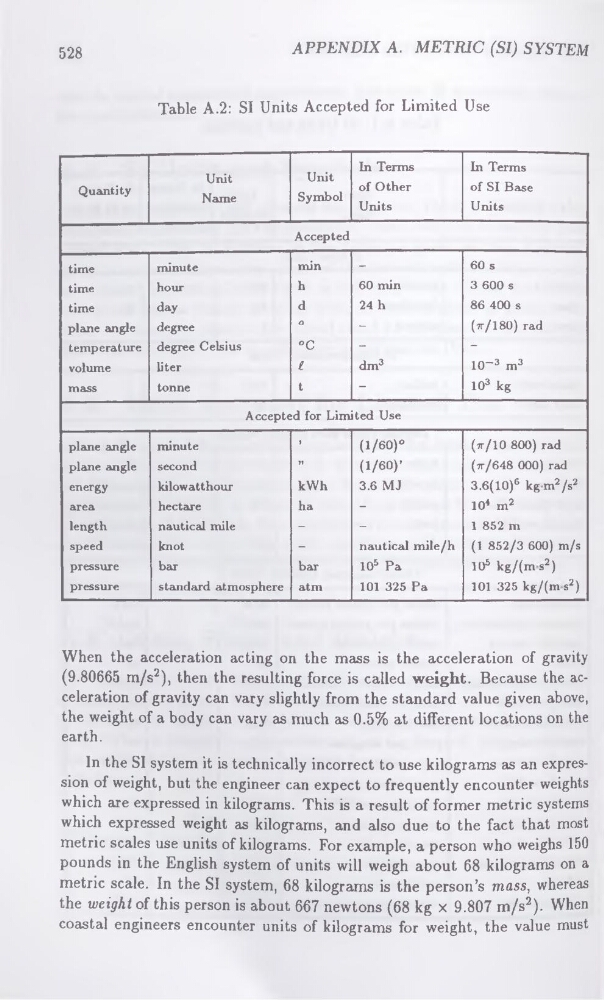
Table A .2: SI Units Accepted for Limited Use
Quantity
Unit
Name
Unit
Symbol
In Terms
of Other
Units
In Terms
of SI Base
Units
Accepted
time
minute
min
-
60 s
time
hour
h
60 min
3 600 s
time
day
d
24 h
86 400 s
plane angle
degree
o
-
(tt/180) rad
temperature degree Celsius
°C
-
-
volume
liter
£
dm3
10~3 m3
mass
tonne
t
-
103 kg
Accepted for Limited Use
plane angle
minute
J
(1/60)°
(tt/10 800) rad
plane angle
second
n
(1/60)’
(tt/648 000) rad
energy
kilowatthour
kWh
3.6 MJ
3.6(10)6 kg m2/s2
area
hectare
ha
-
104 m2
length
nautical mile
-
-
1 852 m
speed
knot
-
nautical mile/h (1 852/3 600) m/s
pressure
bar
bar
105 Pa
105 kg/(m s2)
pressure
standard atmosphere atm
101 325 Pa
101 325 kg/(m s2)
When the acceleration acting on the mass is the acceleration of gravity
(9.80665 m/s2), then the resulting force is called weight. Because the acceleration of gravity can vary slightly from the standard value given above,
the weight of a body can vary as much as 0.5% at different locations on the
earth.
In the SI system it is technically incorrect to use kilograms as an expression of weight, but the engineer can expect to frequently encounter weights
which are expressed in kilograms. This is a result of former metric systems
which expressed weight as kilograms, and also due to the fact that most
metric scales use units of kilograms. For example, a person who weighs 150
pounds in the English system of units will weigh about 68 kilograms on a
metric scale. In the SI system, 68 kilograms is the person’s mass, whereas
the weight of this person is about 667 newtons (68 kg x 9.807 m/s2). When
coastal engineers encounter units of kilograms for weight, the value must
APPENDIX A. METRIC (SI) SYSTEM
Table A .2: SI Units Accepted for Limited Use
Quantity
Unit
Name
Unit
Symbol
In Terms
of Other
Units
In Terms
of SI Base
Units
Accepted
time
minute
min
-
60 s
time
hour
h
60 min
3 600 s
time
day
d
24 h
86 400 s
plane angle
degree
o
-
(tt/180) rad
temperature degree Celsius
°C
-
-
volume
liter
£
dm3
10~3 m3
mass
tonne
t
-
103 kg
Accepted for Limited Use
plane angle
minute
J
(1/60)°
(tt/10 800) rad
plane angle
second
n
(1/60)’
(tt/648 000) rad
energy
kilowatthour
kWh
3.6 MJ
3.6(10)6 kg m2/s2
area
hectare
ha
-
104 m2
length
nautical mile
-
-
1 852 m
speed
knot
-
nautical mile/h (1 852/3 600) m/s
pressure
bar
bar
105 Pa
105 kg/(m s2)
pressure
standard atmosphere atm
101 325 Pa
101 325 kg/(m s2)
When the acceleration acting on the mass is the acceleration of gravity
(9.80665 m/s2), then the resulting force is called weight. Because the acceleration of gravity can vary slightly from the standard value given above,
the weight of a body can vary as much as 0.5% at different locations on the
earth.
In the SI system it is technically incorrect to use kilograms as an expression of weight, but the engineer can expect to frequently encounter weights
which are expressed in kilograms. This is a result of former metric systems
which expressed weight as kilograms, and also due to the fact that most
metric scales use units of kilograms. For example, a person who weighs 150
pounds in the English system of units will weigh about 68 kilograms on a
metric scale. In the SI system, 68 kilograms is the person’s mass, whereas
the weight of this person is about 667 newtons (68 kg x 9.807 m/s2). When
coastal engineers encounter units of kilograms for weight, the value must