

508 CHAPTER 8. LABORATORY MEASUREMENT AND ANALYSIS
and the velocity transfer functions are given by
gki cosh ki(h + z)
ai
cosh(fc,h)
(8.33)
gki sinh kt(h + z)
*
ai
cosh(fct/i)
(8.34)
The above first-order equations and definitions form the basis for the
reflection analysis methods derived in the following sections.
Spatially-Separated Wave Gauges
Most laboratories employ techniques that use two or three spatially separated wave gauges to estimate reflection of irregular waves.
Goda and Suzuki Method. Based on earlier work by Kajima (1969)
and Thornton and Calhoun (1972), Goda and Suzuki (1976) introduced an
analysis technique for estimation of incident and reflected spectra11. This
method uses synoptic time series of sea surface elevations from two wave
gauges separated by a short distance on a line parallel to the direction of
wave travel.
11 The method is also summarized in Goda (1985).
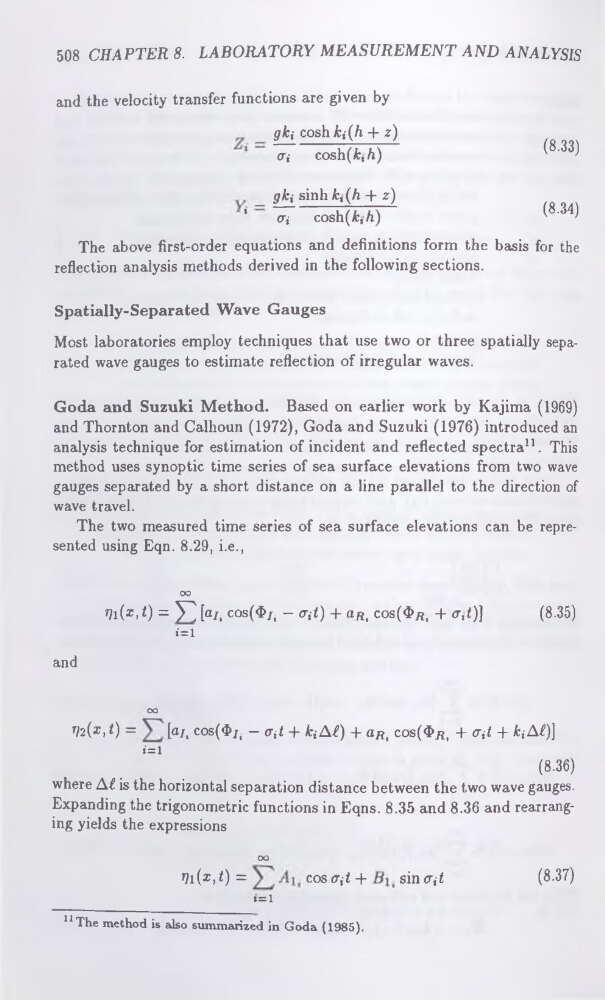
The two measured time series of sea surface elevations can be represented using Eqn. 8.29, i.e.,
oo
rçi(æ> t) = ^7 faA cos($/. -
ï=i
and
OO
7/2(2, t) =
[a/, cos($yt - ait 4- kiA/') + urx cos(d>^i + arf + kiA£)]
i=l
(8.36)
where A^ is the horizontal separation distance between the two wave gauges.
Expanding the trigonometric functions in Eqns. 8.35 and 8.36 and rearranging yields the expressions
OO
7/1 (x,f) =
cos<7jf +
sin ait
t=i
(8.37)
and the velocity transfer functions are given by
gki cosh ki(h + z)
ai
cosh(fc,h)
(8.33)
gki sinh kt(h + z)
*
ai
cosh(fct/i)
(8.34)
The above first-order equations and definitions form the basis for the
reflection analysis methods derived in the following sections.
Spatially-Separated Wave Gauges
Most laboratories employ techniques that use two or three spatially separated wave gauges to estimate reflection of irregular waves.
Goda and Suzuki Method. Based on earlier work by Kajima (1969)
and Thornton and Calhoun (1972), Goda and Suzuki (1976) introduced an
analysis technique for estimation of incident and reflected spectra11. This
method uses synoptic time series of sea surface elevations from two wave
gauges separated by a short distance on a line parallel to the direction of
wave travel.
11 The method is also summarized in Goda (1985).
The two measured time series of sea surface elevations can be represented using Eqn. 8.29, i.e.,
oo
rçi(æ> t) = ^7 faA cos($/. -
ï=i
and
OO
7/2(2, t) =
[a/, cos($yt - ait 4- kiA/') + urx cos(d>^i + arf + kiA£)]
i=l
(8.36)
where A^ is the horizontal separation distance between the two wave gauges.
Expanding the trigonometric functions in Eqns. 8.35 and 8.36 and rearranging yields the expressions
OO
7/1 (x,f) =
cos<7jf +
sin ait
t=i
(8.37)