

8.4. WAVE REFLECTION ANALYSIS
507
where
aj. - amplitude of the z'th incident wave component
ani - amplitude of the ith reflected wave component
ki - wavenumber of the zth component
d - angular wave frequency of the zth component
[= ^ir/Ti, where Ti is wave period of the zth component]
q.
- phase angle of the zth incident wave component
(Ri ~ phase angle of the zth reflected wave component
x - horizontal coordinate
h - water depth
z - vertical coordinate with z — 0 at still water level
and z — —h at bottom
t - time
g - gravitational acceleration
Just as in the case of regular waves, the first term in Eqn. 8.27 represents
the incident wave components propagating in the positive x-direction, and
the second term represents the partially reflected wave components moving
in the opposite direction.
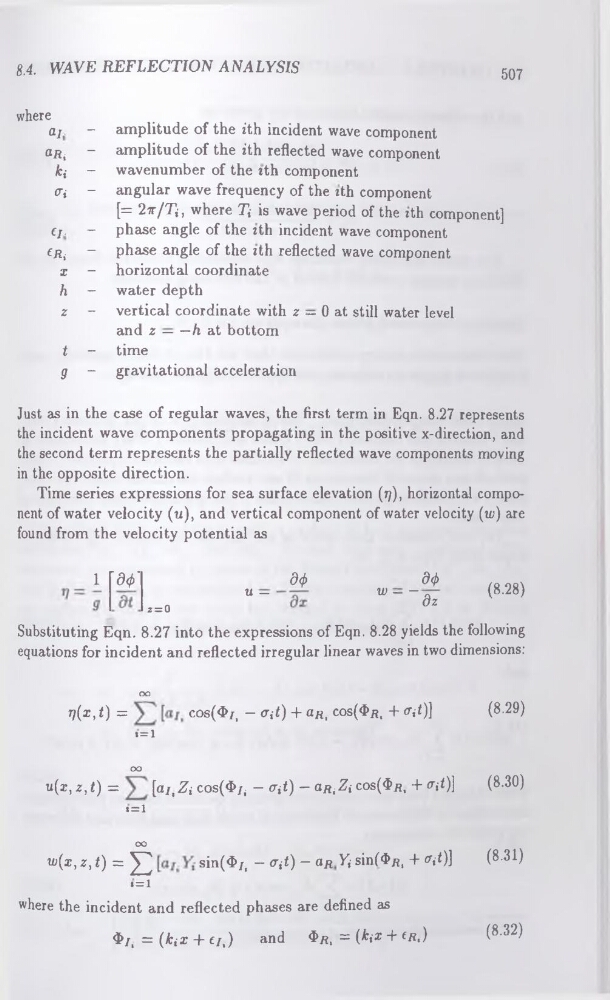
Time series expressions for sea surface elevation (77), horizontal component of water velocity (u), and vertical component of water velocity (w) are
found from the velocity potential as
1 w
z = 0
d(f>
U ~
d
(8.28)
w ~ —
Substituting Eqn. 8.27 into the expressions of Eqn. 8.28 yields the following
equations for incident and reflected irregular linear waves in two dimensions:
00
77(0:,Z) =
cos($/t — ait) + a.Rt cos(<&Rt + a^)]
(8.29)
«=1
00
u(x,z,t) =
[ai,Zi cos^/i — a^) - ajiiZi cos(#b, + a it)]
(8.30)
1=1
00
w(z,z,/) = y2
sin^y, - ait) - aRYisin($R, +
«=1
where the incident and reflected phases are defined as
$z> = (kiX 4-fy.)
and $Ri = (hx + cr,)
(8-32)
507
where
aj. - amplitude of the z'th incident wave component
ani - amplitude of the ith reflected wave component
ki - wavenumber of the zth component
d - angular wave frequency of the zth component
[= ^ir/Ti, where Ti is wave period of the zth component]
q.
- phase angle of the zth incident wave component
(Ri ~ phase angle of the zth reflected wave component
x - horizontal coordinate
h - water depth
z - vertical coordinate with z — 0 at still water level
and z — —h at bottom
t - time
g - gravitational acceleration
Just as in the case of regular waves, the first term in Eqn. 8.27 represents
the incident wave components propagating in the positive x-direction, and
the second term represents the partially reflected wave components moving
in the opposite direction.
Time series expressions for sea surface elevation (77), horizontal component of water velocity (u), and vertical component of water velocity (w) are
found from the velocity potential as
1 w
z = 0
d(f>
U ~
d
(8.28)
w ~ —
Substituting Eqn. 8.27 into the expressions of Eqn. 8.28 yields the following
equations for incident and reflected irregular linear waves in two dimensions:
00
77(0:,Z) =
cos($/t — ait) + a.Rt cos(<&Rt + a^)]
(8.29)
«=1
00
u(x,z,t) =
[ai,Zi cos^/i — a^) - ajiiZi cos(#b, + a it)]
(8.30)
1=1
00
w(z,z,/) = y2
sin^y, - ait) - aRYisin($R, +
«=1
where the incident and reflected phases are defined as
$z> = (kiX 4-fy.)
and $Ri = (hx + cr,)
(8-32)