

36
CHAPTER 2. DIMENSIONAL ANALYSIS
From this matrix, we can determine the number of dimensionless products in the
complete set as 6 — 3 = 3.
Each of the products will have the form given by the expression
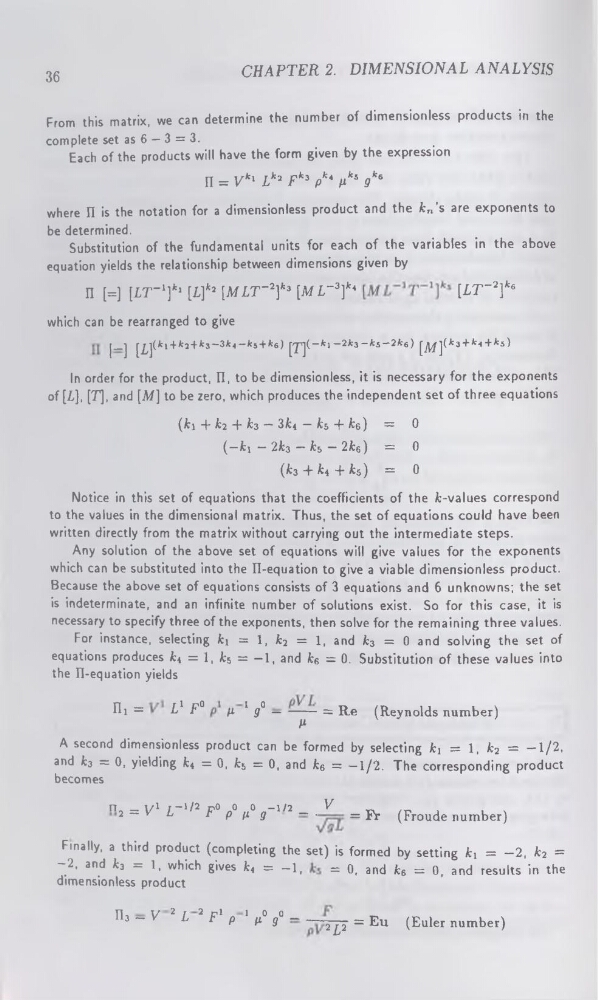
H = Vkl Lk* Fk3 pk4 pk* gk&
where II is the notation for a dimensionless product and the kn's are exponents to
be determined.
Substitution of the fundamental units for each of the variables in the above
equation yields the relationship between dimensions given by
n [=] [LT~l]kl [L] * 2 [MLT~2]k3 [ML~3]ki
[LT~2]ke
which can be rearranged to give
[_j ^£j(fcl+ * 2
+ * 3-3 * 4- * 5+ * 6)
JJ^(- * 1
-2 * 3
- * 5~2 * 6)
[fyf ]( ki + k4 + * 5 )
In order for the product, II, to be dimensionless, it is necessary for the exponents
of [L], [T], and [M] to be zero, which produces the independent set of three equations
(ki 4- k2 4 * k3 — 3k4 — k3 4~ k&) = 0
(-fci - 2k3 — fc5 — 2k6) = 0
(k3 4" ki 4- kg) = 0
Notice in this set of equations that the coefficients of the k-values correspond
to the values in the dimensional matrix. Thus, the set of equations could have been
written directly from the matrix without carrying out the intermediate steps.
Any solution of the above set of equations will give values for the exponents
which can be substituted into the II-equation to give a viable dimensionless product.
Because the above set of equations consists of 3 equations and 6 unknowns; the set
is indeterminate, and an infinite number of solutions exist. So for this case, it is
necessary to specify three of the exponents, then solve for the remaining three values.
For instance, selecting ki = 1, fc2 = 1, and k3 = 0 and solving the set of
equations produces k4 = 1, fc5 = — 1, and ke = 0. Substitution of these values into
the II-equation yields
^1 =
L1 F°
p, 1 g° — - -----= Re (Reynolds number)
M
A second dimensionless product can be formed by selecting ki = 1, k2 = —1/2,
and k3 = 0, yielding kt = 0, kg = 0, and ke = —1/2. The corresponding product
becomes
n _ i/t r —1/2 i?o o o —i/2
Y
„
2 ~ Y L
F p n g
— ■
— Fr (Froude number)
Finally, a third product (completing the set) is formed by setting kj = -2, k2 =
-2, and k3 = 1, which gives k4 = -1,
= o, and fc6 = 0, and results in the
dimensionless product
n3 - V 2 L 2 F1 p 1 g° g° - -~2L2 = Eu (Euler number)
CHAPTER 2. DIMENSIONAL ANALYSIS
From this matrix, we can determine the number of dimensionless products in the
complete set as 6 — 3 = 3.
Each of the products will have the form given by the expression
H = Vkl Lk* Fk3 pk4 pk* gk&
where II is the notation for a dimensionless product and the kn's are exponents to
be determined.
Substitution of the fundamental units for each of the variables in the above
equation yields the relationship between dimensions given by
n [=] [LT~l]kl [L] * 2 [MLT~2]k3 [ML~3]ki
[LT~2]ke
which can be rearranged to give
[_j ^£j(fcl+ * 2
+ * 3-3 * 4- * 5+ * 6)
JJ^(- * 1
-2 * 3
- * 5~2 * 6)
[fyf ]( ki + k4 + * 5 )
In order for the product, II, to be dimensionless, it is necessary for the exponents
of [L], [T], and [M] to be zero, which produces the independent set of three equations
(ki 4- k2 4 * k3 — 3k4 — k3 4~ k&) = 0
(-fci - 2k3 — fc5 — 2k6) = 0
(k3 4" ki 4- kg) = 0
Notice in this set of equations that the coefficients of the k-values correspond
to the values in the dimensional matrix. Thus, the set of equations could have been
written directly from the matrix without carrying out the intermediate steps.
Any solution of the above set of equations will give values for the exponents
which can be substituted into the II-equation to give a viable dimensionless product.
Because the above set of equations consists of 3 equations and 6 unknowns; the set
is indeterminate, and an infinite number of solutions exist. So for this case, it is
necessary to specify three of the exponents, then solve for the remaining three values.
For instance, selecting ki = 1, fc2 = 1, and k3 = 0 and solving the set of
equations produces k4 = 1, fc5 = — 1, and ke = 0. Substitution of these values into
the II-equation yields
^1 =
L1 F°
p, 1 g° — - -----= Re (Reynolds number)
M
A second dimensionless product can be formed by selecting ki = 1, k2 = —1/2,
and k3 = 0, yielding kt = 0, kg = 0, and ke = —1/2. The corresponding product
becomes
n _ i/t r —1/2 i?o o o —i/2
Y
„
2 ~ Y L
F p n g
— ■
— Fr (Froude number)
Finally, a third product (completing the set) is formed by setting kj = -2, k2 =
-2, and k3 = 1, which gives k4 = -1,
= o, and fc6 = 0, and results in the
dimensionless product
n3 - V 2 L 2 F1 p 1 g° g° - -~2L2 = Eu (Euler number)